


DUBAI: Iranian retaliatory strikes in response to the US-Israeli attack on Iran have damaged at least 17 US military, diplomatic and support installations across the Middle East, according to an analysis by The New York Times published on Wednesday.
Since the war began on February 28, Iran has launched large numbers of drones and missiles targeting US facilities across the region.
Some Iranian strikes hit embassies, killed American soldiers and damaged military bases and air defence infrastructure.
The New York Times said its assessment was based on high-resolution commercial satellite imagery, verified social media videos and statements by US officials and Iranian state media.
The scale and intensity of the strikes indicate that Iran appeared better prepared for the conflict than many in the administration of US President Donald Trump had anticipated, US military officials told the newspaper.
Military bases hit across region
According to the report, at least 11 US military bases or installations — nearly half of American military sites in the region — have suffered damage since the conflict began.
On February 28, the first day of the war, Iran targeted several major US facilities.
These included Ali Al Salem Air Base and Camp Buehring in Kuwait, and Al Udeid Air Base in Qatar, the largest US military base in the Middle East.
Satellite imagery cited by The New York Times showed extensive damage to buildings and communications infrastructure at some of the sites.
A video recorded on March 1 showed an Iranian drone exploding near sports facilities at Camp Buehring in Kuwait. No casualties were reported in that incident.
However, another Iranian drone strike on March 1 hit a structure housing military personnel at Shuaiba Port in Kuwait, killing six US service members, according to the report.
Satellite imagery reviewed by the newspaper showed that the roof of the building partially collapsed following the attack.
Damage to US naval and air facilities
The financial cost of the damage remains difficult to estimate, according to the Times report.
However, a Pentagon assessment provided to the US Congress last week estimated that a single Iranian strike on the headquarters of the US Navy’s Fifth Fleet in Bahrain on February 28 caused roughly $200 million in damage, a congressional official told the newspaper.
The New York Times reported that several installations — including Al Udeid Air Base, Ali Al Salem Air Base, Al Dhafra Air Base, Camp Buehring and the Fifth Fleet headquarters — had been struck more than once since the conflict began.
Iranian missiles have also travelled long distances across the region.
On March 4, NATO intercepted an Iranian ballistic missile headed towards Incirlik Air Base in Turkiye, which hosts a major US Air Force presence, a senior US military official told the newspaper.
Iran’s military denied firing that missile.
Turkish authorities said a second Iranian missile entered Turkish airspace and was shot down by NATO forces, according to a statement from Turkiye’s defence ministry.
Air defence systems targeted
The report said some of the most costly damage has been inflicted on US air defence and communications systems deployed across the region.
Iran has targeted radar and communications infrastructure, including components of the Terminal High Altitude Area Defense (THAAD) system.
The system uses advanced radar to track and intercept incoming aerial threats.
Satellite imagery examined by The New York Times showed severe damage to radar equipment at Muwaffaq Salti Air Base in Jordan.
Images taken two days after the war began indicated that an air defence sensor located at the southern edge of the base had been heavily damaged.
Military budget documents suggest that a single radar unit of that type can cost up to $500 million, the newspaper reported.
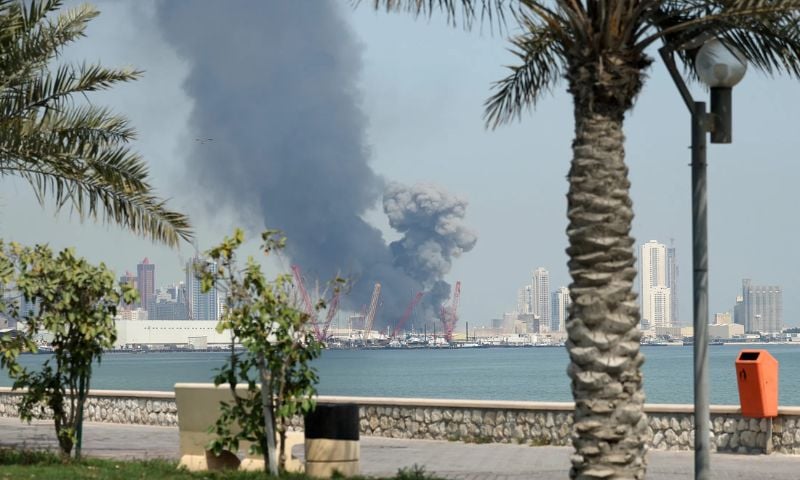
A video from February 28 also showed an Iranian drone striking the headquarters of the US Navy’s Fifth Fleet in Manama, Bahrain, damaging what appeared to be a communications radome — a protective cover used for radar and communications equipment.
Iran has also targeted facilities where air defence equipment supplied by the United States to Gulf countries was recently observed.
According to satellite imagery reviewed by The New York Times, the Al Ruwais facility in the United Arab Emirates sustained significant damage to storage structures during Iranian strikes.
Earlier images had shown a THAAD unit deployed near the site.
The newspaper said it could not verify whether the mobile THAAD system was inside the storage structures at the time of the attack.
In Qatar, satellite images indicated that a long-range AN/FPS-132 radar system near Umm Dahal had apparently sustained damage to its main radar structure.
The system, built at a cost of about $1.1 billion, provides early warning coverage across a radius of roughly 3,000 miles.
Impact on US capabilities
Despite the damage, defence analysts told the newspaper that the attacks were unlikely to significantly degrade overall US military capabilities in the region.
Michael Eisenstadt, a director at the Washington Institute for Near East Policy, said that damaged radar systems would be difficult to repair or replace.
However, Seth G. Jones, president of the Center for Strategic and International Studies, said the US military maintains extensive redundancy in its intelligence and surveillance systems.
“The US has such redundancy in collecting intelligence and other information from sensor networks, whether it’s land-based radars, aircraft or space-based systems,” Jones told the newspaper.
The New York Times reported that Iranian strikes also hit some non-military US targets.
These included the US consulate in Dubai and the US embassy in Kuwait City, forcing temporary closures. No injuries were reported in those incidents.
Separately, rockets targeted the US embassy in Baghdad on Saturday night. No casualties were reported and it was not clear who carried out the attack.
The newspaper said that the incident was not included in its tally of damaged sites.
Pace of attacks slowing
US officials say the intensity of Iranian attacks has declined since the opening days of the war.
Admiral Brad Cooper, commander of US Central Command, said on March 7 that Iranian ballistic missile attacks had dropped by about 90 percent compared with the first day of the conflict.
Drone attacks had also fallen by roughly 83 percent, he said.