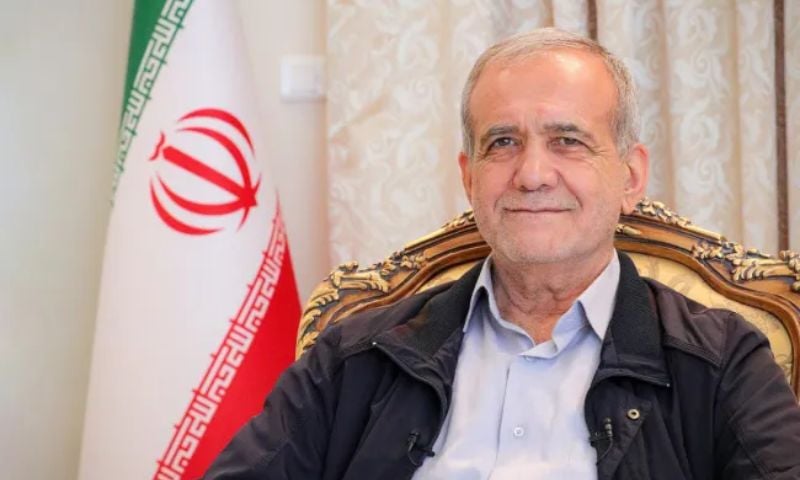
ISLAMABAD: Iranian President Masoud Pezeshkian has praised the diplomatic efforts of Pakistan in facilitating recent Iran–US understandings, describing Islamabad’s role as crucial in advancing regional dialogue and easing tensions between Tehran and Washington.
In a message shared ahead of his official visit to Islamabad, President Pezeshkian expressed appreciation for Pakistan’s leadership, including Prime Minister Shehbaz Sharif, Chief of Defence Forces and Chief of Army Staff Field Marshal Syed Asim Munir, and Interior Minister Mohsin Naqvi, crediting their engagement in facilitating the “Islamabad Memorandum” process between Iran and the United States.
1/3
President @drpezeshkian , before departing for Pakistan, said the visit follows extensive efforts by PM Shehbaz Sharif, Field Marshal Asim Munir, Interior Minister Mohsin Naqvi, and the Pakistani government in facilitating the Iran–US Islamabad Memorandum. pic.twitter.com/3eqkTgIR5F— Government of the Islamic Republic of Iran (@Iran_GOV) June 23, 2026
He praised Pakistan’s diplomatic support for Iranian interests and its broader commitment to promoting dialogue, regional peace, and stability. The visit itself, according to Iranian messaging, is being viewed as a continuation of this diplomatic engagement and a signal of recognition of Pakistan’s role in the process.
Officials in Islamabad maintain that Pakistan’s involvement was driven by regional security concerns, particularly the potential impact of Iran–US tensions on trade routes, energy security, and broader regional stability. They stress that Islamabad’s approach has remained grounded in neutrality, international law, and facilitation of communication between relevant parties.
Pakistan has positioned itself as a mediator by providing indirect channels of communication, helping reduce mistrust and encouraging compromise where possible.
Observers note that this role reflects Islamabad’s wider diplomatic outreach across multiple regional blocs, including ties with Iran, the United States, China, Gulf states, and Türkiye.
Analysts suggest the “Islamabad Memorandum” process should be viewed as the beginning of an ongoing confidence-building framework rather than a final agreement, with sustained engagement expected to remain central to implementation and future progress.
The Iranian President’s visit is expected to include discussions on strengthening bilateral relations and reviewing the implementation aspects of the diplomatic understanding, alongside broader regional and economic cooperation.
Pakistan continues to emphasise that dialogue and diplomacy remain the preferred path for resolving disputes, with officials presenting the recent engagement as evidence of its growing role as a regional bridge for de-escalation and cooperation.