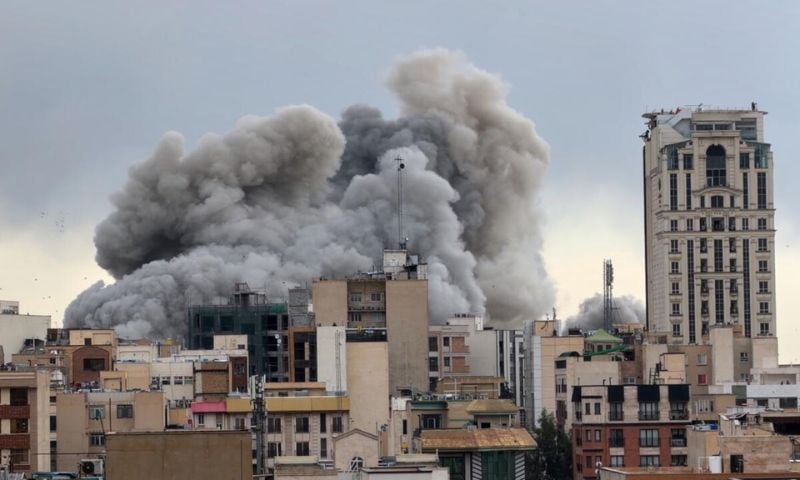



TEHRAN, Iran: Iran has warned it will target economic and financial interests linked to the United States and Israel across the region after an overnight attack on one of its major banks, escalating tensions in the widening Middle East conflict.
A spokesperson for Iran’s central operational military command, Khatam al-Anbiya, said on Wednesday that Tehran now considers banks and economic centres associated with Washington and Israel as legitimate targets.
“The enemy has given us free rein to target economic centres and banks belonging to the United States and the Zionist regime,” the command said in a statement carried by Iranian state television.
The warning came after an administrative building linked to Bank Sepah, one of Iran’s largest state-owned banks, was struck overnight in Tehran, according to the semi-official Mehr news agency.
Iran threatens economic retaliation
Military spokesperson Ebrahim Zolfaqari said the attack had prompted Iran to expand its list of potential targets.
“Following their failed campaign, the US army and the Zionist regime have targeted one of the country’s banks,” Zolfaqari was quoted by state media as saying.
“With this illegitimate and uncommon action, the enemy is forcing our hand to target economic centres and banks linked to the US and the Zionist regime in the region,” he added.
The spokesperson urged civilians across the region to remain at least 1,000 metres away from banks, warning they could become targets.
Zolfaqari also warned that Iran would move from “reciprocal strikes” to continuous attacks on its adversaries.
“We won’t allow even one litre of oil to reach the US, Zionists and their partners,” he said, according to Reuters. “Any vessel or tanker bound to them will be a legitimate target.”
He also predicted that global crude prices could surge sharply as the conflict disrupts energy flows.
“Get ready for the oil barrel to be at $200,” he said, adding that oil prices depend on regional security which, he said, had been destabilised by US-Israeli military action.
Strait of Hormuz tensions
Iran’s military also issued warnings regarding the Strait of Hormuz, a critical global oil shipping route.
The Khatam al-Anbiya command said any vessel belonging to the United States, Israel or their allies passing through the waterway could be targeted, according to AFP.
“Any vessel whose oil cargo or the vessel itself belongs to the United States, the Zionist regime or their hostile allies will be considered legitimate targets,” the command said.
Separately, Alireza Tangsiri, commander of the Islamic Revolutionary Guard Corps (IRGC) Navy, said on X that ships intending to cross the strait must obtain permission from Iran.
به کشتیها برای عبور از #تنگه_هرمز اطمینان داده بودند؟
این را باید از خدمه کشتیهای expres rome و mayuree naree جویا شد که امروز بااعتماد به وعدههای توخالی به اخطارها بیتوجهی کردند و قصد عبور از تنگه را داشتند اما گرفتار شدند.
هر شناوری قصد عبوردارد باید از #ایران اجازه بگیرد.— علیرضا تنگسیری (@alirezatangsiri) March 11, 2026
Iran’s military reiterated that it would not allow “a single litre of oil” to transit through the strategic passage if the conflict continues.
Trump says ‘nothing left to target’ in Iran
Meanwhile, US President Donald Trump has again signalled there could be a swift ending to the war on Iran, saying there is little left in the country for US forces to attack.
There is “practically nothing left to target” and the war will end “soon,” Trump was quoted as saying in an interview with Axios.
“Any time I want it to end, it will end.”
🚨🇺🇸🇮🇷President Trump told me in a phone interview Wednesday that the war with Iran will end "soon" because there is "practically nothing left" to target. "Little this and that… Any time I want it to end, it will end," Trump said. My story on @axios https://t.co/Z9iL47VRq2
— Barak Ravid (@BarakRavid) March 11, 2026
Meanwhile, Iranian authorities dismissed reports that Mojtaba Khamenei, recently appointed as Iran’s supreme leader, had been injured during the conflict.
According to Al Jazeera, Yousef Pezeshkian, a government adviser and son of Iranian President Masoud Pezeshkian, said Khamenei was “safe and sound”.
In a message posted on Instagram, Pezeshkian said he had heard rumours about the leader being wounded but confirmed after making enquiries that the reports were false.
“Thank God, he is safe and sound,” he wrote.
Earlier, Iranian state television had referred to Khamenei as a “wounded veteran of the Ramadan war”, without providing details about any injuries.
However, Reuters reported that Israeli intelligence believes Mojtaba Khamenei may have been lightly wounded during the ongoing US-Israeli air campaign against Iran.
A senior Israeli official told the news agency that the injury could explain why Khamenei had not appeared in public recently.
Israel’s Defence Minister Israel Katz warned last week that any leader installed by the current Iranian leadership would be “an unequivocal target for elimination”.
Military confrontation intensifies
Iran’s Revolutionary Guards said they had targeted several American bases in Kuwait and Bahrain during recent strikes.
According to the Guards’ website Sepah News, missiles and drones struck key infrastructure at the US base at Mina Salman port in Bahrain, home to the headquarters of the US Fifth Fleet.
They also claimed attacks on Camp Patriot, Mohammed Al-Ahmad naval base, Ali Al-Salem base and Camp Buehring in Kuwait.
Iran’s army separately said it had targeted several Israeli military sites, including the Aman military intelligence directorate, Unit 8200, the Green Pine radar system, and a submarine headquarters building at the Haifa naval base.
At the same time, the Israeli military announced it had launched a new “wide-scale wave of strikes” across Iran and against Hezbollah infrastructure in Beirut.
Israeli Defence Minister Israel Katz said the campaign against Iran would continue “as long as necessary”.
“This operation will continue without any time limit, as long as necessary, until we achieve all the objectives,” he said.
Global energy markets shaken
The conflict has triggered major disruptions in global energy markets.
The International Energy Agency (IEA) said its member states would release 400 million barrels of oil from strategic reserves, the largest coordinated release ever.
“The oil market challenges we are facing are unprecedented in scale,” said IEA Executive Director Fatih Birol in a statement.
🔴 WATCH LIVE | IEA Executive Director @fbirol is delivering a statement on the situation in global energy markets.
Follow along 👉 https://t.co/999e6fvMDH pic.twitter.com/K1L7IXeTr4
— International Energy Agency (@IEA) March 11, 2026
Japan also announced it would release oil from its strategic reserves as early as Monday to ease domestic fuel price pressures.
Prime Minister Sanae Takaichi said Tokyo needed to act quickly because the country depends heavily on Middle Eastern oil imports.
Germany also said it would release part of its reserves, while imposing limits on how frequently petrol stations can raise fuel prices, according to Economy and Energy Minister Katherina Reiche.
Meanwhile, Shell has declared force majeure on liquefied natural gas cargoes sourced from QatarEnergy, Reuters reported citing industry sources, after Qatar halted production at its 77-million-tonne-per-year LNG facility last week.
War impact on markets and aviation
Oil prices have surged as markets react to the prolonged conflict, while global stock markets have declined.
Crude futures have fluctuated between gains of two to six per cent, according to AFP.
“Oil prices remain volatile and risk sentiment fragile,” said Neil Wilson, investor strategist at Saxo UK.
The aviation industry is also facing growing pressure as jet fuel prices rise and regional airspace disruptions intensify.
The average global jet fuel price has climbed to $173.91 per barrel, according to the Platts benchmark index.
Dutch airline KLM has cancelled all flights to Dubai until March 28 due to security concerns, while several airlines are reviewing routes through the Gulf region.
Calls for de-escalation
International leaders have urged restraint as the conflict spreads.
During a phone call with Iranian Foreign Minister Abbas Araghchi, UN Secretary-General António Guterres stressed the need to respect international law and called for de-escalation, according to Iran’s foreign ministry.
The ministry said Guterres acknowledged Iran’s “right to defend itself”.
Iran FM, UN Secretary-General hold telephone conversation
Seyed Abbas Araghchi, Minister of Foreign Affairs of the Islamic Republic of Iran, and António Guterres, Secretary-General of the United Nations, discussed and exchanged views in a telephone conversation regarding the… pic.twitter.com/A31cAOapM9
— Foreign Ministry, Islamic Republic of Iran (@IRIMFA_EN) March 11, 2026
China also called for an end to military operations.
According to Chinese foreign ministry spokesperson Lin Jian, Foreign Minister Wang Yi told Pakistan’s Deputy Prime Minister and Foreign Minister Ishaq Dar during a phone call that preventing further escalation depends on the United States and Israel halting their attacks on Iran.
Chinese FM Wang Yi held a phone conversation with Pakistani Deputy PM & FM Mohammad Ishaq Dar.
On the situation in #Iran, Wang noted that the key to preventing further escalation lies in the #US and #Israel halting their military operations. China does not condone attacks on… pic.twitter.com/prLtPPKscd
— Lin Jian 林剑 (@SpoxCHN_LinJian) March 11, 2026
Turkish President Recep Tayyip Erdogan also warned that the war could engulf the entire region if it continues.
“This war must be stopped before it becomes bigger and completely engulfs the region in flames,” Erdogan said.
AK Parti TBMM Grup Toplantısı https://t.co/BMlis3Saiu
— Recep Tayyip Erdoğan (@RTErdogan) March 11, 2026