


KEY POINTS
- Iran’s President orders start of nuclear talks with US.
- Talks will focus on Iran’s nuclear programme, with no timeline announced.
- Iran’s foreign ministry said multiple diplomatic channels are being examined.
- Trump said he hopes to reach a deal with Iran to avoid military action.
- Washington increased its military presence in the Middle East.
- Iran denied receiving any US ultimatum for negotiations.
- Khamenei warned that any US attack on Iran would trigger regional war.
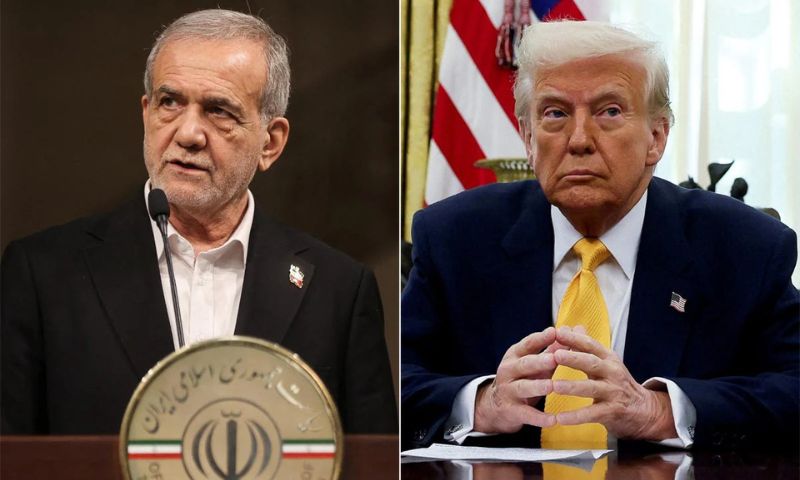
TEHRAN, Iran: Iranian President Masoud Pezeshkian has ordered the start of talks with the United States on Tehran’s nuclear programme, Iranian media reported on Monday, after US President Donald Trump said he was hopeful of a deal to avert military action.
“President Pezeshkian has ordered the opening of talks with the United States,” Iran’s semi-government Fars news agency reported, citing an unnamed government source.
“Iran and the United States will hold talks on the nuclear file,” Fars reported, without giving a timeline or details on the format of the discussions. The report was also carried by the government daily Iran and the Shargh newspaper.
On Monday, Iran’s foreign ministry confirmed that multiple diplomatic channels were being examined to manage tensions with Washington.
“Details of various diplomatic processes are under review,” foreign ministry spokesperson Esmaeil Baghaei told a weekly news briefing in Tehran.
He said Iran hoped the efforts would yield results “in the coming days”.
Baghaei added that regional countries were acting as intermediaries to pass messages between Tehran and Washington.
“Various points have been exchanged and we are currently deciding and examining the details of each diplomatic process,” he said, describing the discussions as focused on the “process and framework” of possible talks.
Trump hopes for a deal with Iran
On Sunday, US President Donald Trump said that he hoped to reach an agreement with Iran, hours after Iran’s Supreme Leader Ayatollah Ali Khamenei warned that any US attack would spark a regional war.
“Hopefully, we’ll make a deal,” Trump told reporters in Washington. “If we don’t make a deal, then we’ll find out whether or not he was right.”
Trump said Iran was “seriously talking” with the United States, as Washington steps up its military presence near Iran.
The US has deployed a carrier strike group, several destroyers and other naval assets to the Middle East.
Trump has repeatedly warned that the US could take military action if Iran does not agree to limits on its nuclear programme.
He has also said a “big fleet” was moving closer to Iran, while declining to brief allies on potential military plans for security reasons.
Iran rejects ‘ultimatum’
Tehran on Monday denied claims by Trump that Iran had been given a deadline to enter negotiations.
Asked whether Iran had received an ultimatum from Washington, Baghaei said Iran “never accepts ultimatums”.
“For that reason, such a statement cannot be confirmed,” the spokesperson said.
Foreign Minister Abbas Araghchi has said Iran is prepared to resume talks with the US, but stressed that negotiations must be fair and must not include Iran’s defence and missile capabilities.
Baghaei reiterated that Iran does not seek nuclear weapons and that its nuclear activities fall within international law.
“Our basis is international treaties and the principles of international law,” he said, adding that Iran’s right to peaceful nuclear energy was recognised under existing agreements.
Khamenei warns of regional war
On Sunday, Khamenei warned that a US attack on Iran would have far-reaching consequences.
“If the US initiates a war this time, it would spill over across the entire region,” he said during a speech in Tehran ahead of the anniversary of Iran’s 1979 Islamic Revolution.
Khamenei dismissed US naval deployments as routine and rejected American claims that “all options are on the table”.
He said Iran did not seek war but would respond forcefully to any aggression.
The US Navy currently has an aircraft carrier, six destroyers and several other vessels in the region, according to US media.
Tensions between Tehran and Washington have remained high since a wave of protests in Iran, which Iranian officials say were fuelled by the United States and Israel.
Trump has publicly expressed support for protesters, urging them to continue demonstrations.
Iran’s top national security official, Ali Larijani, said on Saturday that a framework for negotiations was “taking shape and moving forward”, cautioning against what he described as excessive media speculation.
Iran and the US were engaged in indirect talks last year before negotiations were suspended following Israeli strikes on Iran and a brief but intense military confrontation.
On Monday, Baghaei said Iran was in a “decision-making stage” and dismissed speculation about the timing or venue of any talks.
He confirmed that several regional countries, including Turkiye, were mediating between the two sides.
“For both Iran and the other party, it is clear what a fair agreement means,” Baghaei said.