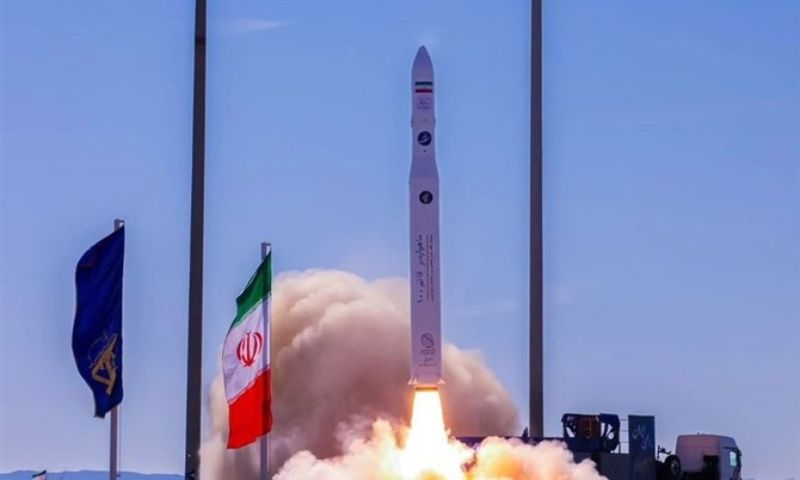



TEHRAN, Iran: Iran has launched three more “domestically built” satellites into low-Earth orbit aboard a Russian Soyuz rocket, state media reported on Sunday, as the two nations expand their space collaboration.
Iran has increasingly relied on Russia to put satellites in orbit in recent years, with the latest three intended to help with monitoring agriculture, natural resources, and the environment.
“These satellites were designed and produced by Iranian scientists … despite all the sanctions and threats,” Iran’s ambassador to Russia, Kazem Jalali, told state TV in reference to Western measures over Tehran’s nuclear programme.
“We are working together (with Russia) in different areas. Some are evident, and some we don’t like to clarify.” Iran’s official IRNA news agency said the three satellites — Paya, Zafar 2, and a second Kowsar —were for low-earth orbit.
The satellites were launched from Russia’s Vostochny Cosmodrome using a Soyuz-2.1b carrier rocket.
Russia’s state space corporation Roscosmos said minutes after the launch that the Soyuz rocket had lifted off normally and would deploy the satellites into their designated orbit as planned.
Vahid Yazdanian, Iran’s deputy communications minister and head of the Iranian Space Research Institute, said the three Earth observation satellites were built by the private sector.
He said the satellites are capable of transmitting imaging data with resolutions ranging from 15 meters to less than five meters, adding that the data could be used for a wide range of civilian applications inside the country.
Yazdanian cited agriculture, water resource management, and environmental monitoring among the main uses of the imagery.
He added that the new satellites will operate at an altitude of about 500 kilometers above Earth, in what is known as low Earth orbit (LEO).
In recent years, Iran and Russia have deepened ties in multiple domains.
Iran’s space agency chief, Hassan Salarieh, said the launch reflected Iran’s standing among a small group of countries with end-to-end space capabilities.
“Iran is among 10 or 11 countries in the world that simultaneously possess the capability to design and build satellites, launch vehicles, and the infrastructure for launching, receiving data, and processing images,” he said.
Iran says its space program is civilian and focused on scientific and economic goals, but Western governments argue that satellite launch technology overlaps with systems used to develop intercontinental ballistic missiles.