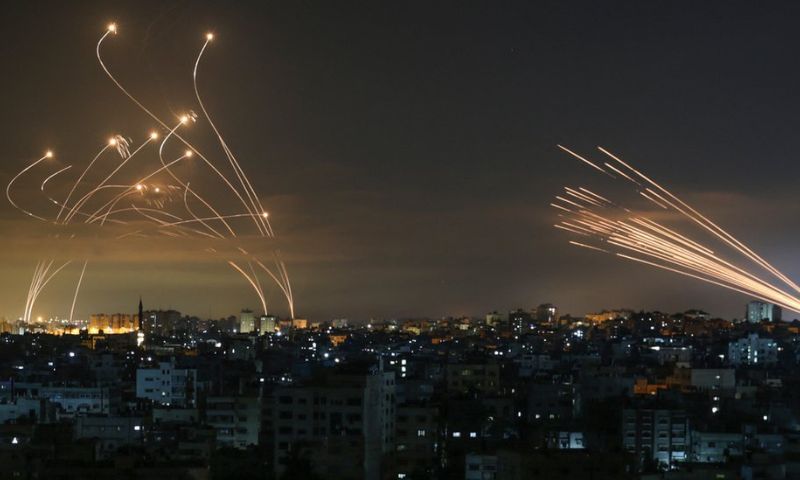



DUBAI: Iran said it launched more than 40 missiles at United States and Israeli targets during fresh retaliatory strikes, while claiming it had also shot down 10 drones belonging to the two countries, as the conflict entered its sixth day.
Iranian military officials, cited by Iranian media, said that the missiles targeted a range of locations, including US bases in Kuwait and Bahrain.
The strikes were carried out in response to attacks by the United States and Israel on Iran.
An Iranian military spokesperson said more than 40 missiles were fired during the operation and claimed that Iranian forces destroyed 10 drones belonging to the United States and Israel during the confrontation.
The spokesperson also warned that if Washington and Tel Aviv attempted to pursue regime change in Tehran, Iran could target Israel’s nuclear facilities.
Explosions in Jerusalem
Meanwhile, the Israeli military confirmed that Iran launched several rounds of missiles toward Israel early Thursday, triggering air raid alerts in multiple areas.
Explosions were heard in Jerusalem following the launches, AFP reported.
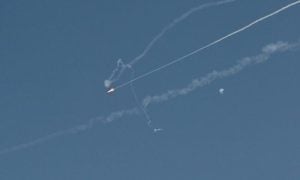
The Israeli military issued three separate alerts warning of incoming Iranian missiles within less than two hours after a lull of more than seven hours.
Iran’s state broadcaster IRIB also reported the missile launches.
Israel’s emergency service, Magen David Adom, said it had received no immediate reports of casualties.
Authorities later cleared residents to leave bomb shelters.
Attacks across the region
The conflict has expanded beyond Iran and Israel, with attacks reported across several countries in the region.
Iran’s army said it launched a drone strike against a US military site in the Iraqi Kurdish city of Erbil.
“The headquarters of the American aggressor forces in Erbil, Iraq, was attacked by the army’s ground forces’ attack drones,” the Iranian army said in a statement broadcast on state television.
Iranian state television also reported that an Iranian missile struck a US oil tanker in the northern Arabian Gulf, saying the vessel was on fire.
In Israel, the Lebanese group Hezbollah said it had targeted a military base south of Tel Aviv with a drone aimed at an Iron Dome radar system.
🚨 BREAKING — #Israel:
New wave of Iranian ballistic missiles reportedly striking Tel Aviv.#TelAvivBlast https://t.co/Y86fBXA0cD
— أنيس منصور (@anesmansory) March 5, 2026
Meanwhile, Israel carried out airstrikes in Beirut on Wednesday that killed three people and injured six others, according to local reports.
– An apartment in the Beddawi Refugee Camp near Tripoli, Lebanon has been struck in what appears to be a targeted assassination of a senior Hamas figure based in the country. pic.twitter.com/N8W1bP0r3f
— The Red Truck Times (@RedTruckTimes) March 5, 2026
Lebanon’s state-run National News Agency said an Israeli drone strike also killed a senior Hamas official, Wassim Atallah al-Ali, and his wife in the Beddawi Palestinian refugee camp near Tripoli.
Lebanese authorities said at least 72 people had been killed and 437 injured since Monday, while around 83,000 people had been displaced.
US-Israeli strikes on Iran
Meanwhile, Israel and the US continued strikes across Iran.
Iran’s state-run Foundation of Martyrs and Veterans Affairs said 1,230 people had been killed since the start of the conflict on Saturday.
Martyrs and Veterans Affairs Foundation announced that the number of martyrs from the aggressive and military attack by the criminal United States and the usurping Israeli regime on Iran has reached 1,230 as of March 5th.
— IRNA News Agency ☫ (@IrnaEnglish) March 5, 2026
Separately, the US-based Human Rights Activists News Agency (HRANA) said it had documented 1,097 deaths and more than 5,000 injuries.
The group said an additional 880 reported deaths were still under review for verification.
New strikes on different parts of Tehran
Follow: https://t.co/mLGcUTS2ei pic.twitter.com/lAhRm9fUQQ
— Press TV 🔻 (@PressTV) March 5, 2026
The war began early Saturday with large-scale US and Israeli airstrikes across Iran that killed Supreme Leader Ayatollah Ali Khamenei and other senior political and military figures, according to Iranian media.
Gulf states on high alert
Several Gulf countries reported intercepting missiles and drones amid the widening confrontation.
The United Arab Emirates said its air defences detected seven ballistic missiles and 131 drones.
Authorities said six missiles and 125 drones were intercepted, while one missile and six drones fell inside the country.
الدفاعات الجوية الإماراتية تتعامل مع 6 صواريخ باليستية و 131 طائرة مسيرة.
رصدت الدفاعات الجوية الإماراتية اليوم (5 مارس 2026) 7 صواريخ باليستية حيث تم التعامل وتدمير عدد 6 صواريخ باليستية فيما سقط عدد 1 صاروخ باليستي داخل أراضي الدولة. كما رصدت 131 طائرة مسيرة، حيث تم اعتراض 125… pic.twitter.com/VXsHKcgUEM
— وزارة الدفاع |MOD UAE (@modgovae) March 5, 2026
Explosions were also reported in Qatar’s capital Doha, where AFP journalists described hearing some of the most intense blasts since the start of the conflict.
Residents living near the US embassy had earlier been evacuated as a precaution.
Drone attack on Azerbaijan
The conflict also appeared to spill into the South Caucasus.
Azerbaijan accused Iran of carrying out drone strikes that injured four people near an airport and a school in the Nakhchivan exclave.
President Ilham Aliyev described the incident as a “terrorist act” and ordered the military to prepare retaliatory measures.
Azerbaijan’s defence ministry said its armed forces had been placed on the highest mobilisation level.
Iran’s armed forces denied launching any drone attack on Azerbaijan, calling the accusations unfounded.
تکذیب پرتاب پهپاد به جمهوری آذربایجان
ستادکل نیروهای مسلح:
اینگونه اقدامات از سوی رژیم جعلی صهیونیستی برای برهم زدن روابط کشورهای مسلمان از طرق گوناگون مسبوق به سابقه بوده است
چنین اقدامی برای متهمسازی جمهوری اسلامی ایران توسط آن رژیم، صورت گرفته است https://t.co/IvAimfdtp0
— خبرگزاری تسنیم – خبر فوری (@Tasnimbrk) March 5, 2026
Global concerns grow
The widening war has raised fears of a broader regional conflict involving multiple countries.
Russia accused the United States and Israel of trying to drag Arab states into a wider war by provoking Iran into retaliatory strikes.
“Nobody’s talking about Article 5,” NATO Secretary General Mark Rutte told Reuters, referring to the alliance’s mutual defence clause, after Turkish air defences shot down an Iranian ballistic missile headed toward its airspace.
Meanwhile, Pakistan’s Prime Minister Shehbaz Sharif expressed serious concern over the escalating tensions and stressed the need to uphold the principles of the UN Charter and international law.
He urged all parties to exercise restraint and resolve disputes through diplomacy and dialogue.
Aviation and energy markets disruption
The conflict has severely disrupted air travel and maritime trade across the region.
More than 20,000 flights across eight countries have been cancelled over the past five days, while 145 flights from Pakistan to Middle Eastern destinations were reportedly cancelled for a sixth consecutive day.
Shipping through the Strait of Hormuz — a critical route for global oil supplies — has also been affected, with around 200 vessels anchored off the coast amid security concerns, according to Reuters estimates.