


WASHINGTON: US President Donald Trump said on Thursday that Iran had allowed 10 oil tankers to pass through the strategic Strait of Hormuz as a “present” to demonstrate it was serious about talks with the United States.
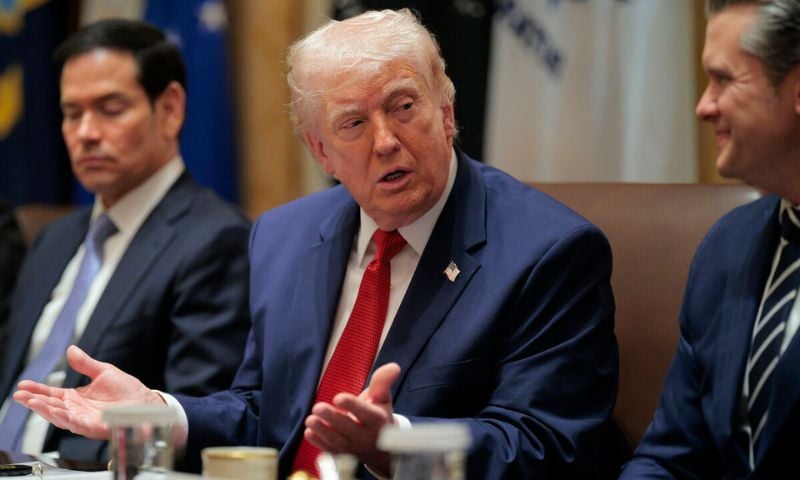
Speaking at a cabinet meeting, Trump said Tehran initially permitted eight “big boats of oil” to transit the strategic waterway earlier this week, followed by two more vessels later.
“Iran allowed 10 oil tankers to pass… as a present,” he said, describing the move as a sign of willingness to engage with Washington to end the war.
The tankers also included some Pakistan-flagged vessels, he said.
Taking control of Iran’s oil an ‘option’: Trump
Trump also said taking control of Iran’s oil resources remained “an option”, drawing comparisons with US actions in Venezuela.
“It’s an option,” he told reporters, adding that Washington had done “very well” with Venezuelan reserves.
He reiterated pressure on Tehran to reach a deal, warning that the United States would continue military action if negotiations failed.
“If they don’t, we’re their worst nightmare… we’ll just keep blowing them away,” he said.
US claims major military gains
Senior US officials echoed Trump’s hardline stance, claiming significant degradation of Iran’s military capabilities.
US Vice President JD Vance said Iran’s conventional military had been “effectively destroyed”, adding that it no longer had the capability to strike as it did weeks ago.
US Defence Secretary Pete Hegseth described the conflict as a “decisive campaign” aimed at eliminating Iran’s military capabilities and preventing it from acquiring nuclear weapons.
He claimed Iran now had “no navy, no navy leader” and said US operations were “ahead of pace”.
US Secretary of State Marco Rubio warned that a nuclear-armed Iran could “kill millions of Americans”.
“These people will kill as many Americans as they have a chance to do, and if they have a nuclear weapon… they could kill millions of Americans… and that is a risk that was NOT going to continue to exist as long as we had this president,” Rubio said.
.@SecRubio on the Iranian regime: "These people will kill as many Americans as they have a chance to do, and if they have a nuclear weapon… they could kill millions of Americans… and that is a risk that was NOT going to continue to exist as long as we had this president." pic.twitter.com/5zsqTg2MqQ
— Rapid Response 47 (@RapidResponse47) March 26, 2026
US sees ‘strong signs’ for deal
US envoy Steve Witkoff said there were “strong signs” that Iran could be persuaded to agree to a peace deal, confirming that a 15-point proposal had been shared with Tehran through Pakistan.
“We will see where things lead… we have strong signs that this is a possibility,” he said.
However, Witkoff accused Iran of “stalling talks” and seeking an “off-ramp” from the conflict, while noting that multiple regional countries were attempting to facilitate a peaceful resolution.
Pakistan facilitating indirect US-Iran talks
Earlier today, Pakistan’s Deputy Prime Minister and Foreign Minister Ishaq Dar said that indirect talks between the United States and Iran are ongoing through messages relayed by Islamabad.
“There has been unnecessary speculation in the media… In reality, US-Iran indirect talks are taking place through messages being relayed by Pakistan,” Dar said in a post on X, adding that Washington had shared a 15-point proposal now under consideration by Tehran.
He said countries including Turkiye and Egypt were also supporting the diplomatic initiative, reaffirming Pakistan’s commitment to promoting peace and stability in the region.
“Pakistan remains fully committed to promoting peace and continues to make every effort to ensure stability in the region and beyond,” Dar said.
“Dialogue and diplomacy is the only way forward,” he said.
There has been unnecessary speculation in the media regarding peace talks to end ongoing conflict in the Middle East. In reality, US-Iran indirect talks are taking place through messages being relayed by Pakistan. In this context, the United States has shared 15 points, being…
— Ishaq Dar (@MIshaqDar50) March 26, 2026
Officials said that talks could potentially be hosted in Islamabad in the coming days.
Pakistan’s Foreign Office spokesperson Tahir Andrabi stressed that the process required discretion.
“This is not an event… it is a process,” he said, urging restraint in speculation.
Iran calls US proposal ‘one-sided’
Meanwhile, Iran has pushed back against US claims, with an unnamed senior Iranian official told the Reuters news agency the proposal has been reviewed by top officials, including a representative of the Supreme Leader, Mojtaba Khamenei.
Iran has described a US proposal to end the war as “one-sided and unfair” but signalled a path forward could still emerge.
“In brief, the proposal suggests that Iran would relinquish its ability to defend itself in exchange for a vague plan to lift sanctions,” he said.
He added that it lacked the minimum requirements for success, and “still no arrangement for negotiations” exists, with no realistic talks in sight.
Turkiye and Pakistan are working to “establish common ground”, the official said.
Iran’s Tasnim news agency reported that Tehran has responded to a 15-point US proposal through intermediaries to end the war, and is now waiting for Washington’s reply.
“Iran’s response to the 15 points proposed by the US was officially sent last night through intermediaries, and Iran is awaiting the other side’s response,” Tasnim reported, citing an informed source.
Earlier, Iranian Foreign Minister Abbas Araghchi said confirmed indirect talks with the US through intermediaries.
“Messages being conveyed through our friendly countries… is not called negotiation or dialogue,” he said in a televised interview.
Trump, however, insisted that Iran was “begging to make a deal”, contradicting Tehran’s public stance.
The latest developments come amid continued military escalation and economic disruption across the region.
Trump said US forces had “wiped out” much of Iran’s navy and air force and destroyed a large proportion of its missile capabilities, adding that operations were “extremely” ahead of schedule.
US Central Command commander Admiral Brad Cooper said an Israeli strike that killed a senior Iranian naval commander had made the region “safer”.
Statement from Adm. Brad Cooper, CENTCOM commander: pic.twitter.com/oVqhVjgIDL
— U.S. Central Command (@CENTCOM) March 26, 2026