


CAPE CANAVERAL, Florida: A comet originating from outside the solar system is making a rare and closely monitored pass near Earth this week before continuing its journey back into interstellar space, the US space agency NASA said on Monday.
Discovered earlier this summer, the comet — designated 3I/Atlas — will pass approximately 167 million miles (269 million kilometres) from Earth on Friday, marking its closest approach to the planet during its brief visit to the solar system. NASA officials have confirmed that the object poses no threat to Earth.
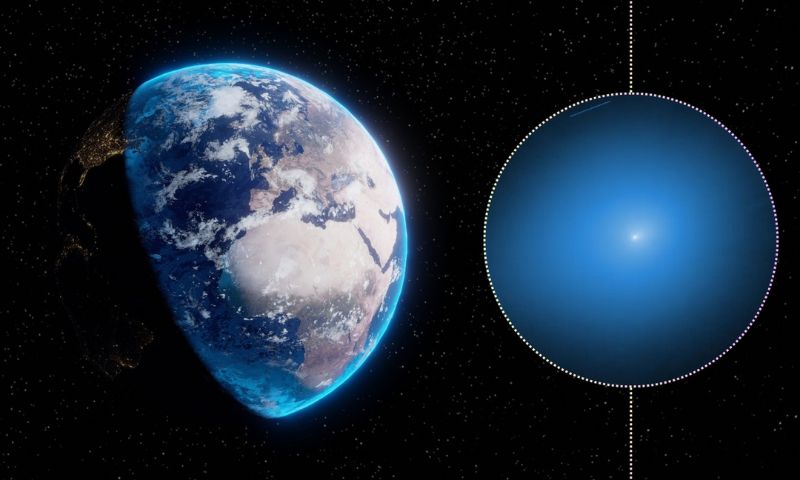
NASA has been tracking the icy visitor using a combination of space telescopes. Based on observational data, scientists estimate the comet measures between 440 metres and 5.6 kilometres in diameter.
As it moves away from the Sun, its brightness is gradually diminishing, making the coming days the best opportunity for amateur astronomers to observe it with telescopes under dark skies.
Before exiting the solar system, 3I/Atlas will make a significantly closer pass by Jupiter in March, approaching within 53 million kilometres of the gas giant.
Paul Chodas, director of NASA’s Centre for Near Earth Object Studies, said the comet is travelling on a hyperbolic trajectory and is expected to fully depart the solar system by the mid-2030s, after which it will never return.
The object is only the third confirmed interstellar visitor detected passing through the solar system. Unlike well-known comets such as Halley’s, which originate from the distant icy regions surrounding the Sun, interstellar comets form around stars elsewhere in the Milky Way and are ejected into space through gravitational interactions.
The first confirmed interstellar object was detected in 2017 by a telescope in Hawaii, followed by an interstellar comet discovered in 2019 by an amateur astronomer in Crimea.
Comet 3I/Atlas was identified in July by NASA’s ATLAS sky-survey telescope in Chile, which is designed to detect potentially hazardous asteroids and near-Earth objects.
Scientists say 3I/Atlas appears brighter — and possibly larger — than its predecessors, suggesting it may have originated in a star system significantly older than our own.
Researchers view the comet as a valuable natural sample from another stellar environment, offering rare insights into the composition, formation, and evolution of planetary systems beyond the Sun.