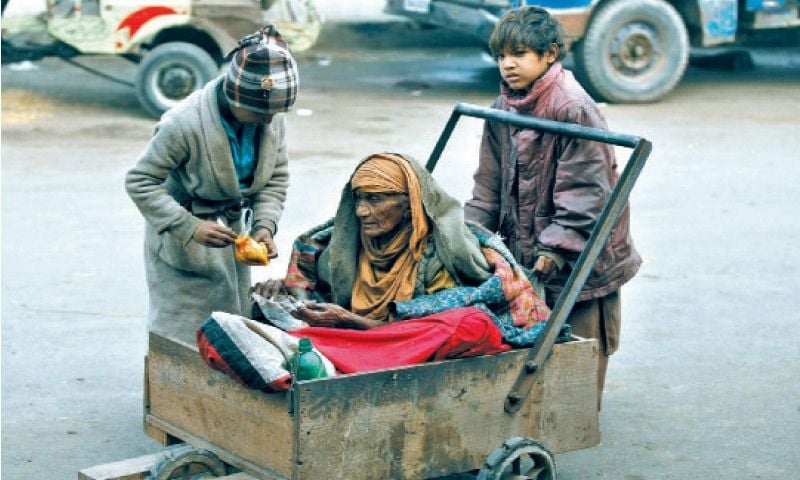



MARDAN, Pakistan: In the crowded lanes of Mardan — the second largest city of the northwestern Khyber Pakhtunkhwa province — children extend their hands to collect change as vehicles move ahead one by one.
Their eyes, tired beyond their age, speak of a struggle for life imposed upon them by others.
Behind this seemingly normal scenario, there is an extraordinary task for the authorities in Khyber Pakhtunkhwa, which is to break down the organised gangs that are taking advantage of the most vulnerable people of the province.
They have intensified their crackdown on human trafficking and organised begging networks, arresting thousands of individuals involved in these illicit trades over the past few years.
The Federal Investigation Agency (FIA) reported the arrest of 64 human smugglers in Khyber Pakhtunkhwa over the last five years.
The agency also confirmed that 645 individuals were deported from other countries and another 895 were offloaded at Peshawar International Airport during the same period as part of ongoing efforts to curb human trafficking and illegal migration.
Separately, the Social Welfare Department of Khyber Pakhtunkhwa discloses that 11,181 beggars were apprehended in just three districts of the province between 2021 and 2025.
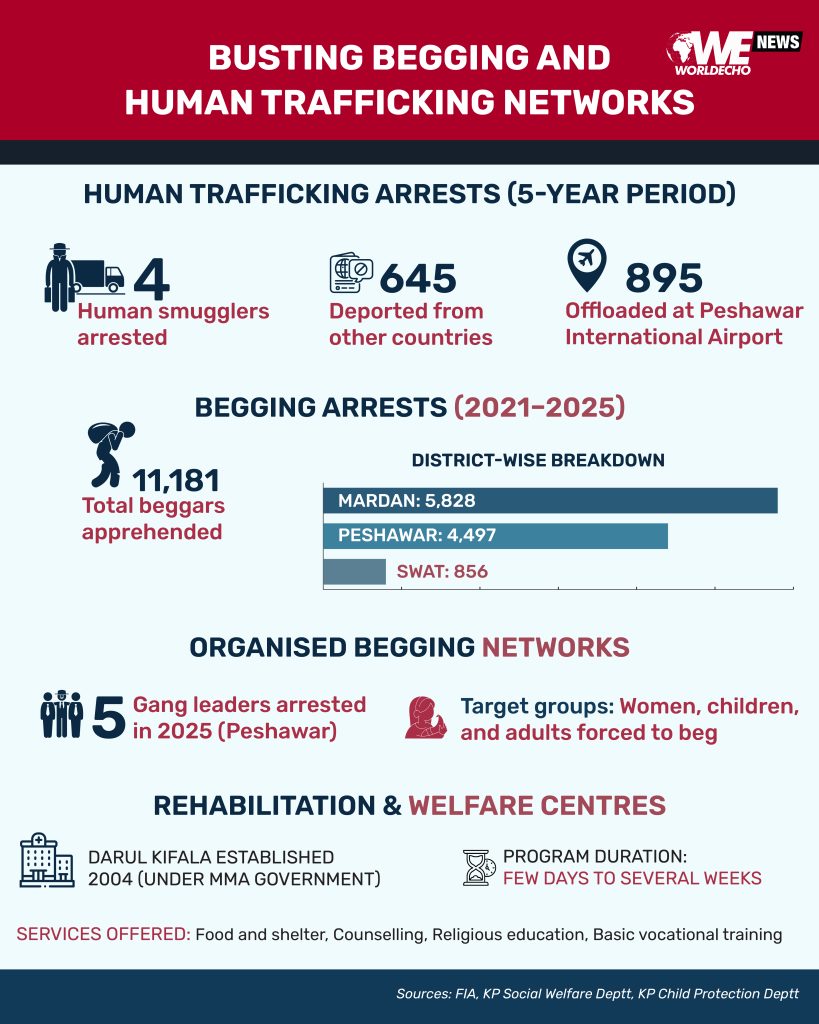
The data shows that Mardan district bore the brunt of the activity with 5,828 arrests, followed by Peshawar with 4,497, and Swat with 856.
We get the lay of the land regarding their family background and where they come from. We check if anyone is forcing them to beg and whether their education is falling through the cracks.” – Sara Ihsan, Child Protection Unit In-Charge
Officials assert that the arrests highlight the growing concern over organised begging rings that often exploit vulnerable people — including children and the disabled — forcing them to toil on the streets to line the pockets of their handlers.
Tracking vulnerable children
Mardan’s Child Protection Unit In-Charge Sara Ihsan says that their department keeps complete records of all children rescued during operations.
“We get the lay of the land regarding their family background and where they come from. We check if anyone is forcing them to beg and whether their education is falling through the cracks,” she says.
Sara explains that many children burn the candle at both ends, begging at night while attending school or madrassa in the morning. According to her, the root of the problem lies in poverty and parental drug addiction.
To find a silver lining, the Child Protection Department is signing a Memorandum of Understanding with the Sociology Department of Abdul Wali Khan University, Mardan.
“The goal is to encourage MPhil and PhD students to dig deep into child protection issues — such as child begging and early marriages — to help find long-term solutions,” she adds.
Nevertheless, persuading students may be an uphill task, as they will receive no financial or logistical support from either the Social Work Department or Sociology Department of the varsity.
Cracking down on gangs
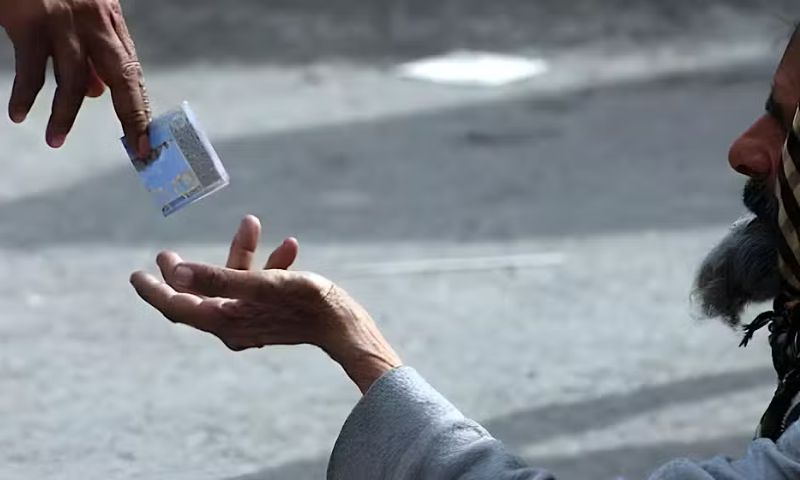
Similarly, Peshawar Police claim having arrested in 2025 five gang leaders involved in organised begging. They say these groups were part of a network that forced people, including children, to beg at different locations.
A senior social welfare official, speaking on condition of anonymity, tells WE News English that many of these individuals are part of larger networks that move people across districts and even borders.
“The government is working to separate the wheat from the chaff by rehabilitating genuine beggars and dismantling these criminal groups.”
The Khyber Pakhtunkhwa government defines rehabilitation primarily as removing beggars from the streets and placing them in welfare centres, where they receive temporary shelter, basic assistance, and referrals to vocational training programmes rather than assured long-term employment.
Many of these individuals are part of larger networks that move people across districts and even borders. The government is working to separate the wheat from the chaff by rehabilitating genuine beggars and dismantling these criminal groups.” – A Social Welfare Deptt official
However, the jury is still out on the success of this approach, as no consolidated province-wide figures have been released regarding successful integration.
While authorities confirm that operations have been launched against organised begging networks, data on the number of dismantled gangs remains under wraps.
Legal action is pursued under existing anti-beggary laws, while amendments to further strengthen the legal framework are in the pipeline.
The government has additionally announced skill-development initiatives through institutions such as the Technical Education and Vocational Training Authority, though officials acknowledge that implementation is lagging behind.
These centres, operating under the Social Welfare Department, typically provide registration, medical check-ups, and limited counselling.
While most centres claim to offer counselling, religious education, and basic skills training, vocational programmes are often irregular and minimal due to resource constraints.
The duration of stay generally ranges from a few days to several weeks, after which many individuals are released.
In most cases, there is no structured long-term rehabilitation or reintegration plan, raising questions about the sustainability and effectiveness of these measures.
Pathway to structural reform
Human rights activist Muhammad Arif urges the authorities to clearly distinguish between professional beggars and those pushed onto the streets by extreme hardships such as poverty, unemployment, or displacement.
The first group [of beggars] consists of genuinely needy people. Because poverty is widespread, we describe them as deserving… They have occupied specific streets and bazaars and are backed by influential people. We have zero tolerance for this group.” – Iqbal Khattak, focal person of the Vigilance Committee
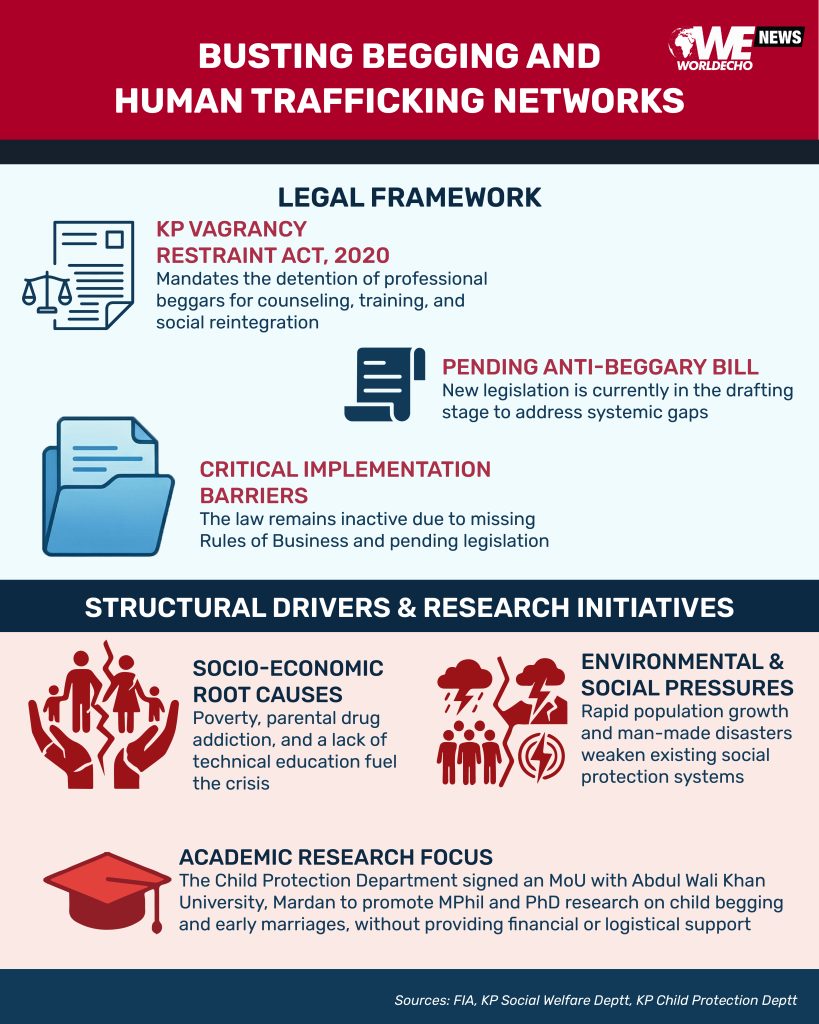
Officials say the arrests are carried out under the Khyber Pakhtunkhwa Vagrancy Restraint Act, 2020, enacted by the Khyber Pakhtunkhwa Assembly to curb begging and provide rehabilitation for those living on the streets.
The law authorises authorities to detain professional beggars and place them in the designated welfare institutions for counselling, training, and social reintegration.
However, despite its enactment, the law has not been effectively implemented due to the absence of essential Rules of Business.
As a result, begging continues to increase across the province. The Khyber Pakhtunkhwa government has yet to pass the Anti-Beggary Bill, which remains stuck in the drafting and vetting stages.
In the interim, authorities continue to rely on the outdated Khyber Pakhtunkhwa Vagrancy Restraint Act, 2020 — a law that lacks clear rules and effective enforcement mechanisms.
Meanwhile, Iqbal Khattak, Additional Deputy Commissioner and focal person of the Vigilance Committee, says beggars have been divided into two groups.
“The first group [of beggars] consists of genuinely needy people. Because poverty is widespread, we describe them as deserving,” he says, explaining that the second group includes people who have been begging in markets for many years.
“They have occupied specific streets and bazaars and are backed by influential people. We have zero tolerance for this group,” Khattak says, adding that operations have been carried out against them many times and will continue.
Breaking the cycle
Noor Muhammad, a deputy director at the Khyber Pakhtunkhwa Social Welfare Department, says that many of those arrested were part of organised networks, exploiting women, children, and people with disabilities. “Our focus is not just on arrests but on rehabilitation and breaking the cycle of exploitation.”
Meaningful long-term state support programmes are crucial, particularly investment in girls’ education, digital and skills-based training, healthcare, support for persons with disabilities, drug rehabilitation services, and targeted assistance for orphans, widows, and other marginalised groups.” – Imran Takkar, child rights activist
Human rights groups have cautiously welcomed government efforts to rehabilitate genuine beggars but stress that enforcement alone will not solve the problem unless poverty and unemployment — the main drivers of begging — are addressed through sustained social and economic reforms.
Peshawar-based child rights activist Imran Takkar argues that the rehabilitation should not be treated as a short-term or charitable exercise, but as a comprehensive social process that upholds human dignity, builds self-confidence, and enables social inclusion.
Khyber Pakhtunkhwa established Darul Kifala — a shelter and rehabilitation centre for beggars and orphans — during the Muttahida Majlis-e-Amal (MMA) government in 2004.
These centres aim to provide food, shelter, and vocational skills to help vulnerable individuals reintegrate into society.
Takkar says begging is rooted in structural issues such as poverty, unequal distribution of resources, unemployment, lack of quality and technical education, weak social protection systems, natural and man-made disasters, and rapid population growth.
“Meaningful long-term state support programmes are crucial, particularly investment in girls’ education, digital and skills-based training, healthcare, support for persons with disabilities, drug rehabilitation services, and targeted assistance for orphans, widows, and other marginalised groups,” Takkar concludes.