


NEW DELHI: A sharp rise in black-market prices of cooking gas in India’s capital is pushing low-income families back to traditional fuels like wood and coal, reversing years of progress toward cleaner energy and posing serious health risks.
Liquefied petroleum gas (LPG), a primary cooking fuel for millions of Indian households, has become increasingly expensive in informal markets.
Although India remains one of the world’s largest importers of LPG, largely sourcing supplies from the Middle East, ongoing geopolitical tensions have disrupted availability and driven up costs.
Prime Minister Narendra Modi has reassured citizens that national energy supplies remain stable, while urging authorities to crack down on hoarding and black-market activity. However, for many urban poor, access—not just supply—has become the critical issue.
According to AFP, in Madanpur Khadar, a densely populated, low-income neighborhood in New Delhi, domestic worker Sheela Kumari says her family can no longer afford LPG cylinders.
Prices that once ranged between ₹1,800 and ₹2,000 have skyrocketed to nearly ₹5,000 in the black market—almost equivalent to her monthly income.
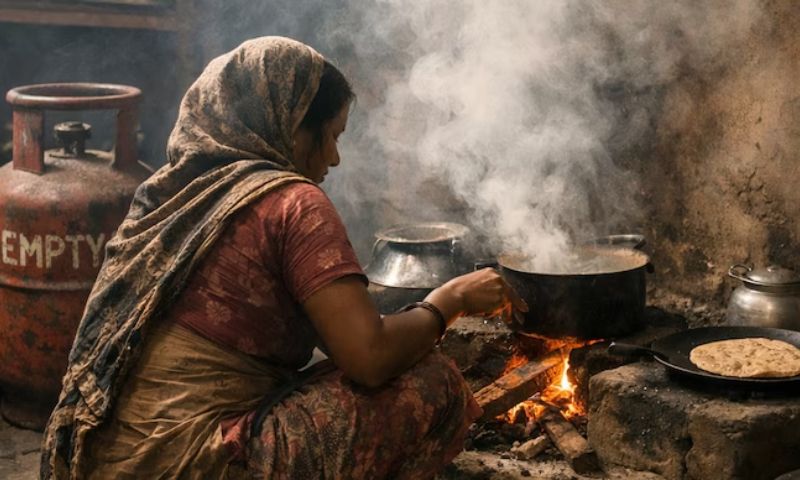
Faced with these costs, Kumari has reverted to using firewood and coal. While significantly cheaper, these alternatives come with severe consequences.
Indoor smoke from solid fuels is known to cause respiratory illnesses, particularly affecting women and children who spend more time near cooking areas. Kumari says her children have already begun experiencing persistent coughing.
Her neighbor, Munni Bai, who suffers from asthma, had previously transitioned to cleaner options like electric cooking and biogas. But the rising cost of LPG has forced her to reconsider. She now faces a difficult trade-off between affordability and her health.
Experts and activists argue that the crisis is less about a nationwide shortage and more about unequal access.
Many migrant workers and informal residents lack the documentation required to benefit from subsidized LPG schemes such as the government’s flagship “Ujjwala” program, which has provided clean cooking connections to over 100 million households.
As a result, these populations rely heavily on unregulated markets, where hoarding and speculation have inflated prices two to three times above official rates.
The shift back to biomass fuels also threatens to worsen air quality in New Delhi, already one of the world’s most polluted cities.
Emissions from household burning add to an existing mix of industrial pollution, vehicle exhaust, and seasonal crop burning, intensifying public health challenges.
The situation highlights a growing gap between policy intentions and ground realities, as economic pressures force vulnerable communities to abandon cleaner energy solutions and return to hazardous alternatives.