
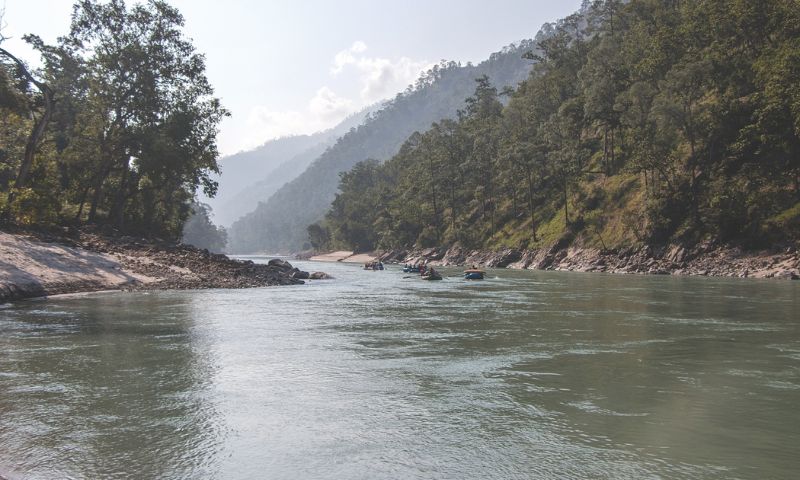



WASHINGTON: A leading US foreign policy journal has supported Pakistan’s position on the Indus Waters Treaty (IWT), warning that India’s recent actions could destabilise South Asia, trigger a humanitarian crisis and undermine one of the world’s most durable water-sharing agreements.
In an in-depth analysis, a US journal, The National Interest, stated that India’s suspension of aspects of the Indus Waters Treaty marked a dangerous shift in regional water politics, introducing water as a potential strategic weapon between two nuclear-armed neighbours.
The journal warned that politicising water in South Asia, a region already vulnerable to climate stress and scarcity, could escalate tensions and pose severe humanitarian risks for millions of people.
Unilateral suspension of water sharing treaty
The US publication stressed that the Indus Waters Treaty remains legally binding and cannot be suspended unilaterally by either party.
It recalled that in August 2025, the Permanent Court of Arbitration reaffirmed that India is obligated to “let flow” the waters of the western rivers — the Indus, Jhelum and Chenab — for Pakistan’s unrestricted use, irrespective of political disputes.
The analysis noted that withholding water flows or suspending hydrological data sharing violates international law and undermines the treaty, which has survived wars and prolonged diplomatic breakdowns since it was brokered by the World Bank in 1960.
“The Indus Waters Treaty is a fundamental guarantee of water and food security in South Asia,” the magazine said, adding that attempts to weaponise water are unacceptable under international law and would face scrutiny from international courts.
Concerns over Dulhasti Stage-II project
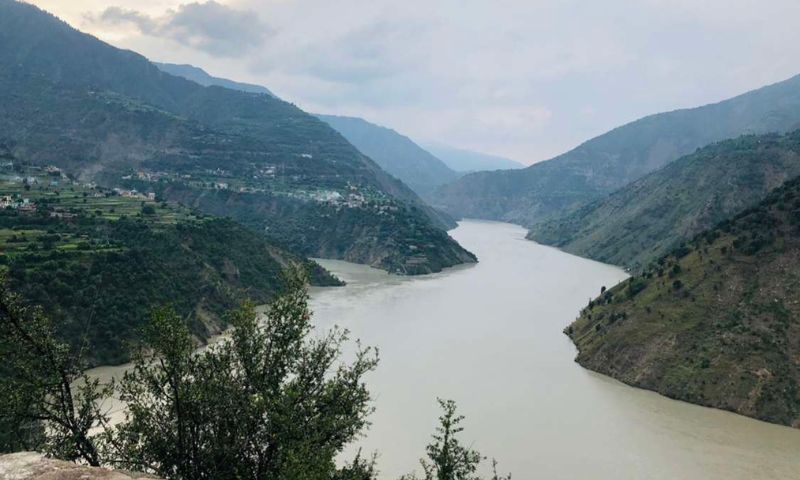
The report specifically flagged India’s planned Dulhasti Stage-II hydropower project as raising serious treaty concerns.
The 260-megawatt run-of-the-river expansion on the Chenab River, located in the Kishtwar district of Indian illegally occupied Jammu and Kashmir, is designed as an extension of the existing Dulhasti Stage-I project, which has been operational since 2007.
According to details cited by the journal, the project involves diverting Chenab waters through tunnels to an underground powerhouse downstream.
The magazine warned that such diversions, if pursued without full transparency and treaty compliance, risk altering natural flow patterns and eroding Pakistan’s guaranteed water rights under the IWT.
Data sharing suspension criticised
The National Interest also criticised India’s suspension of hydrological data sharing with Pakistan, describing it as a breach of established international norms.
It cautioned that water scarcity, if politicised, could escalate into a major humanitarian threat across South Asia.
The article contrasted Pakistan’s continued engagement with dispute-resolution mechanisms, including Neutral Expert proceedings, with what it described as an emerging asymmetry in treaty compliance by India.
UN experts endorse Pakistan’s position
The concerns echoed findings by United Nations special experts, who in December 2025 declared India’s unilateral suspension of the Indus Waters Treaty illegal and endorsed Pakistan’s long-standing legal position.
In a detailed report, UN experts said no party can unilaterally suspend the treaty, stressing that it is a bilateral agreement governed by international law.
They warned that disrupting cross-border water flows threatens the fundamental rights of millions of people in Pakistan.
The report said interference in water flows affects rights to water, food, health, employment, environment and development, and must not be used as a tool of political or economic pressure.
The experts rejected India’s claims linking the treaty to alleged cross-border terrorism, stating that such allegations were irrelevant to the IWT and unsupported by credible evidence.
UN experts send civil notice to India
UN experts also sent a civil notice to the Indian government, seeking responses to misleading claims.
In a five-point questionnaire, they asked India to provide evidence for its allegations against Pakistan and to clarify whether it would compensate for loss of life resulting from the illegal use of force.
The notice also raised questions about steps to ensure the right to self-determination for Kashmiris.
According to the experts, India failed to respond within the required 60-day period, prompting the publication of the report.
Pakistan highlights river flow violations
Pakistan’s Indus Water Commissioner, Mehr Ali Shah, said the UN report was an independent assessment issued through international mechanisms and not prepared by Pakistan. He described it as fact-based and legally sound.
Shah said India had illegally altered water flows in the Jhelum and Chenab rivers on two occasions, in May and December.
He said water flows were maintained for 159 hours before dropping sharply to around 10 percent of normal levels.
According to Shah, average flows fell from 4,000–5,000 cusecs to as low as 870–1,000 cusecs after India’s measures, posing serious risks to agriculture, livelihoods and water security in Pakistan.