


Key Points
- Video of CM Nitish Kumar pulling down Dr Nusrat Parveen’s hijab goes viral, drawing global criticism
- Global human rights groups and Pakistan condemn the act as a violation of dignity and religious freedom
- Opposition parties in India demand accountability, while social media debates secularism and minority rights
ISLAMABAD: A storm of international criticism has erupted after a video surfaced showing Bihar Chief Minister (CM) Nitish Kumar removing the hijab of a Muslim woman doctor during an official government function in Patna, triggering outrage over religious freedom, women’s dignity and the conduct of public officials.
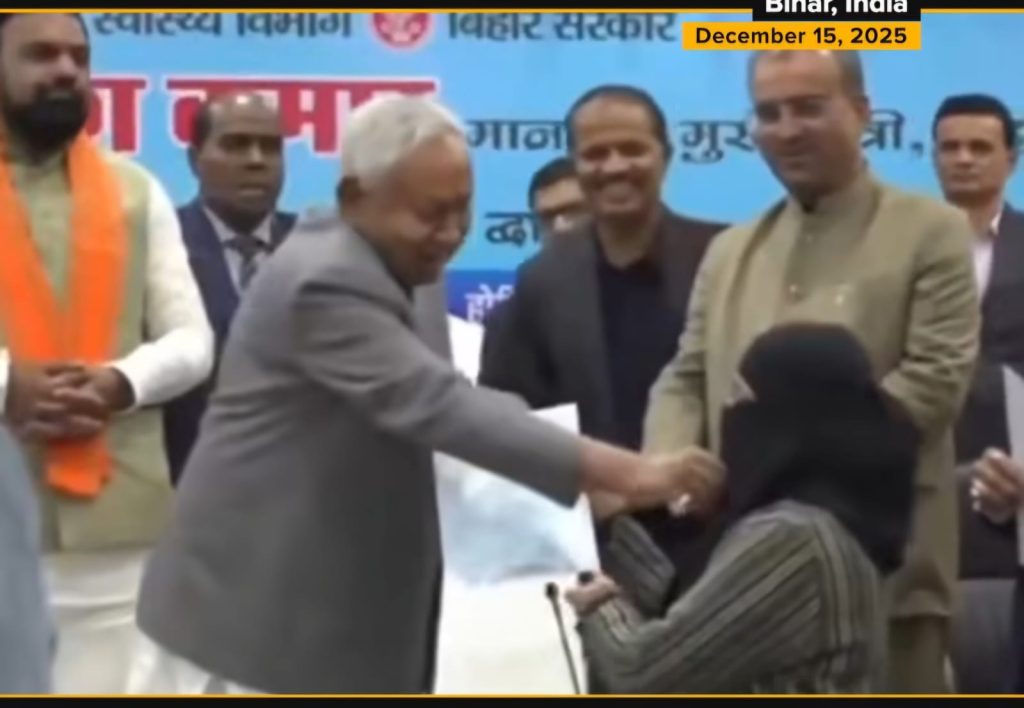
The incident occurred at the Chief Minister’s Secretariat during a ceremony to distribute appointment letters to newly recruited Ayush doctors. As Dr Nusrat Parveen stepped forward to receive her appointment letter, her hijab was seen covering part of her face. In footage that has since gone viral, the 74-year-old chief minister is seen reaching out from the dais and pulling down her veil, a moment that left the doctor visibly uncomfortable before an official escorted her away.
The clip spread rapidly across social media platforms, drawing condemnation not only from within India but also from international human rights organisations, foreign governments, and civil society groups worldwide.
Human Rights Groups Condemn the Act
Global rights organisations have described the incident as a serious violation of personal autonomy and religious freedom. International watchdogs said the public removal of a woman’s religious attire by a senior state official amounted to an assault on her dignity and identity, warning that such acts risk normalising discrimination against religious minorities.
Rights advocates stressed that decisions about religious dress are deeply personal and protected under international human rights norms, and that interference by state representatives sends a dangerous signal, particularly for Muslim women. Several organisations called for a clear public apology and accountability from the Bihar government.
Pakistan and Regional Reaction
The controversy has also sparked sharp reactions in Pakistan, where government officials and human rights bodies condemned the incident as unacceptable and humiliating. Statements from Islamabad described the act as a violation of basic human dignity and religious freedom, urging Indian authorities to take corrective action.
The Human Rights Council of Pakistan termed the incident “reprehensible and inhumane,” calling for an impartial investigation and international attention, including scrutiny by global human rights forums.
Domestic Political Fallout in India
Within India, opposition parties including the Congress and the Rashtriya Janata Dal (RJD) strongly criticised Nitish Kumar’s conduct. Senior opposition leaders described the gesture as inappropriate and disrespectful, with some demanding the chief minister’s resignation and accusing him of violating women’s rights and constitutional values.
Activists, lawyers and public figures also weighed in, calling the act “shameless” and an affront to India’s secular fabric. Many noted that even if unintentional, the chief minister’s action reflected a troubling disregard for consent and religious sensitivity.
Supporters of the Bihar chief minister, however, have sought to downplay the controversy, with some officials characterising the moment as a misunderstanding or a benign gesture, arguments that have done little to stem the backlash.
Global Social Media Outrage
On social media, reactions poured in from across the world, with users warning that such incidents could deepen communal tensions if left unaddressed. Commentators framed the episode within broader debates on secularism, minority rights and women’s bodily autonomy, urging Indian authorities to reaffirm constitutional protections for religious freedom.
A Polarising Moment
The controversy comes amid heightened national and international scrutiny of religious freedoms and minority rights in India. As the video continues to circulate globally, observers say the incident has become one of the most polarising political moments of the year, raising difficult questions about power, consent and the responsibilities of those in public office.
So far, there has been no formal apology from the Bihar chief minister, even as calls for accountability continue to grow both at home and abroad.
The controversy comes amid ongoing discussions in India about religious freedoms and minority rights, and has quickly become one of the most polarising incidents of the year for both domestic and international observers.