



ISLAMABAD: As Australian investigators piece together the events behind the Bondi Beach attack, new details about the father-and-son gunmen have sharpened focus on firearms licensing, background checks, and missed warning signs.
A neighbour’s account highlighting an Indian–Italian family background and licensed gun ownership has added to scrutiny over how the attackers prepared for the assault and whether safeguards failed before the deadly incident.
“His background’s Indian and Italian… his mum’s Italian, his dad’s Indian,” the neighbour told the Australian media, recalling conversations from before the attack. “One thing that we used to talk about was that he was licensed for firearms. I think that’s one of the things that sort of needs to be looked into.”
The comments come as investigators confirmed that two Islamic State flags were found inside the attackers’ car, one of which was visible on the bonnet in footage from the scene, according to Australia’s public broadcaster ABC. Counterterrorism police believe both attackers had pledged allegiance to IS, officials said.
Who Were the Attackers?

The gunmen have been identified as Sajid Akram, 50, and his son Naveed Akram, 24. Police earlier confirmed the attackers were father and son. Sajid Akram was shot dead by police at the scene, while Naveed Akram remains in critical condition in the hospital under police guard and is expected to face criminal charges.
Authorities said the pair targeted a “Chanukah by the Sea” event at Bondi Beach on Sunday evening, opening fire on Jewish families gathered for the celebration. The victims included a 10-year-old girl, a British-born rabbi, a retired police officer, and a Holocaust survivor. At least 15 people were killed, with dozens more wounded.
Sajid Akram, and his son Naveed Akram, came from a mixed ethnic background, with neighbours describing the family as Indian–Italian, noting that the mother was Italian while the father was of Indian origin. Sajid Akram arrived in Australia in 1998 on a student visa, which was later converted into a partner visa and subsequently resident return visas, allowing him to remain in the country long term.
He was a licensed firearms holder, registered as a recreational hunter and a member of a gun club, with six legally owned weapons in his name — all of which have now been recovered by police.
His son, Naveed Akram, was Australian-born and had previously worked as a mason, but had been unemployed for about two months before the attack. Australian authorities have confirmed that he first came to the attention of security agencies in 2019 due to associations with individuals under investigation, though at the time he was assessed as posing no immediate threat.
In the weeks leading up to the attack, the father and son moved from their long-term residence in Bonnyrigg to a short-term rental property in Campsie, which investigators now believe was used to prepare for the assault. Counterterrorism police say both men were radicalised locally, had pledged allegiance to the Islamic State group, and that IS flags were recovered from their vehicle, reinforcing the conclusion that the attack was ideologically motivated and premeditated.
Islamic State links and prior scrutiny
ABC News reported that Naveed Akram, an Australian-born citizen, had previously been examined over close ties to a Sydney-based IS terrorism cell. Prime Minister Anthony Albanese said Akram first came to the attention of Australian authorities in October 2019, but an assessment at the time concluded there was no indication of an ongoing threat or imminent violence.
However, following Sunday’s attack, counterterrorism officials now believe both the father and son had pledged allegiance to the Islamic State group, a development that has intensified scrutiny of earlier assessments.
Police confirmed that Sajid Akram held a valid firearms licence for recreational hunting and was a member of a gun club. He had six weapons registered in his name, all of which have since been recovered by authorities.
Prime Minister Albanese said the government would push for tougher gun laws, noting that the attack has raised serious questions about licensing and oversight, particularly in cases involving radicalisation risks.
Background and movements before the attack
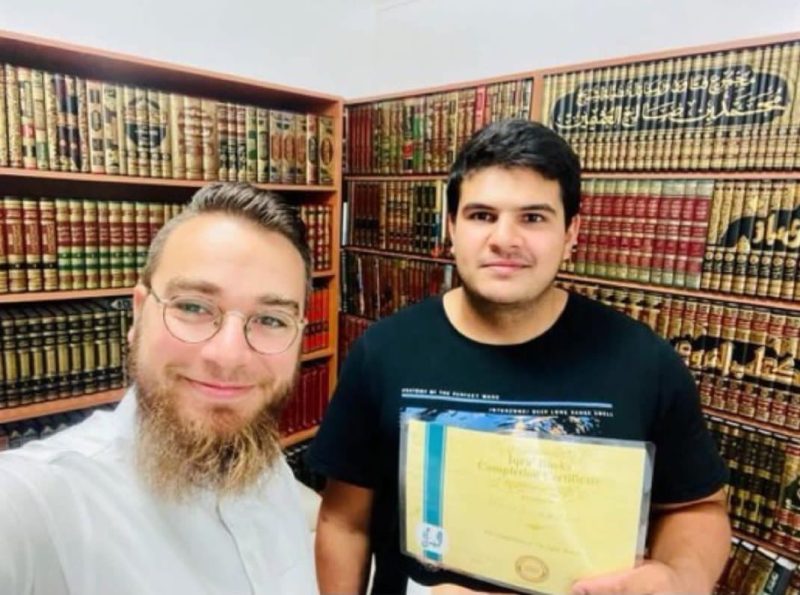
Investigators say the Akram family had lived in Bonnyrigg, New South Wales, about an hour’s drive inland from Bondi Beach. A few weeks before the attack, the father and son reportedly moved into a short-term Airbnb in Campsie, roughly 30 minutes from the beach, which police now believe was used to prepare for the assault.
A single-storey grey building in Campsie has become a central focus of the investigation. Police also raided the family’s former home following the attack.
As the shooting unfolded, bystander Ahmed al Ahmed was filmed wrestling a gun away from one of the attackers, an act widely credited with saving lives. His parents later said he was shot four or five times in the shoulder during the confrontation. New South Wales Premier Chris Minns visited him in hospital, praising his bravery.
Investigation continues

Police say the attack has been formally declared a terrorist incident. A homemade explosive device was also found in a vehicle linked to the gunmen, further underscoring the premeditated nature of the assault.
Authorities are continuing to piece together how the attack was planned, how the gunmen were radicalised, and whether any warning signs were missed — including the role of firearms licensing and prior intelligence assessments — as Australia grapples with one of its deadliest mass shootings in decades.