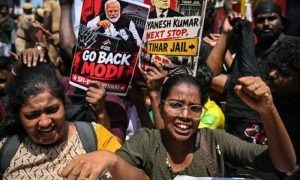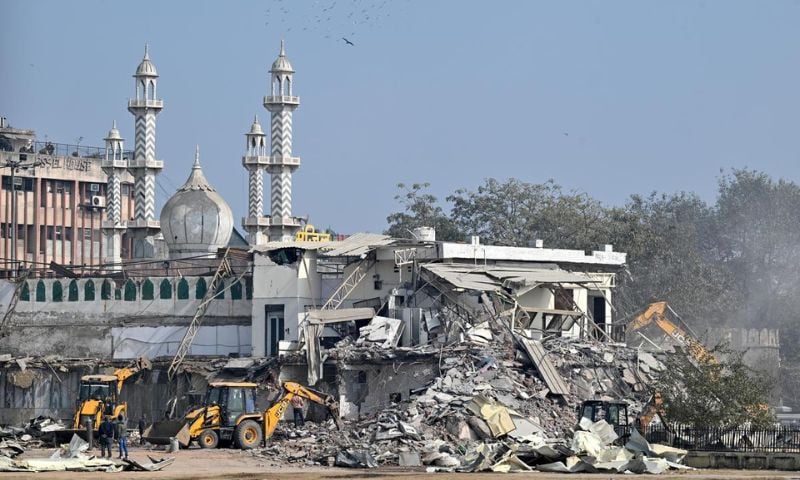
NEW DELHI: Indian civil-society voices have criticised demolitions of Muslim religious sites and properties in several parts of India under Bharatiya Janata Party (BJP) governments, warning that anti-encroachment drives could undermine due process and religious freedom.
The latest controversy followed the demolition of a mosque inside the Saharanpur Collectorate complex in Uttar Pradesh on September 5. Authorities had declared the mosque unauthorised following a dispute over government land.
The mosque’s management and opposition figures questioned the manner and timing of the demolition. Jamiat Ulama-i-Hind president Maulana Mahmood Madani described the action as a serious blow to justice and due process.
Madani also questioned whether the administration could act both as a party to the land dispute and as the authority enforcing the demolition. He said the court order cited in the case did not expressly direct immediate demolition.
#Saharanpur_Mosque_Demolition: A Blow to Law and Justice
Jamiat Ulama-i-Hind central delegation visits Saharanpur, meets key stakeholders; resolves to pursue all legal avenues*Saharanpur, Sept. 8, 2026: Jamiat president Maulana Mahmood Madani has expressed deep concern over the… pic.twitter.com/Sjq5pid1Xs
— Jamiat Ulama-i-Hind (@JamiatUlama_in) September 8, 2026
The issue has since spread to other Muslim places of worship in western Uttar Pradesh.
The Mustafa Mosque in Moradabad has received a notice from the Moradabad Development Authority seeking documents related to its construction. In neighbouring Sambhal, the Baba Bahauddin Shah Masjid is facing an inquiry by the Archaeological Survey of India.
‘Bulldozer justice’ in India
Analysts say the bulldozer has increasingly become a symbol of punitive state action against Muslims in India.
Amnesty International documented 128 Muslim property demolitions across Assam, Delhi, Gujarat, Madhya Pradesh and Uttar Pradesh during a period of violence and protests in 2022.
It said at least 617 people were affected and that Muslim families and businesses were disproportionately impacted.
Filmmakers, writers, activists and other public figures have also criticised a growing culture of demolition.

They have cited earlier cases, including the destruction of the family home of activist Afreen Fatima in Prayagraj, as examples of bulldozer action being used to intimidate dissent and create fear.
The issue has also drawn judicial scrutiny.
In November 2024, India’s Supreme Court stressed that authorities must follow due process before removing alleged encroachments or unauthorised structures. The court rejected “bulldozer justice” as inconsistent with the rule of law.
Analysts expressed concern about whether the law is being applied consistently and whether affected communities are given adequate opportunity to challenge administrative decisions.
BJP government’s controversial actions
The controversy has also intensified amid a wider dispute over Muslim charitable and religious properties following the passage of the Waqf (Amendment) Act, 2025.
According to official figures, India has more than 872,000 immovable Waqf properties covering about 3.82 million acres. They include mosques, graveyards, schools, madrasas, dargahs and charitable properties.
The amended law introduced stricter registration and verification requirements, changed the role of government officials in certain disputes and altered the legal position of “Waqf by user”.
The Bharatiya Janata Party-led government is facing scrutiny from various circles of life over the controversial law.
Opposition parties have strongly criticised the legislation.
Congress leader Rahul Gandhi called it a “weapon aimed at Muslims and usurping their property rights”. Congress president Mallikarjun Kharge said it was “not for any reform, but for control”.
Samajwadi Party chief Akhilesh Yadav questioned the proposed inclusion of non-Muslims on Waqf boards. Rashtriya Janata Dal leader Manoj Jha warned that the legislation could provide “a legal cover for bulldozers”.
Demolitions under scrutiny
Political leaders have questioned whether adequate notices were served, whether historical revenue and property records were examined, whether ownership and long-term use claims were heard, and whether affected parties had a genuine opportunity to challenge decisions before demolition.
Those questions are particularly important for religious sites because demolition is irreversible. Even if a legal challenge succeeds later, the original structure and its accumulated history cannot simply be restored.
The political response to the Saharanpur demolition has been particularly sharp.
Bahujan Samaj Party leader Mayawati criticised the hasty declaration of mosques as illegal. Congress MP Imran Masood called the demolition a “black day” for Saharanpur and an attack on the Constitution.
Samajwadi Party MP Iqra Hasan said she was placed under house arrest while attempting to travel to the area.
The repeated targeting of Muslim religious and community properties has created growing anxiety among minority communities.
India is home to more than 200 million Muslims, who account for about 14.2 percent of its population. Only 24 Muslims were elected to the 543-member Lok Sabha in the 2024 general election, while Muslim labour-force participation has also remained below that of Hindus.
Civil-society activists argue that the cumulative effect of repeated demolitions warrants scrutiny, particularly in a country that constitutionally guarantees religious freedom and equality before the law.
For Muslims, a mosque, madrasa, dargah or graveyard is more than a piece of property. Such sites can carry generations of religious, social and cultural memories.