


Key points:
- Foreign Minister Ishaq Dar calls India’s suspension of the Indus Waters Treaty a violation of international law.
- Islamabad urges the global community to intervene as millions face risk to food and water security.
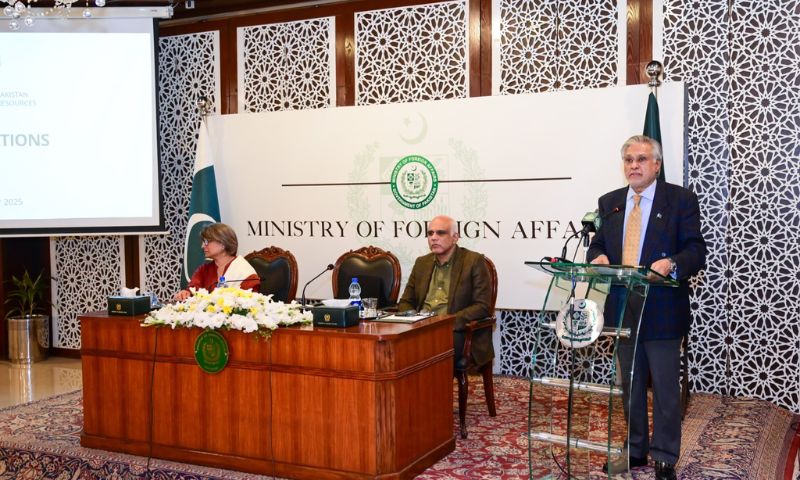
ISLAMABAD: Deputy Prime Minister and Foreign Minister of Pakistan Ishaq Dar on Friday warned against what he described as India’s “weaponisation of water” after abrupt fluctuations in the flow of the Chenab River raised serious concerns among farmers in Pakistan’s Punjab province.
Speaking to envoys from across the world in Islamabad, Dar warned that India’s recent actions on shared rivers threatened peace and stability in South Asia, accusing New Delhi of “weaponising water” in violation of the Indus Waters Treaty (IWT).
“Any attempt to stop or divert Pakistan’s share of water will not be tolerated and will be considered an act of war,” Dar said. He condemned India’s unilateral suspension of the Indus Waters Treaty earlier this year, describing it as a breach of international law and the Vienna Convention on treaty obligations.
“These variations in water flow are of extreme concern to Pakistan as they point to the unilateral release of water by India into the Chenab River,” Dar said, adding that Pakistan’s Indus water commissioner had formally sought clarification from his Indian counterpart. He described the actions as a clear example of “the weaponisation of water,” warning that manipulation during a critical agricultural period threatened Pakistan’s food, economic, and human security.
Dar also accused India of systematically undermining the treaty through the construction of hydropower projects such as Kishanganga and Ratle, which he said violated technical specifications, increased India’s storage capacity and endangered the livelihoods of Pakistan’s population. He said India had halted data-sharing and joint oversight mechanisms, exposing Pakistan to floods and droughts and risking a humanitarian crisis.
The Deputy Prime Minister/Foreign Minister, Senator Mohammad Ishaq Dar @MIshaqDar50, held an urgent briefing for the Diplomatic Corps on India’s persistent material breaches of the Indus Waters Treaty (IWT).
India’s repeated manipulation of water flows, construction of illegal… pic.twitter.com/JGD9s3CCfi
— Ministry of Foreign Affairs – Pakistan (@ForeignOfficePk) December 19, 2025
The foreign minister said India was also subverting dispute resolution by refusing to participate in proceedings at the Permanent Court of Arbitration (PCA) and with neutral experts, despite the PCA recently reaffirming that the treaty remains valid and binding. He urged the international community to reject what he called “Indian impunity” and to safeguard the sanctity of international treaties.
Dar cited a UN rapporteurs’ report made public this month expressing concern over India’s actions related to the IWT, including statements by Indian leaders about diverting water flows. He said Pakistan had raised the issue repeatedly with the UN Security Council, the UN secretary general and the president of the General Assembly, while reaffirming Islamabad’s commitment to peaceful dispute resolution.
“Water is life, and it can not be weaponised,” Dar said, calling on the international community, particularly UNSC members, to take immediate steps to ensure India restores the treaty in full and upholds international law.