


Key Points
- India was invited but skipped the launch ceremony, fuelling debate in New Delhi
- Indian analysts warn Pakistan’s participation could open doors to Kashmir
- Trump says the model can be extended to “other places” beyond Gaza
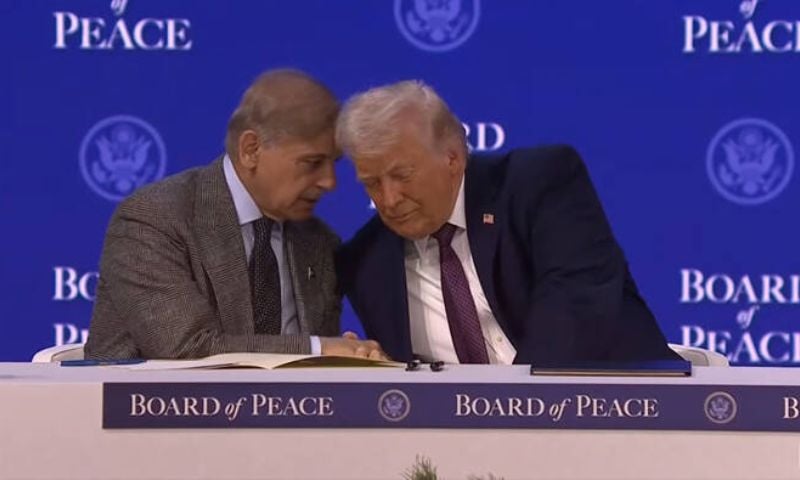
ISLAMABAD: Pakistan’s decision to join the US-backed “Board of Peace” on Gaza has triggered visible unease in India, where analysts and former diplomats are openly warning that President Donald Trump could, in future, also place the Kashmir dispute before the same forum, BBC Urdu reported.
According to a BBC Urdu report by Rajnish Kumar, Trump has invited several countries, including India, to join his initiative, the Board of Peace, which is tasked with ensuring a lasting ceasefire between Israel and Hamas, overseeing Gaza’s reconstruction and supervising an interim governance arrangement.
Pakistan, Turkey, Saudi Arabia and the United Arab Emirates are among the countries that accepted the invitation.
India, however, remained absent when Trump formally launched the board on Thursday in Davos, on the sidelines of the World Economic Forum, despite Prime Minister Narendra Modi being among the invitees.
Trump said 59 countries had signed up to the initiative, but representatives of only 19 attended the ceremony. “This is not only for America, but it is also for the whole world. I think we can spread it to other places as well,” Trump said, as quoted by BBC Urdu.
It is this possibility of expansion that has sharpened concerns in India. BBC Urdu reported that several Indian commentators see Pakistan’s presence on the board as a strategic advantage for Islamabad, particularly in light of Trump’s repeated public offers to mediate on the Kashmir dispute.
“Tomorrow, Trump could also bring the Kashmir dispute to the board,” is the warning now circulating in Indian policy circles.
Former Indian ambassador to the United Nations Syed Akbaruddin argued that India should stay away, claiming the board conflicts with UN Security Council Resolution 2803 and risks functioning more like a “private club” than a multilateral institution.
In contrast, former UN permanent representative T.S. Tirumurti said India’s participation on global platforms has traditionally added balance and pragmatism.
Ranjit Rae, a former Indian envoy to Nepal and Vietnam, was quoted by BBC Urdu as saying that India’s dilemma has intensified. He warned that Trump’s transactional approach raises questions about fairness and that joining the board could lead to India appearing to endorse its decisions.
Indian foreign affairs analyst Nirupama Subramanian also cautioned against rushing into a forum that may reinforce a unipolar, US-dominated world order.
BBC Urdu cited commentary in The Hindu, which described Pakistan’s joining the Board of Peace as an “alarm bell” for India. The newspaper noted that neither practical considerations nor principles support a hasty Indian decision, especially when Pakistan’s participation could internationalise issues that New Delhi prefers to keep bilateral.
The report further noted that the United States has withdrawn from more than 60 international organisations, including several UN bodies. The New York Times has observed that Trump appears keen to build the Board of Peace as a parallel platform to the United Nations, with, unusually, wide powers vested in the US president under its charter.
For Pakistan, participation in the Board of Peace strengthens its pro-Palestinian stance and reinforces its preference for multilateral diplomacy. More significantly, it places Islamabad inside a high-profile international forum that, by Trump’s own admission, could be extended to other conflicts, a prospect that has clearly unsettled New Delhi and revived talk of Kashmir entering a new global diplomatic space.
Pakistan has long argued at the United Nations and other international platforms that the situations in Kashmir and Palestine share fundamental similarities. Both people in Kashmir and Palestine are particularly affected by prolonged foreign occupation, denial of the right to self-determination and the failure to implement binding UN Security Council resolutions.
Islamabad maintains that both disputes are rooted in unfinished decolonisation processes and continue to generate instability due to the absence of just and lasting political settlements. Pakistani diplomats have repeatedly highlighted that, as in Palestine, durable peace in Illegally Occupied Indian Jammu and Kashmir requires adherence to international law, respect for human rights and the genuine expression of the will of the affected people.