


NEW DELHI: Restaurants across India are facing a growing cooking gas crisis as disruptions linked to the war involving Iran, the United States, and Israel ripple through global energy markets and affect liquefied petroleum gas (LPG) supplies.
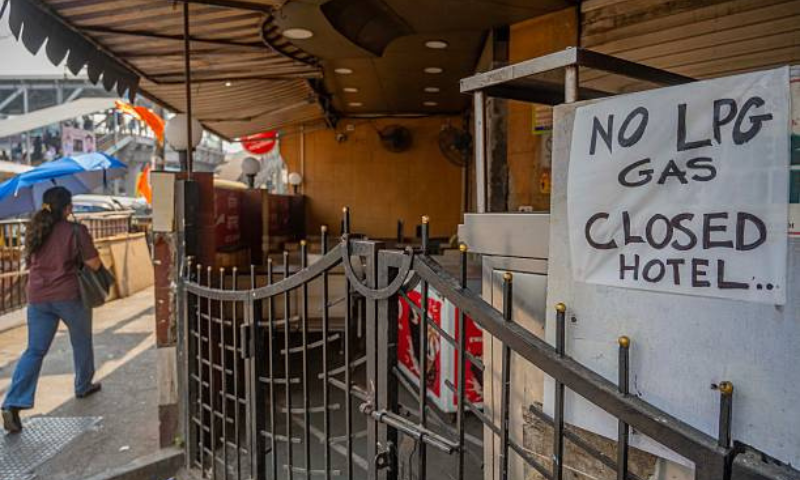
Business owners say shortages of commercial cooking gas are forcing them to reduce menus, shorten operating hours, and turn to alternative energy sources to keep their kitchens running.
The disruption follows the escalation of conflict in the Middle East after the United States and Israel launched attacks on Iran on February 28, triggering instability around the strategic Strait of Hormuz — a vital route for global energy shipments.
India imports roughly 60 percent of its LPG, and around 90 percent of those imports originate from the Middle East, making the country particularly vulnerable to supply disruptions caused by regional conflict.
Although the Indian government has repeatedly said there is no nationwide shortage of LPG, restaurant owners say commercial gas supplies have become increasingly difficult to obtain.
#WATCH | Mumbai, Maharashtra: On reports of commercial LPG cylinder shortage, Indian Hotel & Restaurant Association (AHAR) President Vijay K. Shetty says, “In the Essential Services Act, I think the government should also bring us into the essential commodities. Otherwise, the… pic.twitter.com/wgceFIOUcf
— ANI (@ANI) March 11, 2026
Prime Minister Narendra Modi said on March 12 that some actors were “trying to create panic” about shortages.
However, the government has invoked emergency measures to prioritize LPG supply to households while limiting industrial consumption — a move that has left restaurants scrambling for fuel.
Restaurants Forced to Cut Menus
Restaurant operators say the shortage has already begun reshaping how kitchens operate.
Syed Jameel, who owns several restaurants in Bengaluru, said supply disruptions and soaring prices have forced him to drastically scale back menu options.
“We are finding it really difficult. The supply is really low. We aren’t able to get gas. All the commercial supplies have been stopped.
#WATCH | Delhi | On commercial LPG supply shortage, Zorawar Kalra, Restaurateur & Vice-President of National Restaurants Association of India, says, “If the problem continues, there could be a potential loss of Rs 1200-1300 crores per day to the restaurant industry…We can see… pic.twitter.com/9KEZ7Lmd0k
— ANI (@ANI) March 10, 2026
In India, one gas cylinder is about 21 kilograms. We use about 15 to 20 cylinders a day. And for the available gas, the prices are nearly four times the actual price.
So slowly we have reduced the menu. We just cut down the menu. Our menu has been reduced by almost 50 percent.”
Similar challenges are being reported by restaurant owners in other parts of the country.
Chef Liju Ninan, who runs the Spicy Dine Inn restaurant in the western state of Gujarat, said his business is struggling to stay open as deliveries of cooking gas have stopped.
“We’re just surviving. We don’t have any supplies.
Normally, the supply comes every week. When I called our supplier, the phone was switched off. I thought he might have gone to a wedding or some hospital issue. The next day, his son told me that his father had kept his phone switched off because he was receiving 100 calls daily.
We have reduced the menu. We only have two to three items: one vegetarian, one non-vegetarian. Usually, we have seafood, we have mutton, we have chicken. Now, only the basic chicken item will be cooked. We cook chicken in a pressure cooker so that the consumption of gas is reduced.”
In response to the disruptions, restaurants across the country have turned to social media to alert customers about limited menus and reduced service.
One vegetarian restaurant in Kochi said it had temporarily reduced items on its menu due to a nationwide shortage in the availability of cooking gas.
Restaurant associations have also warned that the situation could worsen quickly if LPG supplies are not restored.
The National Restaurant Association of India wrote to the minister for petroleum and natural gas on March 11, calling for an uninterrupted supply of commercial LPG to restaurants, noting that the food service industry depends heavily on LPG.
Restaurants Turning to Alternative Fuels
To keep their kitchens running, restaurant owners are experimenting with alternative cooking methods.
Some establishments have turned to charcoal grills, wood fires or electric fryers in an attempt to continue serving customers.
But these alternatives offer only limited relief.
“There are alternatives. We have electric fryers. Two days ago, I purchased a lot of electric oil fryers. Charcoal is also used. BBQ is also used.
So whatever can be prepared in a fryer, we can serve. But much of the food that is served here is gravy. So it needs a constant flame. You cannot depend on charcoal or firewood for that,” Jameel said.
Ninan said he might soon have to switch to wood fire or charcoal cooking if the crisis continues, but warned that such methods are not practical.
“It generates smoke and is not practically possible,” he said.
Many restaurants have also begun reducing operating hours to conserve fuel.
“Now, we are closed in the morning and in the afternoon. We are only open in the evenings,” Ninan said.
He added that he had already cancelled a catering event because of the lack of LPG.
Industry Groups Warn of Restaurant Closures
Restaurant owners warn that the crisis could soon lead to closures if the supply situation does not improve.
“If the crisis continues for another five days, I will have to shut down,” Ninan said.
Jameel said the impact was already being felt across the sector.
“Already, almost about 30 to 40 percent of business is low now. Customers are there, but what they want isn’t.
I don’t know why we should suffer for somebody else fighting. The sufferers are not only us. It’s also the labourers who are working, the cooks who are there. It is also going to affect them.”
“And it’s not only money,” Ninan added. “Everybody doesn’t run the shop for money, but it’s also about passion. I’m a chef. I cook with my heart for my customers.”