


Key Points
- Interim Indo-US trade arrangement may undermine India’s agricultural and textile sectors
- Restrictions on Russian oil imports could affect energy security and diplomatic ties
- Deal could turn India’s $60 billion trade surplus with the US into a deficit
- Lack of new market access and high reciprocal tariffs raise concerns of one-sided concessions
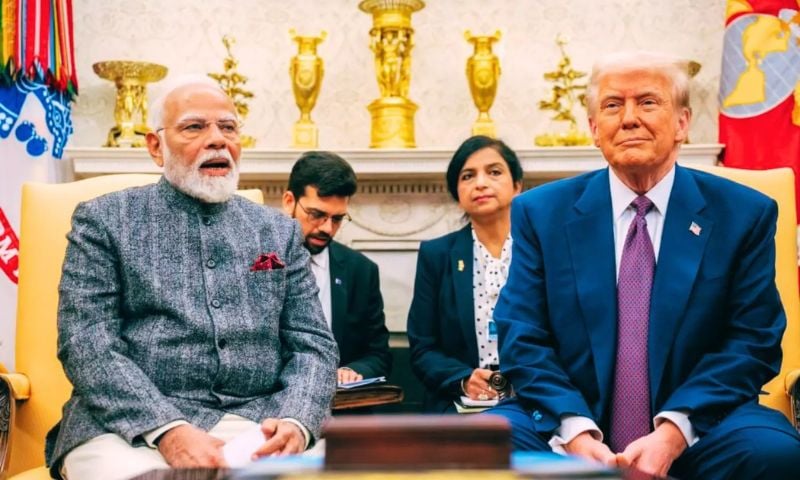
ISLAMABAD: India’s interim trade agreement with the United States has raised alarm among experts, who warn that it could have “disastrous” and long-lasting consequences for the country’s economy and strategic independence.
Subhash Chandra Garg, former Finance Secretary of India, described the deal as “a complete humiliation” and said it would “hurt and haunt India for decades to come.” Subhash Chandra is a prominent former Finance Secretary of India (2018–2019) and 1983-batch Indian Administrative Service (IAS) officer who served the government for over 36 years, in key bureaucratic positions.
Speaking on the Indo-US arrangement in an interview, he highlighted several key challenges:
First, the deal effectively forces India to stop importing oil from Russia, subjecting the country to a US monitoring regime that requires detailed reporting on its energy purchases. Chandra warned that this “serious violation of our sovereign autonomy” could undermine India’s energy security and strain long-standing defence partnerships with Russia.
Second, India is required to lower tariffs and non-tariff barriers while granting American products near-zero duties, yet it gains little in terms of new market access.
Agricultural products, initially protected in negotiations, have been largely conceded without reciprocal benefits. The textile sector, a key employment generator, could also lose competitiveness, as neighbouring Bangladesh secures almost zero tariffs for its exports to the US, undercutting India’s advantage.
Chandra further cautioned that India has committed to buying $500 billion worth of American goods over the next five years, spanning energy, defence, and industrial equipment.
He predicted that this could convert India’s existing $60 billion trade surplus with the US into a substantial deficit, as domestic exporters would struggle to expand market share under high reciprocal tariffs.
The former finance secretary also criticised the lack of clarity in the government’s position, citing contradictory statements from the commerce and foreign ministries on Russian oil imports.
“This is a mockery of collective responsibility,” he said, warning that the deal exemplifies an unprecedented one-sided commitment in modern trade agreements.
Observers suggest that while the US gains leverage over India’s trade and strategic policies, India may face long-term economic and geopolitical vulnerabilities, particularly in energy and defence procurements. They could also risk labour-intensive industries such as textiles.