


CANAGUINIM, India: Barely an hour into India’s high-profile energy summit in Goa, discussions turned to the evolving global order — one no longer centered on America.
“What is happening in the world today is not a gradual economic transition, it is a rupture,” said Canada’s energy minister, Tim Hodgson, echoing Prime Minister Mark Carney, who electrified the Davos crowd last week by highlighting the end of the postwar international system, according to Washington Post.
Sitting center stage with his Indian counterpart, Hodgson highlighted the challenges posed by the current U.S. administration, noting a world “where hegemons use tariffs as leverage.” His proposed solution: “the way to resist … is to build multilateral relationships.”
President Donald Trump’s second term has strained many U.S. alliances. Relations with Canada have been tested over tariffs and territorial tensions, while ties with the European Union fell after Trump’s Greenland demands. The U.S.-India partnership, once a bright spot, has suffered due to trade disagreements and diplomatic missteps.
From the Swiss Alps to India’s coastal cities, global leaders are increasingly engaging in open dialogue about a world less dependent on Washington. Reflecting this shift, New Delhi signed a broad trade deal with the European Union while talks with the U.S. remain stalled.
Notably, no American officials were present at the Goa summit’s opening, with Canada and the UAE taking top billing. Throughout the nearly weeklong event, oil officials and experts emphasized that energy agreements will play a central role in the international realignment, with India, the world’s third-largest energy consumer, positioned as a key player.
“There is turbulence,” said Hardeep Singh Puri, India’s minister of petroleum and natural gas, “and we have to adapt.”
‘An “Age of Walls” and New Partnerships’
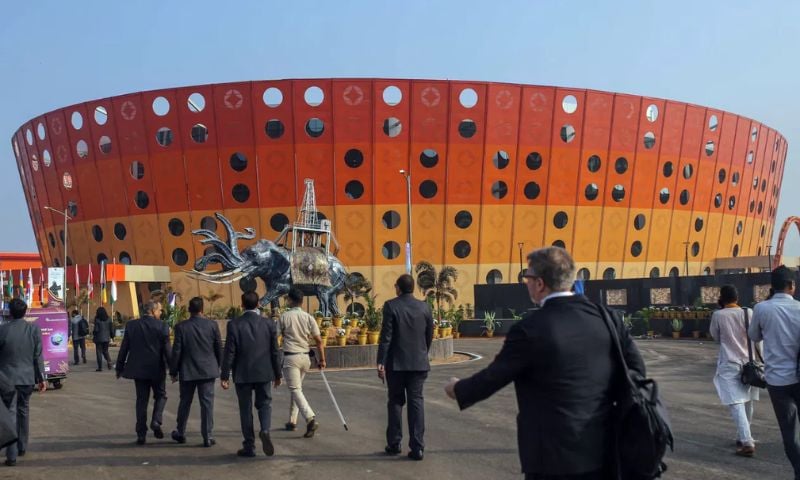
India Energy Week, held on a redeveloped industrial site near Goa’s beaches, drew around 75,000 attendees, including oil ministers, diplomats, and energy executives.
Recurring themes of “turbulence” and “disruption” dominated breakout sessions. Representatives from Norway, Denmark, Paraguay, and Finland discussed ways to help meet India’s growing energy needs.
Norwegian Ambassador May-Elin Stener noted strong interest from energy companies aiming to participate in India’s plans. Indian officials expressed receptiveness: “We need more partners,” said Dammu Ravi, a former senior official at India’s Ministry of External Affairs. India’s power grid produces 500 gigawatts, a fraction of China’s 3.2 terawatts.
India relies heavily on coal for roughly 40 percent of its energy and crude oil for about 25 percent. Sourcing crude has become increasingly challenging. For four years, India’s top supplier was Russia, offering discounted crude under Western price caps imposed to sanction Moscow following its invasion of Ukraine.
While previous U.S. administrations encouraged India to take advantage of lower Russian oil prices, Trump reversed that approach, imposing a 25 percent levy on Indian goods in response to crude imports, pushing some tariffs to 50 percent.
India has since cut Russian oil imports from 1.2 million barrels per day in December to below 600,000 barrels per day as of mid-January. At the same time, India’s oil demand is rising, from 5 million barrels per day in 2021 to 5.6 million barrels per day today, with forecasts suggesting it could soon exceed 6 million barrels daily.
Countries from the Middle East to Europe lined up in Goa to engage with India’s energy market. Canada emphasized its position as a leading energy producer, especially in critical minerals for green energy, offering “reliability” amid concerns about U.S. trade policy.
“We’re not going to live in a world where might makes right,” Hodgson said. “We’re going to live in a world where we believe in free trade, where we believe in trusted relationships.”
Michael Kugelman, senior fellow for South Asia at the Atlantic Council, described these developments as a reflection of growing global discontent with the U.S., intensified under Trump’s leadership. Countries are seeking multipolar arrangements that dilute American influence, including in energy.
UAE Minister Sultan Al Jaber addressed India’s rising energy appetite, noting the country has become the UAE’s top natural gas customer and highlighting opportunities to supply more crude.
“In an age of walls, our message is simple,” Al Jaber said. “Build doors, and the world will walk through them.”