


KEY POINTS
- Russia remains India’s largest crude oil supplier despite reduced volumes.
- India cut its Russian oil share from 44 per cent since June.
- Discounted Russian oil surged after the Ukraine war.
- Trump threatened higher tariffs to curb Indian imports.
- Washington imposed 50 per cent tariffs on Indian goods.
- India increased oil imports from Kuwait and Brazil.
NEW DELHI: Despite public claims of diversification and compliance with Western sanctions, India remains heavily dependent on Russian crude oil, exposing what analysts describe as New Delhi’s contradictory foreign policy posture and its selective adherence to international norms.
According to a report by Nikkei Asia — a leading business and economic news publication based in Japan — citing data from analytics firm Kpler, Russian crude still accounted for around 25 per cent of India’s total oil imports in December 2025, even after falling by more than two-fifths over the past six months.
Russia nevertheless remained India’s largest crude oil supplier, underscoring the depth of New Delhi’s energy ties with Moscow.
Sanctions under strain
India’s reliance on discounted Russian oil surged after the Ukraine war, drawing criticism from Western capitals.
While the share of Russian crude in India’s imports declined from a peak of 44 per cent in June 2025 to about 25 per cent in December, the volumes remain substantial despite renewed pressure from US President Donald Trump, who has threatened higher tariffs to curb India’s Russian energy purchases.
The Trump administration imposed a 50 per cent tariff on Indian goods in August, part of a broader effort to pressure countries seen as undermining Western sanctions regimes.
However, data shows that India has largely continued to benefit from Russian supplies while making selective adjustments to avoid punitive measures.
Diversification narrative
To project an image of diversification, India significantly increased imports from other suppliers.
Kuwait’s exports to India jumped 140 per cent between June and December to 290,000 barrels per day, while Brazil — another BRICS member facing US tariffs — exported 246,000 barrels per day to India in December after shipping none during the summer months.
India also temporarily ramped up purchases of US crude oil, which more than doubled between September and October, shortly after the tariff hike took effect.
Observers say this appeared aimed more at placating Washington than at fundamentally altering India’s energy strategy.
In November, Indian conglomerate Reliance Industries announced it had stopped importing Russian crude at its Jamnagar refinery, the country’s largest, citing sanctions concerns.
However, the company was later forced to deny reports that Russian oil tankers were again headed to the facility, stating it expected no Russian shipments in January.
Economic reality
Energy analysts note that Russia continues to offer India deep discounts, refinery-compatible grades, and long-standing supply relationships, making a complete break unlikely.
“Despite diversification, Russian crude remains economically attractive for India,” said Sumit Ritolia, lead analyst at Kpler.
Strategic double game
The episode highlights what critics describe as India’s strategic duplicity — seeking to appease Washington while quietly maintaining robust ties with Moscow.
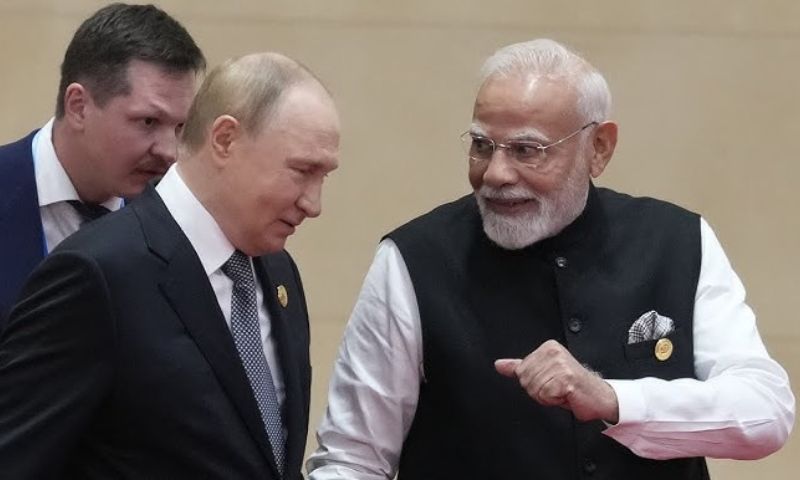
While Indian Prime Minister Narendra Modi has issued symbolic calls for peace in Ukraine and made a high-profile visit to Kyiv, he simultaneously hosted Russian President Vladimir Putin for a state visit in December.
India’s continued engagement with Russia — despite sanctions and global tensions — underscores New Delhi’s willingness to prioritise narrow economic and geopolitical interests while lecturing others on international norms and regional stability.
Analysts say the situation also reflects India’s broader balancing act between the US-led Western bloc and alternative power centres such as BRICS, even as it faces increasing scrutiny over its foreign policy contradictions.