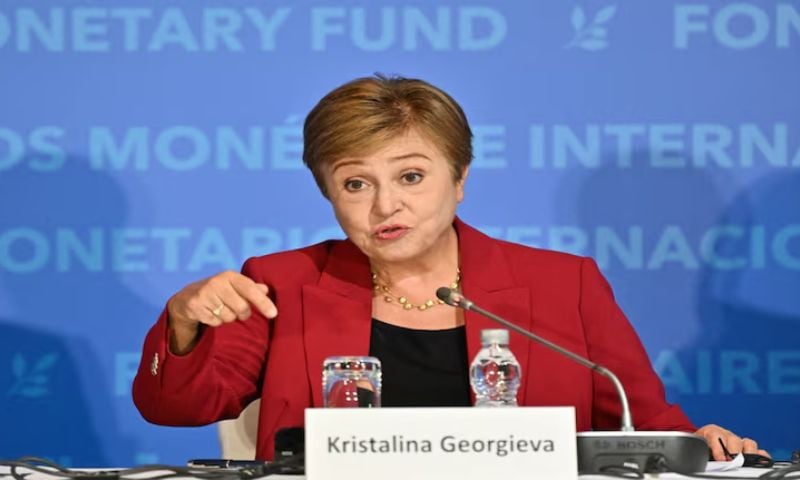



TOKYO: The head of the International Monetary Fund (IMF) on Monday warned that the widening conflict in the Middle East could drive global inflation higher if rising oil prices persist, underscoring growing concern about the economic fallout from the widening regional crisis.
IMF Managing Director Kristalina Georgieva said that sustained increases in oil prices could quickly translate into higher global inflation.
“A 10 percent increase in oil prices, if persistent through most of the year, would result in a 40-basis-point increase in global inflation,” Georgieva said while speaking at a symposium hosted by Japan’s finance ministry in Tokyo.
“We are seeing resilience tested again by the new conflict in the Middle East,” she added, urging policymakers to prepare for potential shocks.
“My advice to policymakers in this new global environment is to think of the unthinkable and prepare for it.”
Oil prices surge
Georgieva’s warning comes as oil markets experience one of the sharpest price rallies in recent years following the outbreak of war between the United States, Israel and Iran.
Benchmark crude prices have surged as the conflict disrupted energy supplies and threatened shipping routes across the Middle East.
Brent crude, the global benchmark, briefly climbed to around $119.50 a barrel before easing slightly.
Just days earlier, on February 27 — the day before US-Israeli strikes on Iran began — Brent crude was trading at about $72.48 per barrel.
The jump represents an increase of more than 65 percent since the start of the conflict.
US benchmark West Texas Intermediate (WTI) also spiked to multi-year highs, reflecting widespread concern about supply disruptions.
Analysts attribute the surge largely to the disruption of crude production and exports from key Middle Eastern producers and the closure of the Strait of Hormuz, a narrow maritime corridor that normally carries about one-fifth of the world’s oil supply.
Military activity, halted tanker traffic and precautionary production cuts in countries such as Qatar, Iraq, Kuwait and the United Arab Emirates have tightened the flow of oil into global markets.
In some cases, storage facilities in the Gulf have approached capacity as tankers have been unable to load cargo, prompting producers to curtail output.
Economists warn that if disruptions continue, reduced supply could keep prices elevated for weeks or months.
Global policymakers weigh emergency measures
Rising energy prices have already triggered discussions among major economies about potential emergency interventions to stabilise markets.
According to AFP, French Finance Minister Roland Lescure said the Group of Seven (G7) countries had discussed the possibility of releasing strategic oil reserves.
“We’re not there yet,” Lescure said when asked whether ministers had agreed on a coordinated release.
“What we’ve agreed upon is to use any necessary tools, if need be, to stabilise the market, including the potential release of necessary stockpiles.”
Meanwhile, Japan’s Finance Minister Satsuki Katayama said the International Energy Agency had urged a coordinated release of emergency oil reserves during a G7 online meeting.
“IEA called for each country to do coordinated release of oil reserves,” Katayama said during a briefing, according to Al Jazeera.
Inflation risks for global economy
European officials have also warned about the potential economic consequences if the conflict drags on.
Valdis Dombrovskis, the European Union’s economy commissioner, said a prolonged war could trigger a major inflationary shock.
“A long war in the Middle East could unleash a substantial inflationary shock on the global and European economy,” he told reporters, according to AFP.
Dombrovskis said a short-lived conflict lasting only a few weeks would likely have limited impact.
However, a prolonged crisis involving attacks on energy infrastructure and maritime routes could significantly push up prices.
Shipping risks and security tensions
Tensions have also risen around maritime routes critical to global trade.
Iranian security chief Ali Larijani said security in the Strait of Hormuz could not be guaranteed while the conflict continues.
“It is unlikely that any security can be achieved in the Strait of Hormuz amid the fires ignited by the United States and Israel in the region,” Larijani wrote on X.
من المستبعد أن يتحقق أيُّ أمنٍ في مضيق هرمز في ظلِّ نيران الحرب التي أشعلتها الولايات المتحدة وإسرائيل في المنطقة، ولا سيّما إذا كان ذلك بتصميم أطرافٍ لم تكن بعيدةً عن دعم هذه الحرب والإسهام في تأجيجها. https://t.co/Fn2tcbLhDT
— Ali Larijani | علی لاریجانی (@alilarijani_ir) March 9, 2026
The warning followed reports that France and its allies were considering a defensive mission to secure the waterway.
French President Emmanuel Macron has said France would send two frigates as part of the European Union’s naval mission Aspides in the Red Sea to protect shipping.
“We are in the process of setting up a purely defensive, purely escort mission,” Macron said after meeting leaders from Cyprus and Greece.
À l’invitation du Président Nikos Christodoulides, je suis à Chypre, aux côtés du Premier ministre grec Kyriákos Mitsotakis.
La sécurité de tous les Européens est notre intérêt commun. Nous avons immédiatement pris des mesures de solidarité avec Chypre,… pic.twitter.com/DVgQ0vgfb4
— Emmanuel Macron (@EmmanuelMacron) March 9, 2026
Military tensions spread across region
The war has also raised security concerns across several neighbouring countries.
NATO confirmed it had intercepted a missile heading towards Turkey for the second time since the conflict began.
“NATO stands firm in its readiness to defend all Allies against any threat,” alliance spokesperson Allison Hart said in a statement.
NATO has again intercepted a missile heading to Türkiye. NATO stands firm in its readiness to defend all Allies against any threat
— NATO Spokesperson (@NATOpress) March 9, 2026
Turkish officials urged restraint from all parties.
Burhanettin Duran said it was vital that tensions did not escalate further or spread across the region.
“We once again strongly reiterate our warning to all parties, particularly Iran, to refrain from actions that could endanger regional security and put civilians at risk,” he said.
A ballistic missile launched from Iran and detected heading towards Türkiye was timely engaged and neutralised by NATO air and missile defence assets over the Şahinbey district of Gaziantep. No casualties or injuries have been reported in the incident.
The development has been…
— Burhanettin Duran (@burhanduran) March 9, 2026
The United States also ordered non-essential staff to leave its consulate in Adana in southern Turkey and urged American citizens in the region to depart due to security risks.
Iran defends its position
Meanwhile, Foreign Ministry spokesperson Esmaeil Baghaei said Tehran had not launched attacks against Turkey, Cyprus or Azerbaijan.
He suggested some reported incidents may have been staged and warned that hostile actors could be attempting to create divisions between Iran and neighbouring countries.
Baghaei also accused the United States of undermining diplomatic efforts before launching military strikes.
“We did not start this war. It is not a war of choice, but a war of necessity that has been imposed on us,” he said.