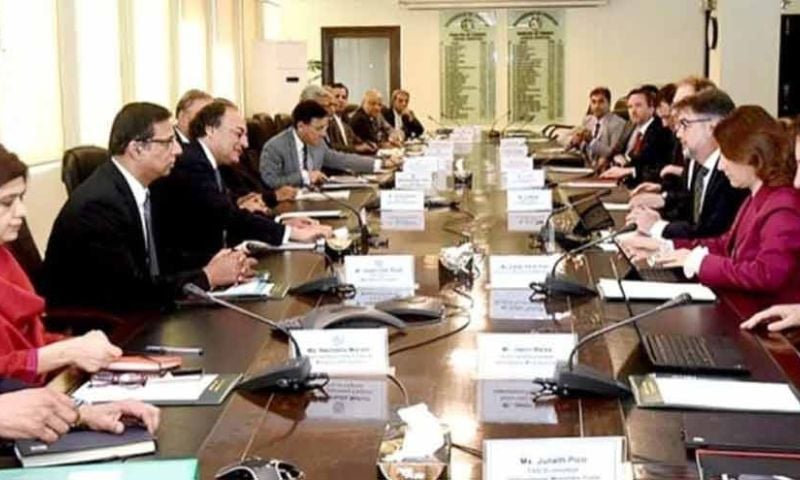



ISLAMABAD: An International Monetary Fund (IMF) mission led by Iva Petrova began technical-level discussions with the State Bank of Pakistan (SBP) in Karachi on Wednesday.
The pre-review session is covering the monetary side of the third review of the $7 billion Extended Fund Facility (EFF) and the second review of the $1.1 billion Resilience and Sustainability Facility (RSF).
The mission will remain in Karachi this week and begin policy discussions with the federal and provincial governments on Monday, with an opening session led by Finance Minister Muhammad Aurangzeb.
Speaking to reporters after a parliamentary committee meeting, Aurangzeb said the government was well-positioned for a successful review of its loan programmes.
He noted that Pakistan was in a strong position regarding tax collection by the Federal Board of Revenue (FBR) and that the matter would feature in upcoming discussions.
He also assured there were no issues regarding the rollover of the United Arab Emirates’s $2 billion deposit with the central bank, which typically rolls over annually.
Authorities maintain regular contact with the Gulf state, and Deputy Prime Minister and Foreign Minister Ishaq Dar also confirmed the deposits would be “automatically rolled over.”
Earlier, the IMF delegation met SBP officials soon after arrival in Karachi, receiving briefings on monetary policy, anti-money laundering measures, and anti-terror financing efforts.
During the almost two-week review, ending March 11, the mission will also evaluate programme performance for the half-year ending December 31, 2025.
Forward-looking preparations, including budget proposals based on current-year performance, will be discussed, along with provincial finances, agriculture income tax, and governance-related challenges.
Procurement and accountability agencies will be scrutinised, including assessments of independence, institutional capacities, processes, and performance.
The power sector, especially issues relating to industrial and residential charges, will also be reviewed, although circular debt figures remain within target ranges.
While Pakistan has met almost all quantitative performance criteria for the period under review, it lags behind on some indicative targets and structural benchmarks, which could affect future programme implementation.
Upon successful completion of the review, Pakistan will be eligible for disbursement of approximately $1 billion under the EFF and a separate $200 million under the RSF by the end of April.
On the technical side, Pakistan is expected to meet nearly all seven quantitative performance indicators, though net international reserves may remain slightly below benchmarks for September and December 2025.
International Monetary Fund spokesperson noted last week that Pakistan’s policy efforts under the EFF had “helped stabilise the economy and rebuild confidence.”