


KEY POINTS
- Pakistan withdraw boycott after midnight call confirmed Bangladesh’s stance.
- Bangladesh escapes sanctions despite relocation demand, preserving Asian bloc unity.
ISLAMABAD: With geopolitical undercurrents threatening to spill onto the cricket field, the International Cricket Council (ICC) has convened informal peace talks involving five key Asian nations on the margins of the high-voltage Pakistan-India T20 World Cup clash scheduled for February 15.
The diplomatic push follows weeks of escalating friction, triggered by Bangladesh’s failed demand to shift matches from India, Pakistan’s subsequent boycott threat, and lingering bitterness over last year’s Asia Cup handshake snub.
Bangladesh’s demand rejected, Scotland steps in
The current impasse traces back to Bangladesh’s request to relocate its World Cup fixtures from India to Sri Lanka.
The move came after ruling party activists objected to pacer Mustafizur Rahman’s participation in the Indian Premier League, leading to his premature release from his franchise.
The ICC denied Bangladesh’s request and instead replaced the side with Scotland, a decision that drew sharp criticism from Pakistan.
Islamabad took a principled stand in solidarity with Dhaka, with the federal government initially directing its team to boycott the high-profile group match against India in Colombo.
Crisis talks in Lahore earlier this week, involving ICC and Bangladesh Cricket Board (BCB) officials, ultimately paved the way for Pakistan’s participation. But the underlying fractures have not fully healed.
BCB Chief reveals backchannel diplomacy
In an interview with Bangladeshi daily Prothom Alo on Thursday, BCB President Aminul Islam disclosed that the ICC is now orchestrating a carefully choreographed show of unity.
“The five major Asian stakeholders play a central role in world cricket,” Islam said.
“During the India–Pakistan World Cup match on the 15th, the ICC wants representatives from these five Asian nations to attend together, watch the match, and engage in dialogue.”
When asked whether the move should be interpreted as an “ice-melting step,” Islam replied: “You may interpret it that way.”
Islam, who recently travelled to Lahore for meetings with PCB Chairman Mohsin Naqvi, revealed that Pakistan had initially refused to take the field against India—a stance that threatened to unravel the tournament.
“I felt strongly that if Pakistan refused to play, it would prove disastrous for the ICC,” he said.
“All 107 member countries are involved in the ICC structure, and revenues are distributed among them. World cricket currently operates largely under the influence of the subcontinent, where viewership is highest and the player base is largest.”
Pakistan’s conditions, Bangladesh’s pivotal role
Islam detailed the delicate negotiations that unfolded behind closed doors. According to the BCB chief, Pakistan’s final decision hinged significantly on Bangladesh’s position.
“The most crucial moment was the final call, which took place the night before last at around 11:30 pm Pakistan time,” he revealed.
“Everyone wanted to know Bangladesh’s position. If Bangladesh agreed, Pakistan might consider playing against India.”
Islam urged Pakistan to reflect on its own history as a victim of cricketing isolation.
“When our proposal reached them, they reflected on their own experience as an affected party and, as a cricketing nation, concluded that they should support us.”
The ICC ultimately confirmed that no penalties or sanctions would be imposed on Bangladesh for its non-participation.
A joint statement with the PCB and BCB reaffirmed Bangladesh’s status as a valued full member with a vital role in global cricket development.
Asia Cup handshake snub still stings
The current tensions are rooted in a controversy that erupted five months ago.
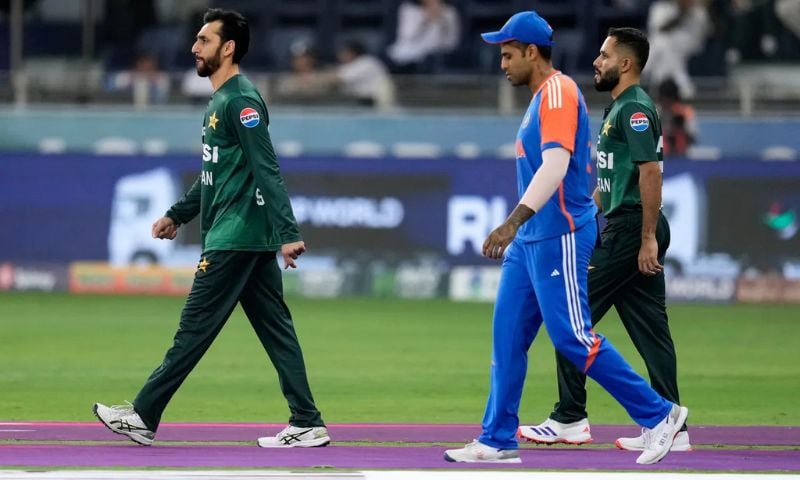
Following India’s seven-wicket victory over Pakistan in last September’s Asia Cup, their first meeting since a military conflict in May, Indian players left the field without the customary post-match handshake.
The snub triggered fury all over the world. Captain Salman Ali Agha boycotted his media duties, and the PCB lodged a formal protest with the ICC and Marylebone Cricket Club.
The board even demanded the removal of match referee Andy Pycroft, warning it would reconsider its continued participation in the tournament.
Indian skipper Suryakumar Yadav compounded the friction with political remarks following the win, further inflaming bilateral tensions.
What lies ahead
With the February 15 clash now carrying emotional and diplomatic weight far beyond two points on the table, all eyes will turn to the VIP box in Colombo.
Whether five Asian cricket boards sitting together can begin to repair what handshake snubs and political posturing have fractured remains an open question.
Aminul Islam struck a cautiously optimistic note: “In the interest of cricket, all parties must maintain constructive relationships.”
Bangladesh, he noted, is set to host the ICC Under-19 Women’s World Cup next year, a reminder that the business of cricket must continue, even as old rivalries refuse to fade.