


Key points
- 8.8 magnitude quake hits near city of Petropavlovsk-Kamchatsky
- Tsunami of 3-4 metres recorded in Kamchatka peninsula
- Warnings for Japan, Hawaii, US West Coast and other Pacific nations
ISLAMABAD: A magnitude 8.8 earthquake struck off Russia’s Far Eastern Kamchatka Peninsula on Wednesday, damaging buildings and generating a tsunami of up to 4 metres (13 feet) that prompted warnings and evacuations stretching across the Pacific Ocean.
Several people were injured in the remote Russian region, while much of Japan’s eastern seaboard – devastated by a powerful earthquake and tsunami in 2011 – was ordered to evacuate, according to Reuters.
Russia’s emergencies ministry said a tsunami hit and flooded the port town of Severo-Kurilsk, where the population of around 2,000 people was evacuated.
A video posted on Russian social media appeared to show buildings in the town submerged in seawater.
Several people were injured in Russia by the quake, state media reported, but none of them seriously.
Strongest since 1952
The earthquake off Russia’s far east coast was the region’s strongest since 1952, with aftershocks of up to 7.5 magnitude possible, the regional seismic monitoring service said.
“The strongest earthquake since 1952 has just occurred in the Kamchatka seismic zone … Given the scale of the event, strong aftershocks with a magnitude of up to 7.5 should be expected,” Kamchatka’s geophysical service said on Telegram.
Evacuations
Live footage on Japanese television showed people evacuating by car or on foot to higher ground, including the northern island of Hokkaido, where the first wave, measuring 30 centimetres (one foot) was observed.
Wednesday’s quake was the strongest since 1952 in Russia’s Kamchatka region, the Geophysical Service of the Russian Academy of Sciences reported.
The epicentre of the earthquake is roughly the same as the massive 9.0 temblor that year which resulted in a destructive, Pacific-wide tsunami, according to the USGS.
At least six aftershocks have further rattled the region, including one of 6.9 magnitude and another listed at 6.3.
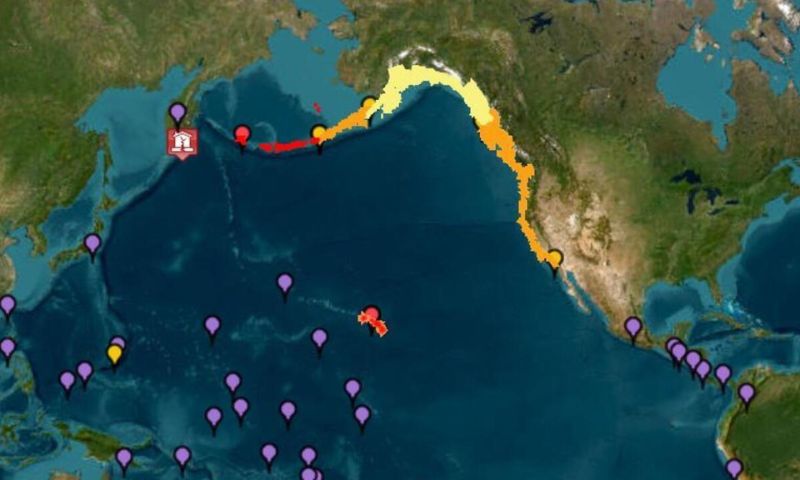
Tsunami warnings were issued across the Pacific, including Hawaii, Japan, and the U.S. West Coast
Scary, Videos showing the shaking from the M8.7 earthquake that hit off the coast of Kamchatka, Russia #earthquake #tsunami #Russia #Japan #Hawaii #Alaska pic.twitter.com/dAZY8dpsIF
— Sumit (@SumitHansd) July 30, 2025
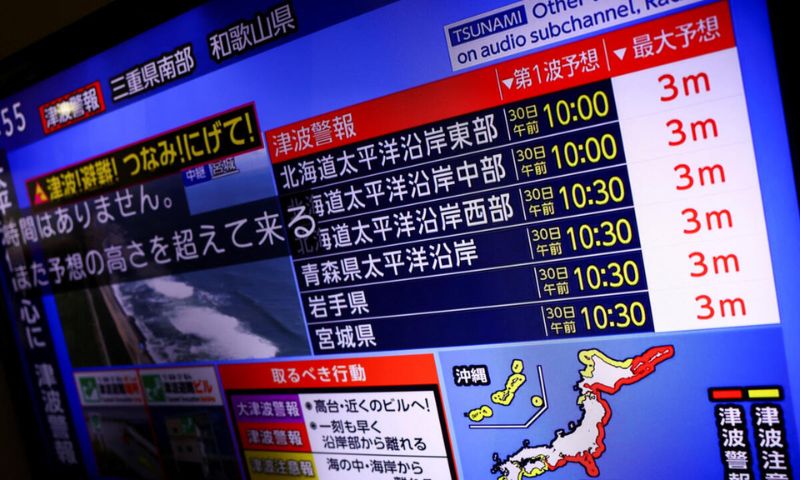
Japanese broadcaster NHK switched to special coverage, with presenters telling people on the coast to “please evacuate immediately”.
Its screen showed the messages “Tsunami! Evacuate!”
Workers at the stricken Fukushima nuclear plant in northeast Japan — destroyed by a huge quake and tsunami in 2011 — were evacuated, its operator said.
Potentially dangerous
Japan’s weather agency initially warned that the waves would be up to one metre high, but this was later upgraded to a much more potentially dangerous three metres.
This covered all the way down the northern and eastern coasts of Japan as far as Wakayama, south of Osaka, as well as outlying smaller islands.
Beyond that, as well as in the Tokyo Bay and Osaka Bay, the waves were forecast to be one metre high and to hit between 10:00 am and 11:30 am (0100-0230 GMT).
The US Geological Survey (USGS) initially said the tremor measured 8.0 but then upgraded the reading to 8.8.
READ ALSO: Key Facts About Tsunamis and The Damage They Cause
The US Tsunami Warning Centres said the waves exceeding three metres above the tide level were possible along some coasts of Ecuador, north-western Hawaiian islands and Russia.
Between one- and three-metre waves were possible along some coasts of Chile, Costa Rica, French Polynesia, Guam, Hawaii, Japan and other islands and island groups in the Pacific, it said.
Waves of up to one metre were possible elsewhere, including Australia, Colombia, Mexico, New Zealand, Tonga and Taiwan.
It described the potential conditions as “hazardous.”
North America’s West Coast
The United States further sounded the alarm with a series of alerts of varying levels along North America’s West Coast, from Alaska down to the entire coast of California.
Tsunami alerts were pushed to mobile phones in California, according to local AFP reporters.
The Japan Meteorological Agency warned on X that “tsunamis will strike repeatedly. Do not enter the sea or approach the coast until the warning is lifted.”
“Residents in regions where warnings have been issued should immediately evacuate to safe locations such as elevated areas or evacuation buildings,” top government spokesman Yoshimasa Hayashi said in a short-notice brief news conference.
Some train lines in Japan were suspended due to the alert, including lines serving the coast around Chiba, Yokohama, Fujisawa and down the Izu coast.
The Philippines urged residents living along the eastern seaboard to move further inland, predicting tsunami waves of as high as one metre to arrive between 1:20 pm and 2:40 pm (0520-0640 GMT).
“People are also advised to stay away from the beach and not to go to the coast … until the cancellation of the advisory,” the seismology centre said in a warning.
The warning also advised fishermen already out to sea to stay offshore in deep waters until the threat passed.
Peru issues tsunami warning
Peru issued a tsunami warning on Tuesday after an 8.8-magnitude earthquake struck off Russia’s far east coast, according to the navy.
“After an analysis and evaluation by the National Tsunami Warning Center, it has been determined that this event generates a tsunami warning for the Peruvian coast,” the Directorate of Hydrography and Navigation of the Peruvian Navy said in a statement, adding that the situation “will be kept under constant surveillance.