



KEY POINTS
- The ban on Pakistani players in IPL is labelled a “big divide” harming world cricket.
- Both urge cricketers to use their influence to unite “cricket family” beyond politics.
ISLAMABAD: Former West Indies captain Jason Holder has labelled the India-Pakistan cricket rift as “sad” and detrimental to the sport’s spirit, joining analyst Grace Hayden in calling for players to use their influence to bridge the political divide.
The comments come in the wake of a series of controversies that have seen on-field rivalry overshadowed by off-field snubs and boycotts, raising serious questions about the politicisation of the game.
From trophy snubs to tournament boycotts
Holder specifically pointed to the recent Asia Cup final, where the Indian team, after defeating Pakistan, did not mount the stage to receive the trophy from Pakistan Cricket Board (PCB) Chairman and Asian Cricket Council (ACC) President, Mohsin Naqvi.
“I saw India win the Asia Cup and they didn’t go on stage to accept the trophy. I think it’s too much; these things should not be in our game,” Holder stated.
He emphasised that cricketers are “ambassadors for the world” and such actions contradict messages of unity and peace.
This incident was not isolated. The sportsmanship saga extended through the tournament, with similar reported snubs during group-stage clashes and the Women’s World Cup.
The tensions reached a new peak when India refused to play Pakistan in the recent World Championship of Legends (WCL), boycotting scheduled group and semi-final matches.
‘Scary’ atmosphere and ‘big divide’
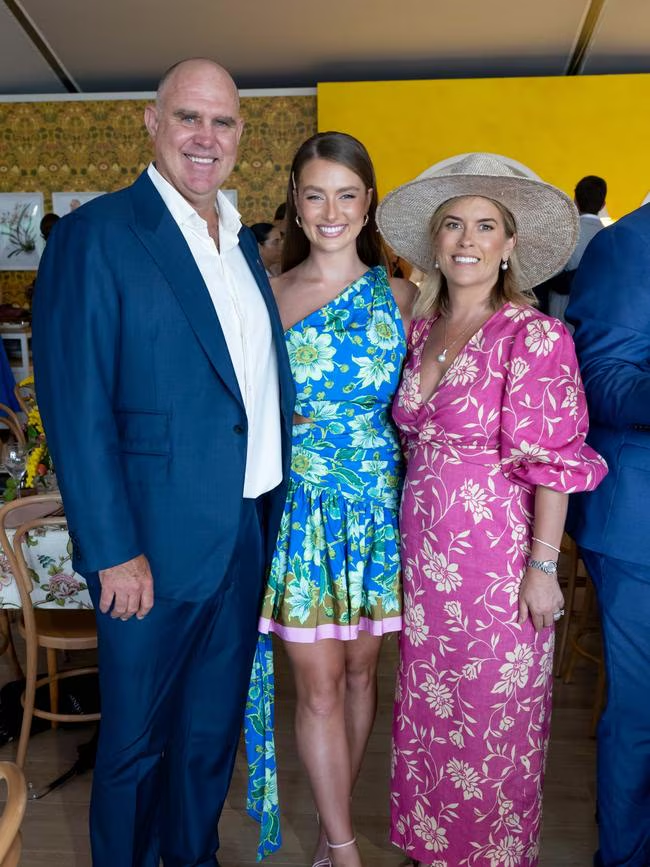
Grace Hayden, daughter of Australian legend Matthew Hayden, reflected on the palpable tension during past IPL and PSL seasons.
“I was in India at the time and it was tough; you did not know what was going to happen, it was scary,” she said, highlighting the fear and uncertainty experienced by players and fans alike.
Holder criticised the broader structural issues, lamenting the last-minute shifting of World Cup matches due to political directives.
“It’s so hard to be in a World Cup, and you have to shift games because India can’t come to Pakistan and vice versa, I think it’s so wrong,” he stated.
He saved his strongest criticism for the de facto ban on Pakistani players in the Indian Premier League (IPL), describing it as artificial politics creating “a big divide in world cricket.”
“This whole facade they have to put up where Pakistan players can’t be involved in franchises that are owned by Indians, it creates a big divide. We want the best competition; we want the best players to play together without restrictions,” Holder asserted.
Plea for the ‘cricket family’ to unite
Both figures issued a heartfelt plea for reconciliation. Holder, drawing from his own experiences in the region, urged: “We have to find a way to come together; it can change if we as cricketers come together because we have the influence.”
Hayden concluded: “We are one big cricket family at the end of the day. It would be nice if we all could come together and be on the same page.”
Their interventions spotlight a growing concern within the global cricket community: that the historic India-Pakistan rivalry, once the sport’s most electrifying contest, is being increasingly weaponised by politics, damaging the game’s integrity and its potential to unite.