


KEY POINTS
- RSS celebrated centenary, reshaping India’s politics and society under Modi.
- Shakhas train young men in ideology, discipline, and community loyalty.
- RSS infiltrates government, media, courts, police, and educational institutions.
- Bharatiya Janata Party dominates elections, implementing RSS’s political agenda.
- Vigilante affiliates attack Muslim businesses, churches, and interfaith couples.
- Historical grievances exploited to justify Hindu supremacy and societal control.
- Ayodhya mosque demolition exemplifies RSS strategy of communal mobilisation.
ISLAMABAD: India’s Prime Minister Narendra Modi’s annual Independence Day address in August this year saw him publicly honouring the organisation that shaped his personal and political life: the Rashtriya Swayamsevak Sangh (RSS), the far-right Hindu nationalist group that has influenced him since childhood and is now reshaping India’s social and political landscape.
Celebrating its centenary in 2025, the RSS has transformed from a secretive ideological society into a powerful kingmaker, influencing government, media, education, and civil society across India, while systematically promoting a Hindu-first agenda and marginalising religious minorities, according to an article published in The New York Times.
The RSS began as a cabal promoting Hindu pride after centuries of Muslim invasions and colonial rule. Its early leaders openly drew inspiration from European fascist movements in the 1930s and 1940s. Despite repeated bans — including for alleged involvement in Mahatma Gandhi’s assassination — the organisation has grown into the world’s largest right-wing nationalist network.
Today, under the political patronage of Modi, the RSS is pushing India towards a Hindu-first identity, systematically infiltrating government, media, courts, police, and educational institutions. Its affiliates hold sway across civil society, trade unions, student bodies, religious groups, and charitable networks, making and breaking political careers.
Deep societal influence
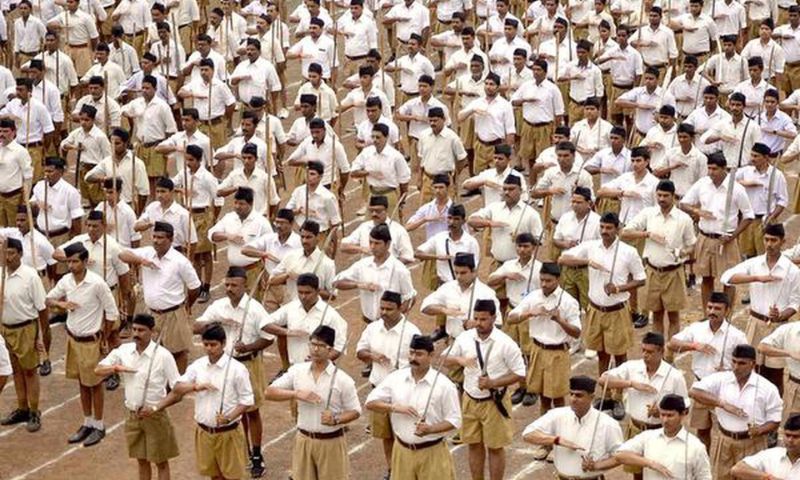
The RSS operates as a vast social services organisation, but its influence extends far beyond volunteer work. Neighbourhood cells, or shakhas, train young men through military-style exercises, spiritual reflection, and ideological instruction. These grassroots units form the backbone of the RSS, recruiting potential leaders who then spread its agenda across affiliated organisations.
According to The New York Times, India now hosts 83,000 shakhas, each linked via WhatsApp groups to a nationwide network that moulds men into proponents of Hindu supremacy. The RSS encourages loyalty through community relevance, positioning young men as enforcers of the Hindu-nationalist vision.
“Service, dedication, organisation, and unmatched discipline — these have been its hallmarks,” Modi said in his Independence Day address at the Red Fort, as reported by The New York Times.
Political dominance and division
The RSS’s political wing — the Bharatiya Janata Party (BJP) — is the world’s largest political party, claiming over 100 million members. Its rise has coincided with escalating tensions along India’s religious fault lines, where Muslims and Christians are increasingly treated as outsiders.
Vigilante actions by RSS affiliates have intensified in recent years. Across India, Muslims face economic boycotts, homes are demolished, and businesses attacked. Churches have been ransacked over alleged forced conversions, Christmas celebrations disrupted, and Muslim graves desecrated. Lynching over cow-related allegations remains common, a practice justified by the sacred status of cows in Hinduism.
The New York Times reports that India’s secular institutions — from courts to classrooms — are being reshaped under this influence, often normalising discrimination and violence against minorities.
Shakhas: Training grounds
The RSS’s shakhas serve as both recruitment and enforcement grounds. Early mornings in Mumbai, volunteers — ranging from property dealers to retired officers — gather in parks to salute saffron flags, sing devotional songs, and undergo rigorous drills. These sessions instil discipline and an unwavering ideological commitment, forming the backbone of the organisation’s national network.
“For the past 100 years, our volunteers have consistently sustained this system in all kinds of circumstances,” said Mohan Bhagwat, the current RSS chief, according to The New York Times.
These cells groom future leaders who then feed into the RSS’s vast network of affiliated organisations, ensuring control over politics, media narratives, and public opinion.
Historical grievances exploited
The RSS has long leveraged historical grievances over centuries of Muslim rule and colonialism to justify its Hindu-first agenda. In 1939, the organisation’s second chief, MS Golwalkar, cited Hitler’s example to argue that non-Hindus could only remain in India if fully subordinated to Hindu authority.
Despite India’s secular vision, the Hindu right remained antagonistic to pluralism. After the partition of India in 1947, the RSS viewed Gandhi’s emphasis on coexistence as betrayal, with his assassination by a right-wing activist linked to the group underscoring the lengths its members were willing to go.
The New York Times notes that the RSS has since positioned itself as a defender of Hindu identity while marginalising minorities, turning historical grievances into a political and social tool.
Rise to political power
The RSS gradually moved into electoral politics, forming the BJP as its political arm in the 1950s. Sympathy surged for the organisation after Indira Gandhi’s emergency rule in the 1970s, when many leaders were jailed, casting the RSS as a champion of democracy.
The 1990s saw its second major rise with the Ayodhya mosque controversy. Claiming a mosque was built over an ancient Hindu temple, RSS affiliates incited deadly communal tensions. In 1992, mobs tore down the mosque, and the group was temporarily banned again. Yet, its strategy — mobilising Hindu grievances and targeting minorities — remains central to its enduring influence.
The New York Times emphasises that these moves have normalised religious intolerance and empowered militant Hindu groups.
Modi’s era expansion
Since 2014, under Prime Minister Modi, the RSS’s agenda has been systematically implemented. The construction of the Ram temple in Ayodhya and the revocation of Jammu and Kashmir’s autonomy illustrate the consolidation of Hindu nationalist policies.
The group’s community reach has also expanded, with luxurious campuses in New Delhi, enabling its leaders to enjoy political and social influence unmatched in the past.
“The society listens to us,” said Mohan Bhagwat, reflecting the unchallenged sway the RSS wields, according to The New York Times.
Vigilante enforcement
In India’s most populous state, Uttar Pradesh, Chief Minister Yogi Adityanath — aligned with the RSS — has frequently sanctioned violence against Muslims while publicly defending India’s secular label. Protests over Islamic expressions are met with police crackdowns, arrests, and home demolitions, earning Adityanath the moniker “Bulldozer Baba.” Meanwhile, Hindu supporters openly celebrate their religious demonstrations without obstruction.
The New York Times notes that this duality — publicly endorsing secularism while enabling religiously targeted enforcement — is emblematic of the RSS’s broader strategy.
Hindu rashtra vision
The RSS’s ultimate goal remains the creation of a Hindu rashtra, a nation where Hindu identity supersedes secular principles. Leaders like Bhagwat frame this as cultural consolidation, but in practice, it often translates into systemic marginalisation of Muslims and Christians.
According to The New York Times, the group’s rhetoric promotes vigilance among followers, encouraging intervention if minorities are perceived to challenge Hindu dominance.
Despite presenting a moderate public image, the organisation’s affiliates frequently normalise religious violence, enforce social segregation, and manipulate educational and judicial institutions to embed its ideology.
Long-term implications
As the RSS enters its second century, its expansive network, political clout, and societal influence suggest it will remain a dominant force in India’s public life. The group’s combination of grassroots indoctrination, political authority, and vigilante enforcement is reshaping India along religious lines, raising alarms for minorities and threatening the country’s secular foundations.
The New York Times reporting reveals that India, once celebrated for pluralism, is now witnessing a profound shift towards a majoritarian Hindu identity, with the RSS at its core.