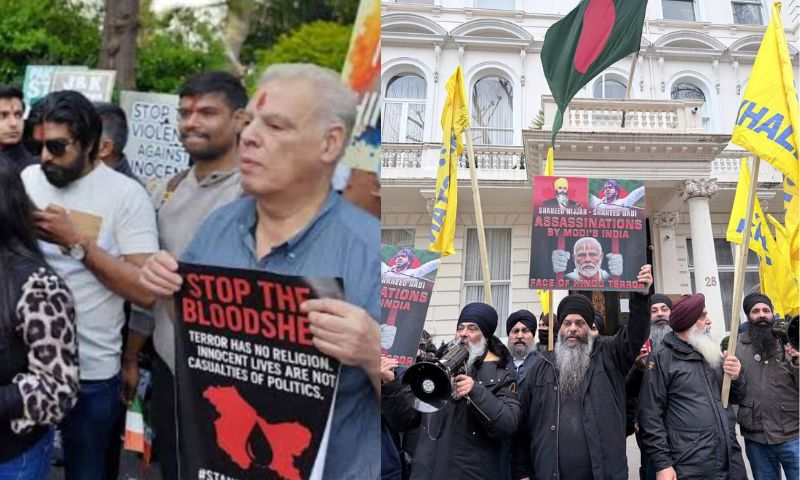



LONDON: Tensions flared outside the Bangladesh Embassy in London when supporters of India’s ruling Bharatiya Janata Party (BJP) clashed with pro-Khalistan Sikh activists during a protest over the alleged killing of Hindus in Bangladesh.
The tension heightened after members of Sikhs for Justice (SFJ) chanted anti-India slogans and raised Khalistani flags near the embassy premises.
The situation escalated as British Indian Hindu groups aligned with the BJP responded, leading to heated exchanges between the two sides.
Veteran Khalistani activist Paramjeet Singh Pamma, a coordinator of the Khalistan Referendum campaign, confronted the Hindu protestors, resulting in a brief scuffle.
Metropolitan Police officers deployed at the scene swiftly intervened, separating the groups and preventing the situation from deteriorating further.
Following the clash, pro-Khalistan activists formed a protective cordon around the embassy building.
Protesters continued chanting slogans accusing the Indian government of involvement in the deaths of Sikh activists, including references to Hardeep Singh Nijjar, before police restored calm in the area.
PRO-KHALISTAN SIKHS CONFRONT AND FORCE INDO-UK HINDU PROTESTERS TO RETREAT OUTSIDE BANGLADESH EMBASSY IN LONDON
SCUFFLE FORCED INDO-UK HINDUS TO DISPERSE
London | Breaking
Paramjeet Singh Pamma, Coordinator of the Khalistan Referendum, confronted a group of Indo-UK Hindu… pic.twitter.com/0F1zWjHsyJ
— Sikhs For Justice (@SFJ_US_Official) December 27, 2025
India’s alleged involvement in persecution of Sikhs
Expressing his views on Indian allegations, the Pamma said, “I reside openly in the United Kingdom; no UK court has convicted me of terrorism-related offences; no extradition request by India has resulted in my removal, and UK authorities have not legally upheld India’s allegations against me.
“We gathered here today to expose India’s dirty face. India is involved in persecuting Sikhs, Muslims and Christians at home; it cannot blame Bangladesh for human rights violations. We are focused on the next phase of the Khalistan Referendum, which will reveal the full scale of atrocities committed by India against the Sikhs,” remarked Pamma.
The clash occurred amid already strained ties between New Delhi and Dhaka, tensions that escalated following the ouster of former Bangladeshi Prime Minister Sheikh Hasina, who is currently in India.
Bilateral ties further deteriorated after the killing of Bangladeshi student leader Sharif Osman Hadi and the killing of a Hindu worker in the capital, Dhaka.
Hindu Extremists in India
India’s Prime Minister Narendra Modi’s annual Independence Day address in August this year saw him publicly honouring the organisation that shaped his personal and political life: the Rashtriya Swayamsevak Sangh (RSS), the far-right Hindu nationalist group that has influenced him since childhood and is now reshaping India’s social and political landscape.
Celebrating its centenary in 2025, the RSS has transformed from a secretive ideological society into a powerful kingmaker, influencing government, media, education, and civil society across India, while systematically promoting a Hindu-first agenda and marginalising religious minorities, according to an article published in The New York Times.
Despite repeated bans — including for alleged involvement in Mahatma Gandhi’s assassination — the organisation has grown into the world’s largest right-wing nationalist network.
Today, under the political patronage of Modi, the RSS is pushing India towards a Hindu-first identity, systematically infiltrating government, media, courts, police, and educational institutions.
Its affiliates hold sway across civil society, trade unions, student bodies, religious groups, and charitable networks, making and breaking political careers.