


GILGIT, Pakistan: The Shishper Glacier, once a vital source of irrigation for the Hunza villages of Hassanabad, Aliabad and Murtazaabad — home to 10,000 people — has turned from a blessing into a curse, unleashing catastrophic glacial lake outburst floods (GLOFs) that are wiping out homes and livelihoods.
Hassanabad is home to two sister glaciers — Shisper and Muchuhar — which converge downstream. Both glaciers are located in the Western Karakoram ranges.
The Shisper Glacier spans 54.7 km², while the combined watershed drained by the Shisper and Muchuhar glaciers covers 359 km².
Melting at record pace
Fuelled by rising temperatures, the glacier’s rapid melting is a stark example of a looming crisis. According to a GLOF-II project report by the United Nations Development Programme (UNDP), melting glaciers in the Hindu Kush, Karakoram, and Himalayan ranges have formed 3,044 glacial lakes in Gilgit-Baltistan and Khyber Pakhtunkhwa.
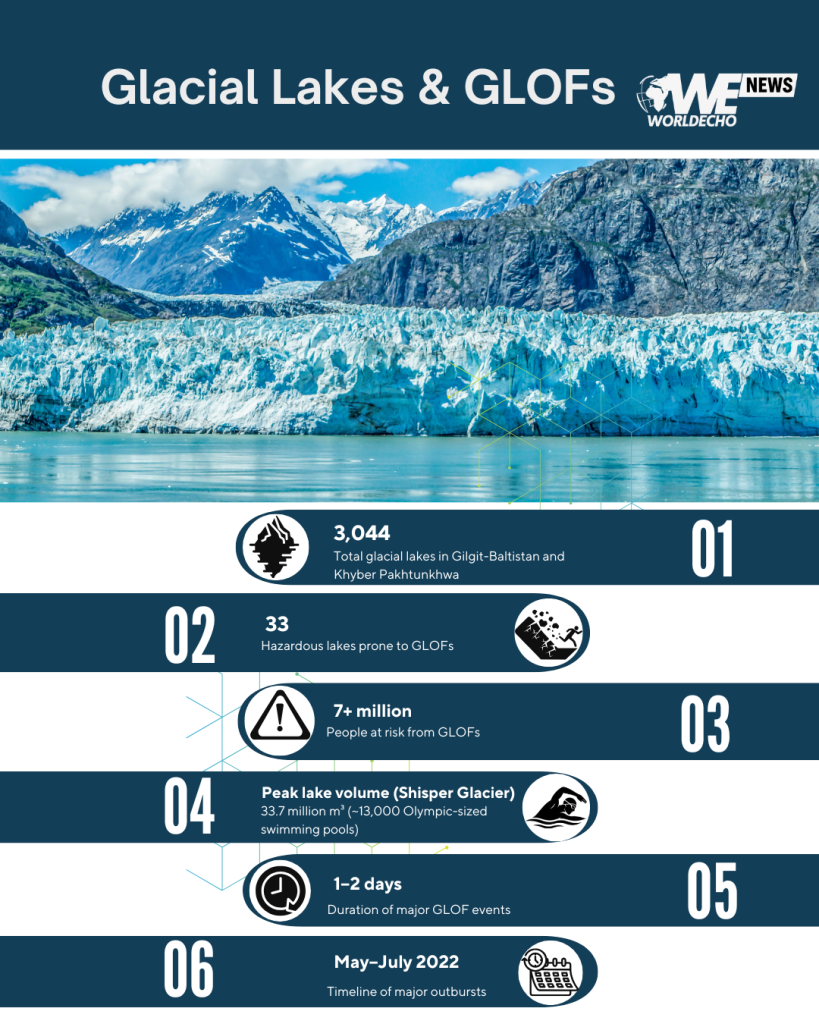
Of these, 33 are considered hazardous and prone to GLOFs — events capable of releasing millions of cubic meters of water and debris in hours, putting over 7 million people in Pakistan’s remote northern regions in harm’s way.
I urge the government to declare Hassanabad a calamity-hit area and either relocate residents to safer places or compensate us at market value so we can rebuild from scratch.” – Zahid Mahmood, resident of Hassanabad
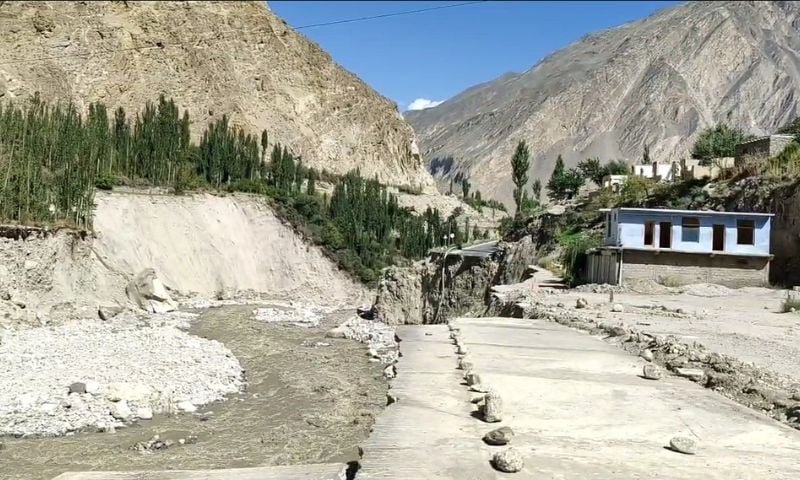
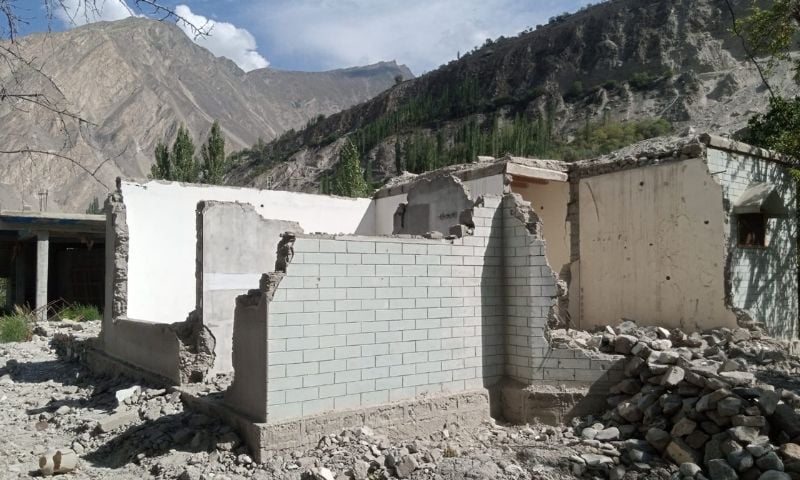
In the village of Hassanabad, the impact is painfully clear as residents are forced to tear down homes to salvage whatever they can. The ongoing GLOFs are pushing the village towards extinction, inch by inch.
Lives upended overnight
Zahid Mahmood, 46, who was born in Hassanabad, says his ancestors came here around three centuries ago and never faced destruction of this magnitude in their lifetime.
“I never imagined I’d have to tear down my home just to keep my family safe,” says Zahid Mahmood, a resident of the Sherabad area in Hassanabad, as he painstakingly removes his personal belongings.
Fighting back tears, Mahmood explains that he sent his parents to Gilgit city — around 90 kilometres away — fearing their hearts might give out upon seeing their lifelong home collapse.
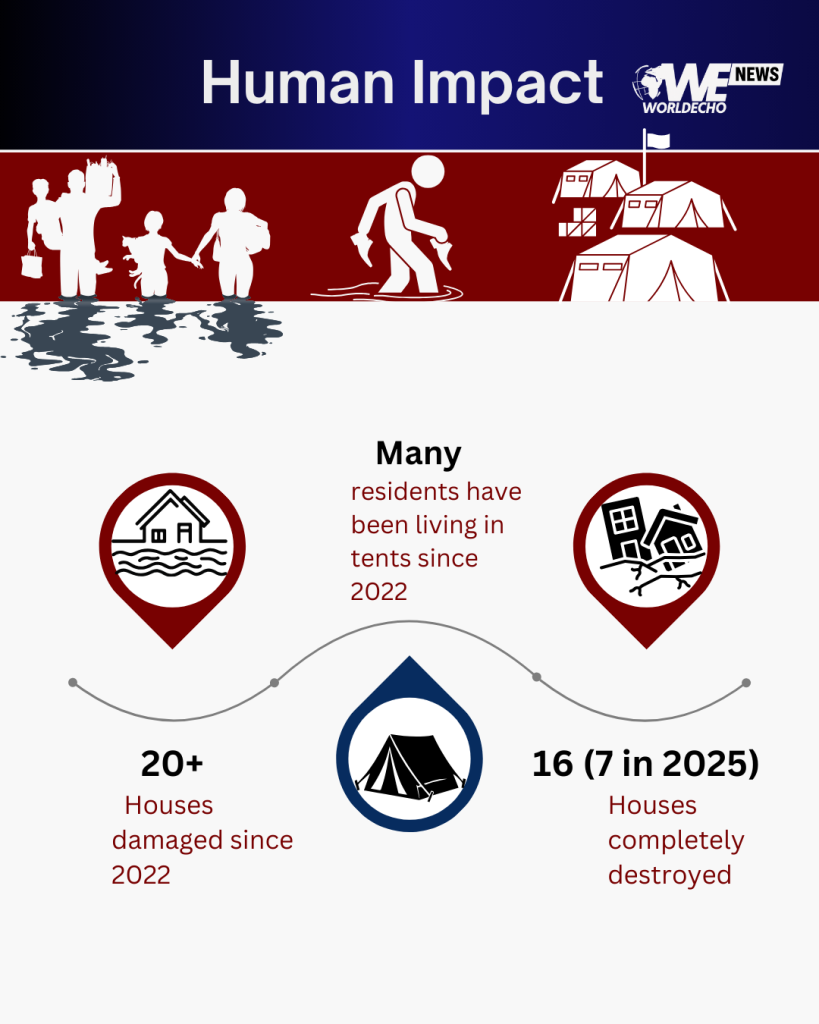
He estimates the value of his house at Rs 5 million (around $18,000). Since 2022, at least 20 houses in the area have been fully or partially damaged.
Mahmood expresses his surprise that, despite continuous land erosion and destruction, the area has not been declared a calamity-hit zone. He says the river water stops for two to three hours daily before surging suddenly, adding insult to injury.
“I urge the government to declare Hassanabad a calamity-hit area and either relocate residents to safer places or compensate us at market value so we can rebuild from scratch,” he says.
Mahmood adds that many affected since 2022 are still living in tents, an unsustainable situation. “It’s impossible to live in tents, so they should be moved to rented homes or government buildings. We need proper shelter, not relief items. We live in constant fear, unable to sleep, wondering which area will collapse next.”
Warning system failures
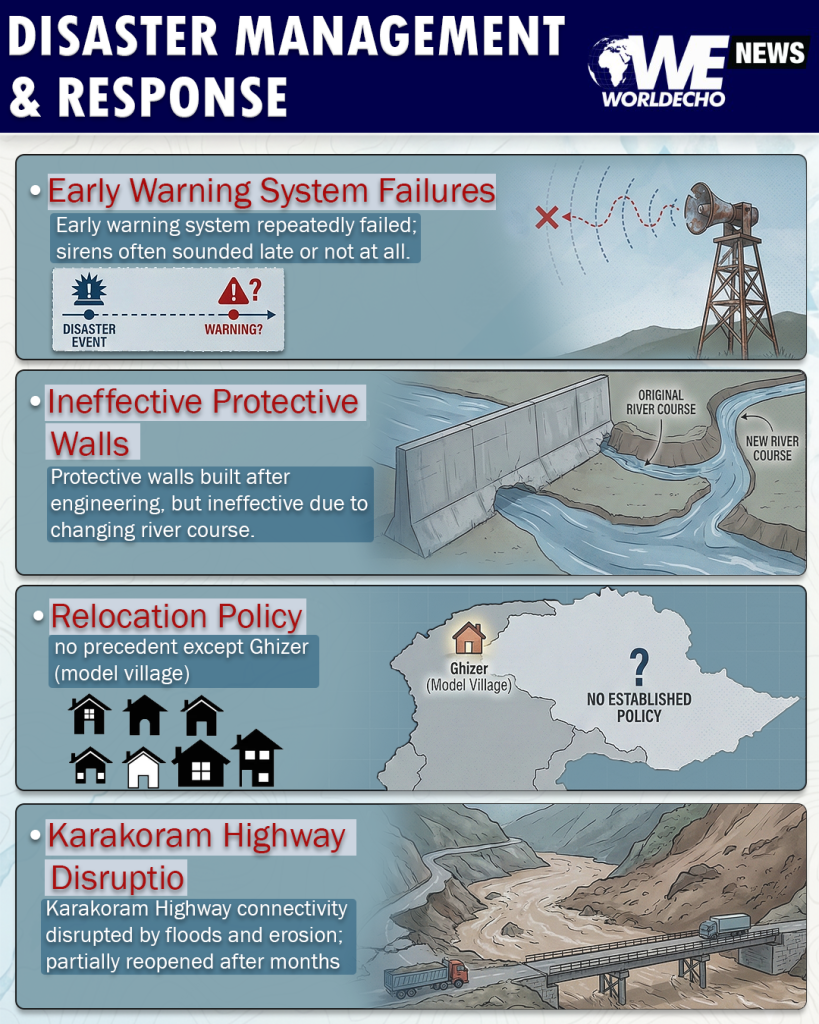
Hassanabad is part of the UN-backed GLOF II project designed to help vulnerable communities. However, locals report that the project’s early warning system has repeatedly failed, with sirens sounding after floods pass, or not at all.
We need a permanent solution — one that keeps the river in check. If other nations have engineered solutions, we should take a leaf out of their book. Protective walls are falling here, and we need an alternate solution.” – Nizamuddin, DC of Hunza
Mahmood criticises the malfunctioning early warning system. “Instead of wasting Rs 20 to 30 million on building protective walls — walls that don’t even keep us safe — the money should go to compensating us so we can pick up the pieces and escape this continuous trauma.”
He says whenever these demands are raised with the local administration and the Gilgit-Baltistan Disaster Management Authority (GBDMA), they are met with a dismissive response, being told there is no such policy — funds can only be allocated for protective walls.
Authorities under pressure
Hunza Deputy Commissioner (DC) Nizamuddin, seemingly at his wits’ end, explains the erosion phenomenon in the nullah — a channel that carries rainwater or floodwater — saying protective walls have been built after proper engineering, but the water does not constantly change course and eats away at the foundations.
“We need a permanent solution — one that keeps the river in check. If other nations have engineered solutions, we should take a leaf out of their book. Protective walls are falling here, and we need an alternate solution,” he says.
He agrees that permanent relocation of residents could be a solution “if there are any possibilities,” but notes there is no precedent in the region for relocation unless a major disaster hits.
“Only in Ghizer people were relocated to a model village. At present, no such policy is on the table,” Nizamuddin adds.
Even if residents are relocated, connectivity remains an issue, as a bridge was already damaged on May 7, 2022, and the road continues to erode.
Regarding the early warning system’s failure, he recalls that during his visit to the area on August 4, 2025, Federal Minister Musadik Malik observed that the siren’s sound was too faint for locals to hear. “I tested it myself, and I agree the sound was too low for locals to hear. Corrective measures are underway.”
We’ve now mobilised teams to conduct the assessments. We were waiting until the end of August because the GLOF events were recurrent; we needed the dust to settle and the water level to recede.” – Zubair Ahmed, GBDMA
When asked why the area has not been declared calamity-hit, Deputy Commissioner Nizamuddin says the matter has been escalated to higher authorities and will be pursued again.
Damage still uncounted
Zubair Ahmed, Additional Director for Hunza and Nagar at the Gilgit-Baltistan Disaster Management Authority (GBDMA), says that 16 houses have been completely destroyed since 2022, seven of them this year alone. He adds that a comprehensive land damage assessment is still pending.
“We’ve now mobilised teams to conduct the assessments. We were waiting until the end of August because the GLOF events were recurrent; we needed the dust to settle and the water level to recede,” he says.
He estimates that hundreds of kanals of land have been damaged, and the Karakoram Highway has also suffered significantly. A severe flood on August 10 cut off the Karakoram Highway (KKH), forcing traffic to be diverted to Nagar. The road was reopened on September 17.
Glaciers under stress
Gilgit-Baltistan Environmental Protection Agency (EPA) Director Khadim Hussain explains the unique GLOF phenomenon affecting Hassanabad. He says that the Shisper and Muchuhar glaciers are situated just 1.5 to 2 kilometres from the Karakoram Highway.
“Here, GLOFs and sudden glacier drainage are common,” he says. “The movement of these glaciers has weakened their structural integrity, causing large pieces of ice to continuously break off. These ice chunks temporarily block water flow, and as they melt, the accumulated water bursts out,” the GB-EPA director adds.
The movement of these glaciers has weakened their structural integrity, causing large pieces of ice to continuously break off. These ice chunks temporarily block water flow, and as they melt, the accumulated water bursts out.” – Khadim Husain, Director GBEPA
Hussain clarifies that the situation in Hassanabad differs from other areas due to the rapid melting and movement of the glaciers.
He describes a specific interaction where the advancing Shisper glacier, combined with meltwater from the Muchuhar glacier, periodically forms unstable glacial dams. When these dams burst, the results are devastating floods.
He adds that some glaciers naturally recede while others advance.
Human footprints rising
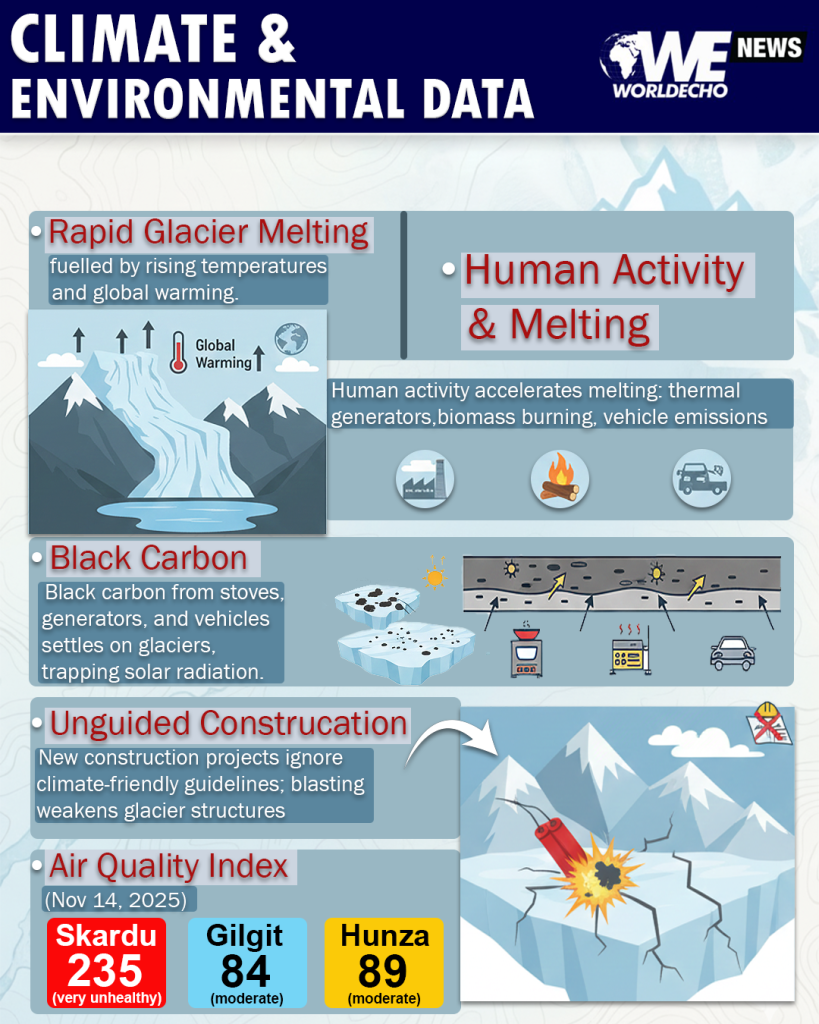
“In Gilgit-Baltistan, many glaciers are located near CPEC [China-Pakistan Economic Corridor] roads and populated centres. Human activity, coupled with global warming and local heating — from thermal generators, biomass burning, and vehicle emissions — accelerates glacial melting,” he says.
The GBEPA director notes that black carbon from stoves, generators and vehicles settles on glaciers, trapping solar radiation and ramping up localised heating.
For instance, on November 14, the Air Quality Index in Skardu was 235 (very unhealthy), Gilgit 84 (moderate), Hunza 89 (moderate).
He also highlights that new construction projects ignore climate-friendly guidelines. “For roads, water channels and other developments, massive blasting is common. Vibrations from the blasts weaken glacier structures and speed up their movement,” he adds.
Recent research from the University of Portsmouth, England, and the Lalitpur/Nepal-based International Centre for Integrated Mountain Development (ICIMOD) used European Space Agency satellite imagery to track a glacial lake formed by the Shisper Glacier surge.
The study found that the lake reached its peak volume in May 2022, holding 33.7 million cubic meters of water — equivalent to over 13,000 Olympic-sized swimming pools.
The lake drained rapidly during major outbursts between May and July, each GLOF lasting one to two days.