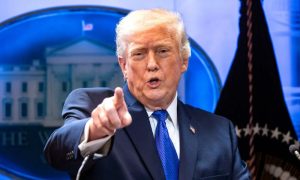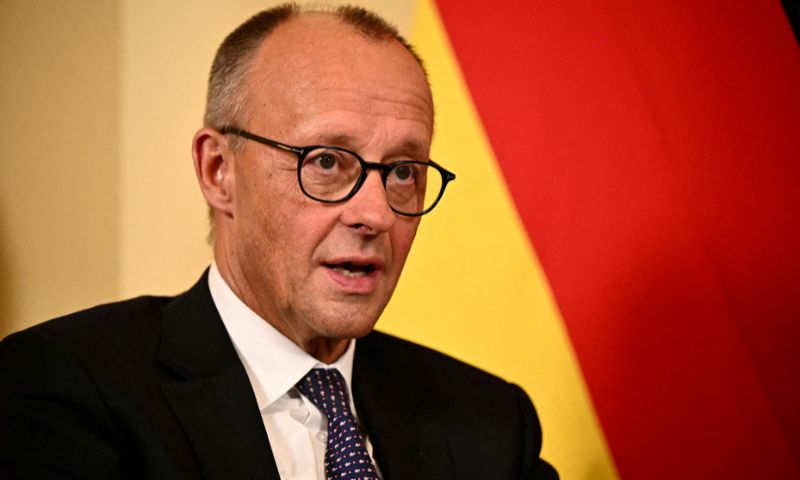



BERLIN: German Chancellor Friedrich Merz said on Saturday he would coordinate closely with European partners to forge a common response to new US tariffs, ahead of a planned visit to Washington to meet President Donald Trump.
“We will have a very clear European position on this, because customs policy is a matter for the European Union, not for individual member states,” Merz told public broadcaster ARD.
His remarks came after Trump announced he would raise tariffs on nearly all US imports from 10 percent to 15 percent, following a US Supreme Court ruling that struck down his previous tariff programme.
Trump raises tariffs after court ruling
On Friday, the US Supreme Court ruled 6–3 that the 1977 International Emergency Economic Powers Act (IEEPA) does not authorise the president to impose tariffs.
The court said the law “does not authorise the President to impose tariffs”, marking a major legal setback for Trump.
The ruling found that Trump had exceeded his authority by invoking emergency powers to impose duties ranging from 10 to 50 per cent on various countries.
Trump responded swiftly. He signed executive orders late on Friday imposing a temporary 10 percent global tariff for 150 days under Section 122 of the Trade Act of 1974, which allows duties of up to 15 percent but requires congressional approval to extend them beyond that period.
On Saturday, Trump said he would increase that rate to 15 percent, the maximum allowed under the law.
“I, as President of the United States of America, will be, effective immediately, raising the 10% Worldwide Tariff… to the fully allowed, and legally tested, 15% level,” he wrote on his Truth Social platform.
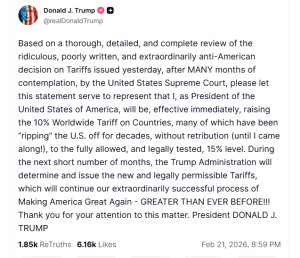
He said the 150-day period would be used to develop other “legally permissible” tariffs.
The administration plans to rely on additional statutes that allow import duties on specific products or countries following investigations into national security risks or unfair trade practices.
The White House said exemptions would remain for aerospace products, passenger cars and some light trucks, goods from Mexico and Canada that comply with the US-Mexico-Canada Agreement, pharmaceuticals and certain critical minerals and agricultural products.
It added that countries which had reached separate tariff arrangements with Washington would also face the new global tariff.
Speaking to reporters, Trump criticised the court’s decision and said he was “ashamed of certain members of the court” for not having “the courage to do what’s right for our country”.
European reaction cautious
In Paris, French President Emmanuel Macron said on Saturday that the US court ruling demonstrated the importance of checks and balances in democracies.
“It is not bad to have a Supreme Court and, therefore, the rule of law,” Macron said at the annual agricultural salon in Paris, responding to a question about the ruling.
“It is good to have power and counterweights to power in democracies,” he added.
Macron said France would examine the consequences of the new 10 percent global tariff and adapt accordingly.
He stressed that France wanted to continue exporting products including agricultural goods, luxury and fashion items, and aeronautical equipment.
He called for a calm approach and said the fairest principle in trade was “reciprocity” rather than being “subjected to unilateral decisions”.
French officials have indicated that the European Union could consider countermeasures if necessary.
These could include existing trade defence instruments or previously suspended retaliatory tariffs.