


KEY POINTS
- Hamas says Gaza ceasefire second phase cannot proceed while Israel continues violations.
- Thousands of children in Gaza suffer acute malnutrition; aid remains insufficient.
- Israeli forces continue airstrikes and shelling, with hundreds of ceasefire violations reported since 10 October.
- Reporters Without Borders reports 29 Palestinian journalists killed in Gaza.
- US-brokered second phase aims for Gaza reconstruction and international supervision.
GAZA CITY, Palestine: Hamas has said that the second phase of the Gaza ceasefire cannot proceed to its second phase as long as Israeli “violations” of the agreement persist, calling on mediators to pressure Israel to respect the deal.
“The second phase cannot begin as long as the occupation continues its violations of the agreement and evades its commitments,” Hamas political bureau member Hossam Badran told AFP on Tuesday.
He said the Palestinian group had requested mediators to ensure Israel completes the first phase of the ceasefire, which came into effect on 10 October.
Humanitarian crisis in Gaza
The UN children’s agency, UNICEF, reported thousands of children admitted for acute malnutrition since the ceasefire. “It’s still a shockingly high number,” said UNICEF spokesperson Tess Ingram.
“The number of children admitted is five times higher than in February, so we need to see the numbers come down further,” the spokesperson said.
Ingram described seeing underweight babies weighing less than 1 kilogram struggling to survive in hospitals.
She added that meat prices remained prohibitively high, at around $20 per kilogram, preventing most families from accessing adequate nutrition.
Doctors Without Borders (MSF) also highlighted ongoing humanitarian challenges. Javid Abdelmoneim, MSF president, told AFP during the Doha Forum that conditions for medics and patients in Gaza remained “as hard as it’s ever been.”
He added that aid had not reached necessary levels and that hospitals were providing substandard care due to shortages of materials and drugs.
Israel’s ceasefire violations
Despite the truce, Israeli forces have continued airstrikes and artillery shelling in northern and southern Gaza, Anadolu Agency reported.
Residents of Rafah and Khan Younis described intense bombardment, including demolitions in Gaza City.
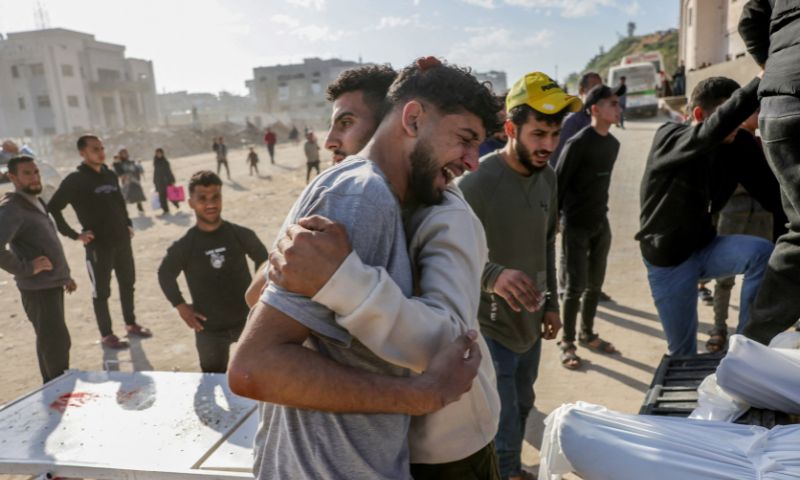
Gaza authorities reported that Israel has committed hundreds of ceasefire violations since 10 October, killing 377 Palestinians and wounding 970 others.
Gaza’s health ministry on Tuesday said that one person was killed and six were wounded in the Palestinian territory in the last 24 hours, bringing the death toll since the ceasefire to 377 since the ceasefire.
At least 70,366 Palestinians, mostly women and children, have been killed in Israel’s military offensive in Gaza since October 7, 2023, the territory’s health ministry said.
Rains and low temperatures threaten tens of thousands of displaced Palestinians, with Gaza authorities warning of a severe winter storm set to hit the territory from Wednesday to Friday.
The storm is expected to cause flooding in tented camps and damage shelters, worsening the humanitarian situation.
Journalist deaths and media restrictions
Reporters Without Borders (RSF) reported that Israeli forces were responsible for nearly half of all journalist deaths worldwide this year.
The group said 29 Palestinian journalists were killed in Gaza, making Israel “the worst enemy of journalists” globally.
RSF noted that foreign reporters remain largely unable to access Gaza, except through tightly controlled tours organised by the Israeli military.
Second phase of ceasefire and peace efforts
The first phase of the US-brokered ceasefire is nearly complete, with the remains of one Israeli hostage still in Gaza.
The second phase, which aims to rebuild a demilitarized Gaza under international supervision, faces significant obstacles.
US President Donald Trump’s 20-point plan, approved by the UN Security Council, envisions reconstruction and eventual Palestinian self-governance.
The plan includes creating an International Stabilization Force to maintain security and train Palestinian police, though no deployment date has been set.
Hamas has indicated it will not disarm until Israel ends its occupation of Palestinian territories.
Bassem Naim, a senior Hamas official, said the group could “freeze or store” weapons during a political process.
The peace plan also proposes a technocratic Palestinian committee to manage daily affairs in Gaza, overseen by a Board of Peace.
US officials have said board members will be announced in the coming weeks, with Trump as the only official member so far.
Further Israeli withdrawals from Gaza remain uncertain. On Sunday, Lt. Gen. Eyal Zamir, Israel’s military chief, described the so-called Yellow Line dividing Israeli-held areas as a “forward defensive line” for communities.
Border reopening for aid
Israel plans to reopen the Allenby Crossing with Jordan on Wednesday to allow passage of goods and aid.
The crossing had been closed since September following an attack on Israeli soldiers by a driver delivering humanitarian aid.
Israeli authorities said security measures have been strengthened, with a dedicated force now assigned to the crossing.
The Allenby Bridge is a key route for more than three million Palestinians in the West Bank to reach Jordan and the wider world and is vital for delivering food, tents, and other aid to Gaza.