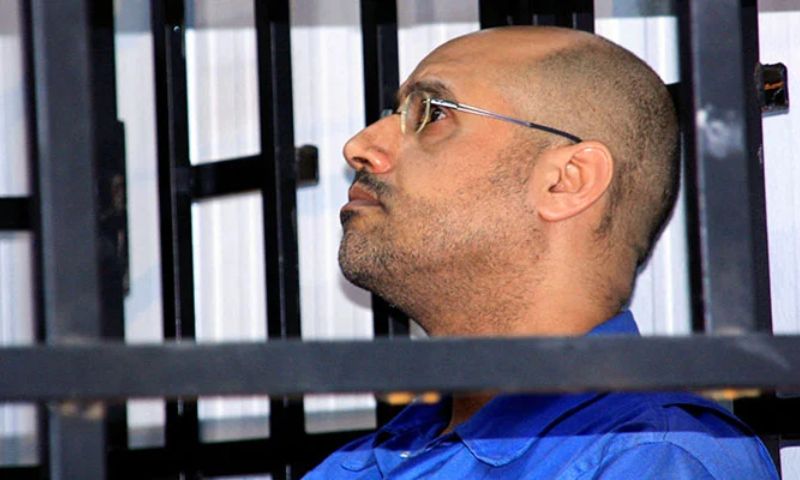



ZINTAN, Libya: Saif al-Islam Gaddafi, son of Libya’s former longtime ruler Muammar Gaddafi, has been killed by a “four-man commando” at his residence in the western Libyan town of Zintan, according to his French lawyer, Marcel Ceccaldi.
Ceccaldi said the killing occurred on Tuesday, though details surrounding the circumstances remained unclear, according to AFP. “For now, we don’t know” who was behind the assassination, he said, adding that he had been informed by one of Saif’s close associates about ten days earlier that there were growing concerns over his security.
Sources close to the Gaddafi family, Saif’s Libyan lawyer Khaled el-Zaydi, and Libyan media outlets also confirmed the death on Tuesday. No group has yet claimed responsibility.
Once regarded as his father’s heir apparent, Saif al-Islam Gaddafi’s political journey spanned privilege, imprisonment, and a controversial return to public life. Despite holding no official state position, he was widely seen as the second most powerful figure in Libya during the later years of his father’s four-decade rule.
Saif played a central role in shaping Libyan policy and acting as an intermediary in sensitive diplomatic negotiations. He led talks that resulted in Libya abandoning its weapons of mass destruction programme and was involved in negotiations over compensation for the families of victims of the 1988 bombing of Pan Am Flight 103 over Lockerbie, Scotland.
Determined to end Libya’s international isolation, Saif cultivated ties with Western governments and presented himself as a reformer. He publicly advocated for a constitution and respect for human rights, positioning himself as a modernising force within an authoritarian system.
Educated at the London School of Economics and fluent in English, he was often described by foreign diplomats as a Western-friendly face of the Libyan regime.
That image collapsed in 2011 when a popular uprising erupted against Muammar Gaddafi’s rule. Saif quickly sided with his family and tribal loyalties, becoming one of the most prominent defenders of the rule.
In televised speeches, he warned of “rivers of blood” and described rebels as “rats,” vowing that the government would fight to the last man and woman.
“We fight here in Libya, we die here in Libya,” he told Reuters at the height of the revolt. He warned that the country would be destroyed and would need decades to recover, predicting prolonged chaos if his father’s rule ended.
After rebels seized Tripoli, Saif attempted to flee to neighbouring Niger disguised as a Bedouin tribesman. He was captured by the Abu Bakr Sadik Brigade militia on a desert road and flown to Zintan roughly a month after Muammar Gaddafi was captured and killed by rebel forces.
“I’m staying here. They’ll empty their guns into me the second I go out there,” Saif said in an audio recording as hundreds of armed men surrounded an old Libyan air force transport plane. He was reportedly betrayed to his captors by a Libyan nomad.
Saif spent the next six years in detention in Zintan, far removed from the opulent lifestyle he once enjoyed, which included exotic pets, falcon hunting, and close ties with British high society. Human Rights Watch representatives who met him during his detention said he did not allege physical mistreatment, though concerns were raised about prolonged solitary confinement.
Hanan Salah, Human Rights Watch’s Libya director at the time, told Reuters that Saif was missing a tooth and said he had been largely isolated, with limited contact with the outside world. He was allowed access to satellite television and some books.
In 2015, a Tripoli court sentenced Saif to death by firing squad for war crimes, a ruling rejected by authorities in eastern Libya. He was also the subject of an arrest warrant from the International Criminal Court in The Hague for murder and persecution.
Released in 2017 under an amnesty law, Saif remained largely underground in Zintan for years, fearing assassination. From 2016 onward, he gradually resumed contact with supporters and political figures, receiving visitors almost weekly and holding discussions about Libya’s future, according to Libyan analyst Mustafa Fetouri.
In 2021, Saif re-emerged publicly, appearing in the southern city of Sabha to register his candidacy for Libya’s long-delayed presidential elections. His campaign sought to tap into nostalgia for the relative stability that existed before the NATO-backed uprising that toppled his father.
His candidacy proved deeply divisive. Many Libyans who suffered under Gaddafi’s rule strongly opposed his return, while powerful armed groups rejected him outright.
Disqualified due to his prior conviction, Saif attempted to appeal, but armed fighters blocked access to the court. The dispute became a central factor in the collapse of the election process and Libya’s return to political stalemate.
In a 2021 interview with The New York Times Magazine, Saif described his political strategy after a decade in isolation. “You need to come back slowly, slowly,” he said. “Like a striptease. You need to play with their minds a little.”
His reported killing now adds another layer of uncertainty to Libya’s long-running conflict and fractured political landscape, as questions remain over who ordered the assassination and what impact it may have on the country’s fragile balance of power.