


KEY POINTS
- Pakistan re-emerged from diplomatic isolation to global prominence.
- Proactive foreign policy earned international recognition and appreciation globally.
- Pakistan’s defence strengthened; nuclear and missile capabilities invincible.
- India’s regional hegemony tested and exposed during four-day conflict.
- Government focuses on transforming Pakistan into economic power and leadership.
- Natural resources and foreign investments boost Pakistan’s economic confidence.
- Kashmir dispute raised internationally; plebiscite remains only viable solution.
- Bangladesh relations improved; goodwill established ahead of February elections.
- US ties strengthened; $13.28 billion bilateral trade, counterterrorism collaboration enhanced.
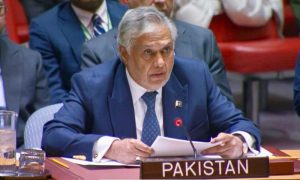
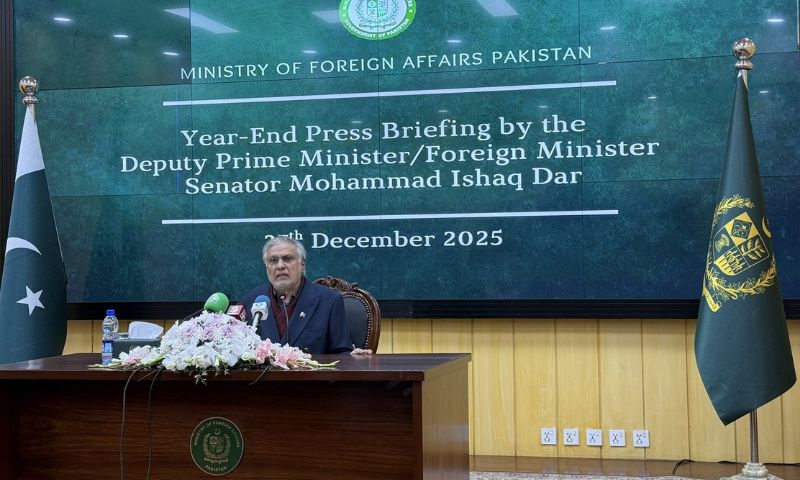
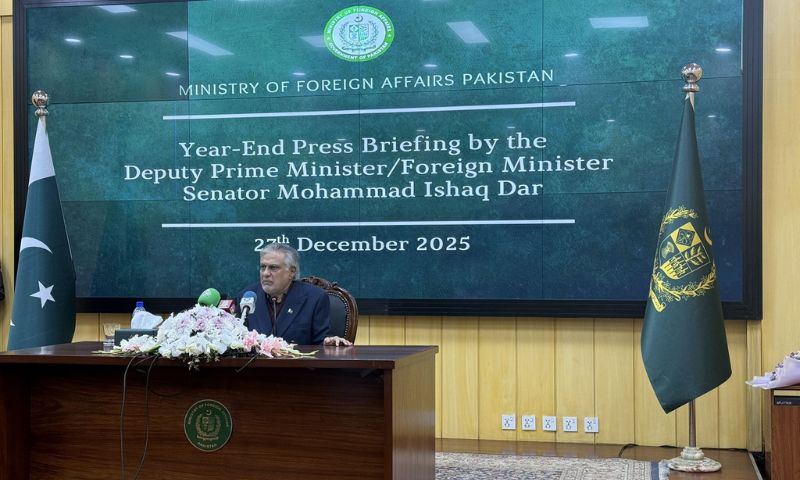
ISLAMABAD: Pakistan’s Deputy Prime Minister and Foreign Minister Mohammad Ishaq Dar reiterated on Saturday that Pakistan, once labelled as “diplomatically isolated,” had re-emerged as a strong and visible player on the diplomatic, political and economic fronts within the international community, attributing this turnaround to the incumbent government’s dynamic policies.
Reclaiming global space
Addressing a press conference here on the annual performance and role of the Ministry of Foreign Affairs, the Deputy Prime Minister said Pakistan’s proactive, principled and firm positions on major global issues had earned international recognition and appreciation at various international forums.
He said Pakistan’s standing among the comity of nations had improved due to its consistent and proactive diplomacy, and expressed gratitude to the national media for projecting the country’s image effectively.
Recalling the formation of the Pakistan Democratic Movement government, Dar said Pakistan was then widely regarded as diplomatically isolated, but today its constructive role is acknowledged internationally.
Peace with preparedness
Referring to the four-day armed conflict with India, he said, “India’s self-proclaimed regional hegemony and its claim of being a net security provider had been tested and exposed.”
He said the Foreign Office had remained proactive after the Pulwama incident, when India falsely accused Pakistan, adding that the country’s defence posture was now solid and resolute.
Reiterating Pakistan’s stance during Indian aggression, Dar said the country had responded responsibly and continued to advocate peace.
“Pakistan’s nuclear and missile capabilities had rendered its defence strong and invincible,” he said.
Economic transformation in focus
The Deputy Prime Minister said the government was now focused on transforming Pakistan into an economic power, adding that achieving this goal would enable the country to lead the Muslim Ummah.
He noted that Pakistan is endowed with vast natural resources, including minerals, precious stones and gas, and cited foreign investments such as Reko Diq as evidence of growing international confidence.
Referring to the recent visit of the United Arab Emirates (UAE) president, Dar said the UAE is expected to acquire shares in the Fauji Group, through which a $1 billion liability could be settled, while another $2 billion loan might be rolled over.
He also thanked Saudi Arabia, the UAE and China for supporting Pakistan’s financial stability through loan facilities.
Kashmir dispute highlighted
“Lasting peace in the region is impossible without resolving the Jammu and Kashmir dispute. Pakistan had strongly opposed India’s illegal actions in Indian Illegally Occupied Jammu and Kashmir and had once again raised the issue internationally,” he remarked.
He said the UN Security Council has discussed human rights violations in Indian Illegally Occupied Jammu and Kashmir, stressing that a plebiscite in line with UNSC resolutions remained the only viable solution.
On the Indus Waters Treaty, Dar said Pakistan is actively pursuing the matter at the Organisation of Islamic Cooperation (OIC), the Permanent Court of Arbitration and the United Nations, noting that reports from these forums were favourable to Pakistan’s position.
Bangladesh ties strengthened
Terming the improvement in ties with Bangladesh a “major thaw” achieved this year, he referred to his extensive visit during which he met the country’s leadership, foreign minister, advisers, Khaleda Zia, Jamaat-e-Islami representatives and a student party.
“A climate of goodwill was created, and after the February elections we will further engage,” he said.
US-Pakistan ties
Speaking on relations with the United States, Dar said ties had fluctuated over time. He noted that engagement was limited during the previous Biden administration, but under the current administration trade, investment and bilateral relations were moving in a positive direction.
He said counterterrorism cooperation had also strengthened.
Praising US President Donald Trump’s administration, Dar said Washington had played a key role in facilitating a ceasefire between Pakistan and India.
He said Pakistan had nominated President Trump for the Nobel Peace Prize on June 11 for his role in promoting peace, adding that Trump had repeatedly referred to the downing of seven Indian jets.
Dar expressed satisfaction over bilateral trade with the US reaching $13.28 billion, noting that Pakistan enjoyed the lowest US tariffs in South Asia.
Expanded global engagement
The Deputy Prime Minister also highlighted Pakistan’s leadership-level engagements with counterparts from Türkiye, OIC member states, China, the European Union, Association of Southeast Asian Nations (ASEAN), the UN, Shanghai Cooperation Organisation (SCO) and Russia at various bilateral and multilateral forums.
He said multiple agreements in the fields of economy, defence and investment have been signed, expanding Pakistan’s global engagement.
Dar also underscored Pakistan’s principled position and efforts for peace in Gaza and the resolution of the Palestine issue. He said dialogue, engagement, regional stability, economic cooperation and the pursuit of peace formed the core of Pakistan’s foreign policy, aligned with national interests.
PTI protest condemned
Commenting on a Pakistan Tehrik-i-Insaf (PTI) protest in the United Kingdom, Dar termed it a provocation, alleging that protesters had issued death threats, which he said is unacceptable.
He said the UK government must take responsibility to prevent such incidents, adding that Pakistan would raise the issue wherever similar acts occur, and noted that issuing a demarche was an appropriate step.
Dar also expressed disappointment over the Taliban government’s failure to take concrete action against militants operating from Afghan soil and carrying out attacks inside Pakistan.
He concluded by saying that India alone was obstructing the functioning of South Asian Association for Regional Cooperation (SAARC), calling it an unfortunate development.