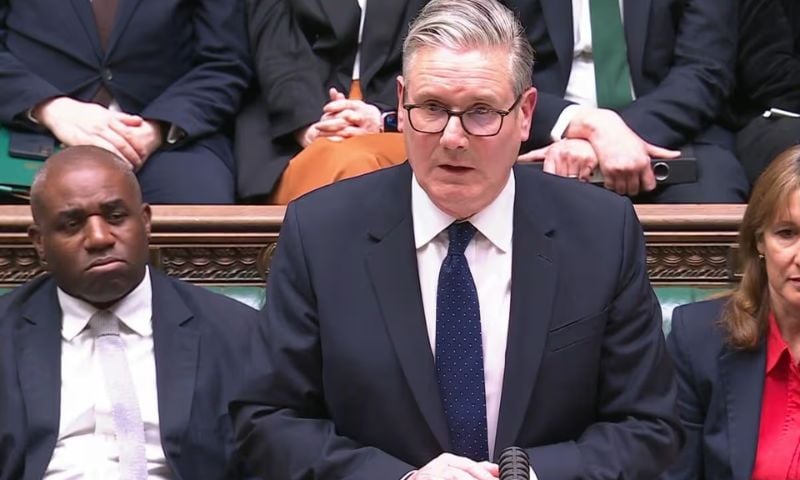
LONDON: British Prime Minister Keir Starmer came under intensifying pressure on Tuesday after a fourth junior minister resigned from his government and nearly 90 Labour lawmakers reportedly called on him to step down or announce a transition plan following the party’s major election setbacks across the UK.
“I now ask you for the sake of that urgency and that national duty, to step aside and set a timetable for an expedient and orderly transition to new leadership that commands the confidence of our country,” Zubir Ahmed, the minister who resigned, said in his resignation letter.
Ahmed’s departure followed the resignations earlier Tuesday of Alex Davies-Jones as minister for victims and violence against women and girls, Miatta Fahnbulleh as communities minister, and Jess Phillips as safeguarding minister.
The resignations came as nearly 90 Labour lawmakers reportedly urged Starmer either to resign immediately or announce a timeline for leaving office.
Starmer entered a Cabinet meeting earlier Tuesday under growing pressure after Labour’s disappointing results in last week’s elections triggered open dissent within the parliamentary party and exposed divisions over his leadership.
The crisis deepened late Monday when Downing Street replaced six ministerial aides who had resigned earlier in the evening, in what appeared to be an attempt to stabilize the government as pressure intensified on the prime minister.
Despite the growing revolt, Starmer told ministers Tuesday that he would “get on with governing” and continue leading the government despite calls for his resignation.
Addressing the Cabinet meeting, Starmer sought to steady his administration following what he described as a “destabilizing” period in British politics.
According to a statement released by Downing Street, Starmer told ministers: “As I said yesterday, I take responsibility for these election results, and I take responsibility for delivering the change we promised.”
Pressure on the prime minister intensified after Labour suffered a series of setbacks in last week’s elections.
In Wales, the party endured a historic defeat in the Senedd elections, while in Scotland, the Scottish National Party retained power for a fifth consecutive term in the Scottish Parliament.
The elections, held across Scotland, Wales, and 136 local authorities in England, marked the largest electoral test since Labour’s landslide victory in the 2024 general election.
Meanwhile, Reform UK continued its recent surge, winning more than 1,450 council seats and building on gains made during last year’s local elections.