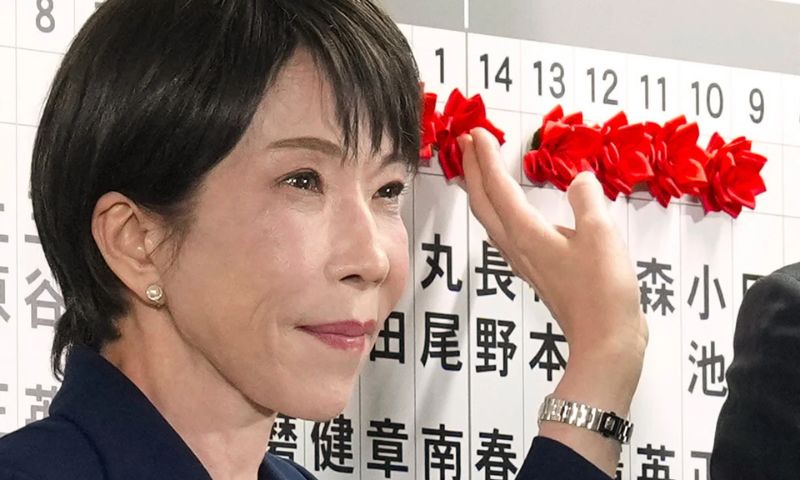



TOKYO: The number of women serving in Japan’s powerful lower house has declined following snap elections held on Sunday, official results showed on Tuesday, dealing a setback to gender representation in the country’s male-dominated political landscape.
Women now account for just 15 percent of lawmakers in the House of Representatives, securing 68 of the chamber’s 465 seats.
This marks a decrease from the 73 women elected in the 2024 general election, despite a modest rise in the number of female candidates contesting the polls.
The election consolidated the authority of Prime Minister Sanae Takaichi, who strengthened her grip on power four months after becoming Japan’s first woman leader.
However, Takaichi has shown little inclination to frame her leadership around advancing women’s representation or gender equality, according to AFP.
Takaichi’s conservative bloc secured a historic landslide victory in the vote. While a record 24 percent of candidates were women, the figure was only one percentage point higher than in the previous election, underscoring the slow pace of change.
Among the notable victories was that of Hikaru Fujita, who ran for the ruling Liberal Democratic Party (LDP) while pregnant and defeated a veteran lawmaker, winning nearly half of the votes in her constituency.
Campaigning in the central province of Nagano, Fujita pledged to support young people and women and received a personal endorsement from Takaichi after publicly announcing her pregnancy.
Japan continues to struggle with deeply entrenched gender norms, where women are often expected to prioritise household and family responsibilities even while pursuing professional careers.
Despite earlier pledges to boost female participation, Takaichi appointed a largely male cabinet after assuming office in October.
Her political outlook places her on the right wing of the already conservative LDP, and she opposes revising a 19th-century law that requires married couples to adopt the same surname.
“The inauguration of Prime Minister Takaichi doesn’t appear to have sparked a strong movement within the LDP to significantly increase the number of female candidates,” Yuki Tsuji, a politics expert and professor at Tokai University, told AFP during the election campaign.
Of the 68 women elected to parliament, 39 belong to the LDP, representing just over 12 percent of the party’s 315 lawmakers.
Yu Uchiyama, a political science professor at the University of Tokyo, said Takaichi’s reputation for hardline conservatism makes it unlikely that she will prioritise policies promoting diversity, equality and inclusion.
Japan ranked 118th out of 148 countries in the World Economic Forum’s 2025 Global Gender Gap Report, highlighting the scale of the challenge facing women in Japanese public life.