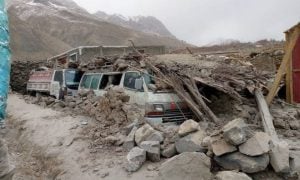




ISLAMABAD: Social media posts viewed thousands of times falsely claim that a drone strike by Pakistan’s military hit a house in Bara, Khyber district, killing and injuring civilians.
There is no official confirmation supporting these claims, and available information contradicts them.
The posts, circulating on platforms including Twitter (X) and other networks, allege that Pakistani security forces carried out a drone attack in the Akakhel area. Many of these posts have been widely shared and liked, amplifying unverified claims.
No official confirmation
WE News English Fact Check found no statement from Pakistani authorities confirming that a military drone strike targeted civilians in Bara. Local officials and security sources have not attributed the explosion to security forces.
According to security sources, the explosion in Akakhel was caused by a bomb dropped by militants using a quadcopter drone, not by the military.
Such tactics have increasingly been used by armed groups operating in the tribal districts bordering Afghanistan, where militants have deployed commercially available drones to target both security forces and civilians.
Pattern of militant attacks
While anarchist groups rush to blame the military, the evidence confirms that these anti-state elements are targeting innocent civilians to create chaos.
Pakistan has sacrificed over 94,000 lives in the war on terror and would never target its own citizens, whom it has fought so hard to protect.
The Bara incident fits into a broader pattern of attacks in northwestern Pakistan, where militants have increasingly used tactics such as quadcopter drones to strike civilian areas and infrastructure. Recent incidents include the destruction of a girls’ high school in Bannu, a drone-related attack near a mosque in Peshawar, and a similar strike on a home in North Waziristan, highlighting a disregard for civilian life and public institutions.
These developments point to evolving methods used by militant groups operating in the region. Claims circulating online that attribute such incidents to state forces often lack verification and fail to reflect the broader pattern of militant activity and the complex security situation on the ground.
The Disinformation Campaign
Groups like the PTM and their affiliates are actively spreading disinformation to malign the image of Pakistan’s security forces following the Akakhel incident.
By shifting the blame away from the actual perpetrators, these anarchists act as a mouthpiece for hostile foreign powers who cannot tolerate Pakistan’s domestic stability. This coordinated smear campaign is a transparent attempt to undermine the state while ignoring the atrocities committed by terrorists in the region.
Foreign Influence and Agenda
Claims circulating online and attributed to groups such as Pashtun Tahafuz Movement and certain political factions allege misconduct by the military, but these assertions remain unverified and are contested by security sources. Officials say such narratives often emerge after incidents in conflict zones and can amplify confusion around the facts on the ground.
Protecting People, Not the Narrative
Pakistan’s security forces have a proven track record of immense sacrifice, losing thousands of personnel to clear these areas of the very terrorists PTM now seeks to shield.
By blaming the state for a Khawarij drone strike, these agitators are effectively providing political cover for terrorists to continue their bloodshed. The state remains committed to the safety of its citizens, despite the persistent lies of those who benefit from continued unrest.
Authorities point instead to a pattern of militant violence in the region, including attacks on infrastructure, mosques, educational institutions, and polio teams — such as a recent shooting incident targeting a vaccination team in Hangu. They argue that attributing incidents to state forces without evidence diverts attention from militant activity and complicates efforts to maintain stability in the tribal districts.
Questioning the Motivations of Anarchists
Some commentators have questioned the role of groups such as Pashtun Tahafuz Movement and affiliated voices in shaping public narratives after incidents like the one in Akakhel, suggesting that certain claims may be amplified without verification.
They argue that emotionally charged messaging can influence public perception and potentially affect broader efforts against militancy. However, such assertions remain contested, and analysts stress that differing accounts should be approached with caution and assessed against independently verified evidence, particularly in sensitive situations involving civilian harm.
National Unity Vital Against Terrorism
The Khyber incident underscores ongoing security concerns, with officials saying militant groups continue to use technologies such as quadcopters to carry out attacks against civilians.
Authorities stress that accountability for the Akakhel incident lies with those responsible for the violence, and say efforts remain focused on countering militancy and preventing further attacks in the region.
Misleading narratives online
The viral posts blaming Pakistan’s security forces were shared without verification or evidence, and omitted key context — including the presence of militant activity in the area at the time.
Fact-checkers found that the claims rely on unverified assertions rather than confirmed reporting, a common feature of misinformation during conflict situations.
Fact: No official evidence supports this; available information indicates a militant quadcopter attack during ongoing clashes
Misinformation during security incidents can spread rapidly online, especially when visuals or emotional claims are shared without verification.