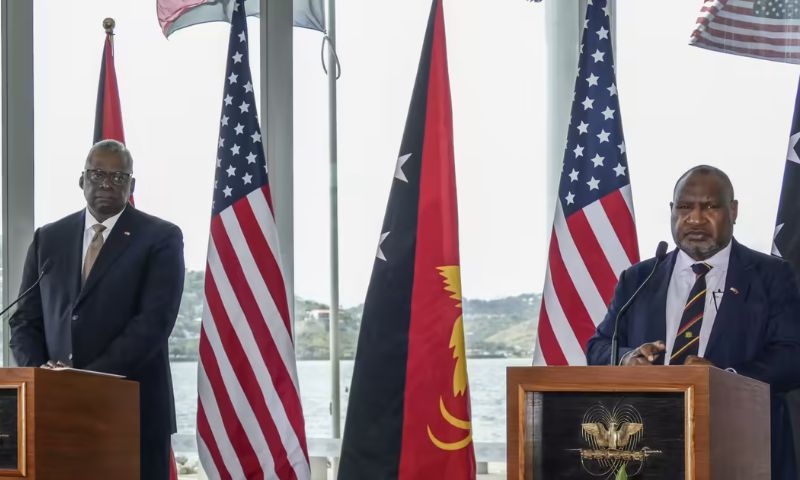



PORT MORESBY, Papua New Guinea: In a move aimed at bolstering the island nation’s efforts to combat illegal fishing and trafficking, a US Coast Guard cutter will be deployed to Papua New Guinea in August.
The announcement was made by US Secretary of Defense Lloyd Austin on Thursday, highlighting the growing competition with China over influence in the South Pacific.
Secretary Austin’s visit to Papua New Guinea marks the first time a sitting US secretary of defence has visited the country, emphasizing the importance of the bilateral relationship. This historic trip comes after Secretary of State Antony Blinken signed a ship rider agreement and a defence cooperation agreement with Papua New Guinea in May, signaling the intention to enhance maritime law enforcement cooperation and defence ties.
During a joint press conference with Papua New Guinea Prime Minister James Marape, Secretary Austin stressed the significance of the Indo-Pacific region as a priority theatre for the United States. He emphasized the critical role of partnerships like the one with Papua New Guinea in maintaining a free and open Indo-Pacific. Both nations share a common vision for upholding the rules-based international order.
The shiprider agreement is specifically designed to assist Papua New Guinea in strengthening its maritime law enforcement and maritime domain awareness within its exclusive economic zone. In an effort to demonstrate their commitment and eagerness to implement the program, the US is expediting the deployment of a coast guard ship to the island nation next month.
The cooperation with the US encompasses various aspects, including the protection of Papua New Guinea’s waters from illegal fishing and forest transportation, as well as safeguarding the country’s economy from transnational crimes while ensuring secure borders.
Regarding the defence cooperation agreement, Secretary Austin assured Papua New Guinea of the United States’ respect for its sovereignty. He pledged to uphold the country’s autonomy and emphasized the mutually beneficial nature of the partnership.
However, concerns have been raised by some opposition party leaders in Papua New Guinea regarding potential violations of the country’s sovereignty. The Supreme Court is being asked to provide a legal interpretation of the agreement’s contents. The agreement is set to be discussed and ratified by the island nation’s parliament in August.
The full text of the agreement reveals that the US military will be granted access to six sites in Papua New Guinea, including a naval base, airports, and ports, for a duration of 15 years. This access will allow American forces to refuel ships and aircraft and stockpile supplies, with specific details to be worked out.
Papua New Guinea’s strategic location at the southern end of the second island chain connecting Japan’s Ogasawara Islands and the US territory of Guam adds further significance to the defence pact. While the primary purpose of the agreement is to enhance the nation’s maritime surveillance capabilities, it also increases America’s strategic access to the region, a point noted by Charles Edel, senior adviser and Australia chair at the Center for Strategic and International Studies.
The US government has been actively spreading its forces across multiple locations in the Indo-Pacific, seeking to create a posture that mitigates the risk of a significant drop in strength if one base were to be attacked. Given the increasing range of Chinese missiles, Andersen Air Force Base in Guam has been identified as a potential target.
In addition to Papua New Guinea, the US is engaging with other Pacific Island nations to advance a shared vision for a free, open, connected, prosperous, secure, and resilient region. During Secretary Blinken’s visit to Tonga, both parties emphasized the importance of listening and working together to achieve this vision.
Elsewhere in the region, the Biden administration is seeking to renew an economic assistance agreement with the Marshall Islands. The negotiations include discussions on providing more compensation for damage from past US nuclear tests, as the US military uses bases in the Marshall Islands for missile testing. The agreement between the two nations is set to expire at the end of September.
Meanwhile, the Solomon Islands, located east of Papua New Guinea, have developed closer ties with China since establishing diplomatic relations in 2019. The two countries have pledged cooperation on policing and disaster response, but some security analysts have raised concerns about the potential dual use of technology provided in this partnership.
As the US strengthens its presence in the Indo-Pacific region, it seeks to build partnerships and alliances that promote stability, security, and prosperity in the face of growing geopolitical competition.