
Key Points
- Sunday crackdown follows demonstrations across several European countries
- Demonstrations sweep France, Italy, Spain and beyond, testing governments
- Housing, pensions, education, corruption and opposition to war broaden Europe’s unrest
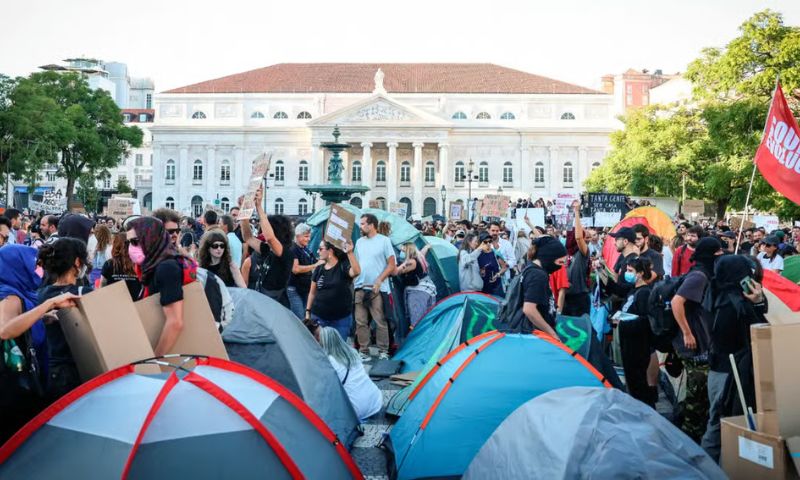
ISLAMABAD: Portuguese police dismantled a housing protest camp in central Lisbon early Sunday, arresting several demonstrators and reporting minor injuries as anger over soaring rents and the shortage of affordable homes continued to fuel unrest across Europe.
Dozens of officers, some accompanied by police dogs, moved into Rossio Square shortly after 2 am and removed more than 100 tents following a march attended by thousands on Saturday.
Police warned protesters to remove the tents or face their dismantling, while those resisting the operation faced possible charges for disobedience.
The operation marked the latest confrontation between housing activists and authorities in Lisbon, where protesters returned to the streets despite police clearance of a similar encampment on Tuesday.
Housing crisis drives Lisbon protest
The demonstrators are demanding that Portugal’s government withdraw legislation that would make evictions easier and remove rent caps on new leases.
The confrontation reflects growing frustration over housing affordability in Portugal, where house prices have more than doubled since 2017 and rents for new leases have nearly doubled, according to Reuters.
The Bank of Portugal estimates the country faces a shortage of 300,000 homes, a deficit equivalent to Lisbon’s entire housing stock.
Young people have been particularly affected by rising accommodation costs, with housing activists arguing that speculation, concentrated wealth and inequality are making independent living increasingly difficult.
Unrest extends beyond Portugal
Sunday’s developments followed Saturday’s massive demonstrations across Europe, including France, Italy, Spain, Belgium and Albania.
Protesters raised different grievances ranging from the cost of living and pensions to education funding, corruption and opposition to war.
In France, the unrest has grown from student protests into a wider movement over living costs, public services and education.
READ ALSO: Clashes Break Out in Paris, Other Cities Amid Fresh Protests
Authorities mounted a major security operation following violence during earlier demonstrations, deploying 70,000 police officers and gendarmes nationwide.
In Italy, thousands marched in Milan, Rome, Turin, Naples, Bologna and Florence. The demonstrations targeted rising living costs, government policies and military spending, with isolated clashes reported in several cities.
In Spain, thousands of pensioners and supporters demonstrated in Madrid on Saturday to defend retirement benefits and oppose potential privatisation of the public pension system.
Housing affordability has also become a major source of discontent, particularly among younger people struggling with high rents and property prices.
Albania witnessed a more violent confrontation in Tirana, where student protests over education funding and corruption merged with demands for Prime Minister Edi Rama to resign.
Police used tear gas and water cannons as some demonstrators attacked government buildings.
Belgium has also experienced clashes during demonstrations over education and public spending, adding to concerns about the scale of social discontent across the continent.
Different grievances, common pressure
The demonstrations do not form a single, coordinated European movement. Their demands differ with respect to national circumstances, and the latest police operation in Lisbon should not be interpreted as evidence that protests have escalated everywhere on Sunday.
However, the events reveal common pressures confronting European governments: housing costs that have outpaced households’ means, concerns about public services, demands for better wages and pensions, and frustration with political decisions.
Housing has emerged as a particularly visible source of anger. In Portugal, activists are challenging proposed changes to rental protections, while demonstrations in Spain have highlighted the difficulties facing younger people and lower-income households seeking affordable accommodation.
For European governments, the challenge extends beyond dispersing demonstrations.
Without effective responses to housing shortages, rising rents and pressure on household budgets, the grievances driving the protests are likely to remain politically significant.
Europe’s latest wave of unrest has therefore shifted from street demonstrations to a broader contest over economic priorities, public services and the protection of social rights.
Sunday’s clearance of the Lisbon camp underscores how unresolved domestic grievances can sustain protests even after authorities remove the immediate focus of a demonstration.