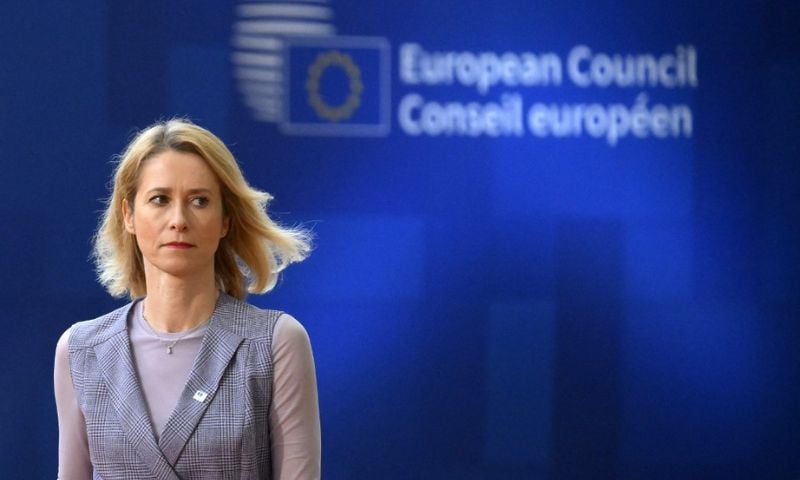



BRUSSELS: Europe must step up efforts on defence and play a bigger role in NATO as US President Donald Trump has “shaken the transatlantic relationship to its foundation”, European Union’s top diplomat Kaja Kallas said Wednesday.
Speaking at a defence conference in Brussels, Kallas said Europe could no longer rely on Washington as it once did, even though the United States would remain a key partner and ally.
“Europe needs to adapt to the new realities,” she said. “Europe is no longer Washington’s primary centre of gravity. No great power in history has outsourced its survival and survived.”
Her remarks followed renewed tensions between Washington and European allies after Trump threatened earlier this month to seize Greenland, an autonomous territory of NATO and EU member Denmark, before later rowing back.
The episode added to growing European concerns about long-term US commitment to the continent’s security.
NATO still central, but Europe must do more
Kallas stressed that NATO remained the cornerstone of European security and said EU defence efforts should remain complementary to the alliance.
However, she argued that Europe needed to shoulder a larger share of the burden.
“Especially now, as the US is setting its sights beyond Europe, NATO needs to become more European to maintain its strength,” she said. “For this, Europe must act.”
European countries have increased defence spending since the Russia-Ukraine was and last year agreed to raise NATO’s spending targets under pressure from Washington.
The EU has also launched initiatives that it says could mobilise up to 800 billion euros in additional defence investment over the coming years.
The United States, meanwhile, has made clear it wants European allies to take more responsibility for conventional defence as its strategic focus shifts towards other challenges, including China.
Rutte warns against going it alone
Earlier this week, NATO Secretary General Mark Rutte struck a more cautious tone, warning EU lawmakers that Europe could not realistically defend itself without the United States.
“Keep on dreaming,” Rutte said earlier this week, arguing that replacing the US nuclear umbrella would cost “billions and billions of euros” and require Europe to at least double its current spending targets.
He warned that attempts to build parallel European forces outside NATO could benefit Russia.
“Putin will love it. So think again,” he said, urging the EU instead to reduce regulation and help its defence industry grow.
EU Defence Commissioner Andrius Kubilius, speaking at the same conference as Kallas, said Europe needed to “rapidly build our independence — without delays and without excuses.”
“To be clear, independence does not mean alone,” he said. “Independence means together.”
Europe’s capabilities and limits
Camille Grand, head of the European defence industry group ASD, told AFP that European manufacturers could match most US military capabilities in the coming years.
However, he said the goal was not to eliminate US support but to allow European forces to take the lead in defending the continent.
“The question is whether the baseline scenario is that the United States defends Europe, or Europe defends Europe with the help of the United States,” he said.
“Europeans need to reach the second scenario as quickly as possible.”
Faster rearmament
Meanwhile, Danish Prime Minister Mette Frederiksen echoed calls for urgent action, saying Europe must strengthen its defences “now” to reduce reliance on the United States.
Speaking in Paris on Wednesday, Frederiksen acknowledged that Europe currently depended heavily on Washington, particularly for intelligence and nuclear deterrence.
“It would be extremely difficult for Europe to defend itself right now,” she said at Sciences Po university.
“But I think we’re able to do more than what is being said publicly,” she added, warning that a long-term target such as 2035 to ramp up defence spending would be “too late.”
“I think rearming ourselves now is the most important thing,” she said, adding that Europe had made a “big mistake” by cutting military budgets in the past.
NATO members last year committed to raising defence and security spending to 5 percent of economic output, building on an earlier target of 2 percent by 2024, following pressure from the US.