


NEW DELHI/BRUSSELS: As the European Union and India move closer to a long-negotiated free trade agreement, human rights groups are urging both sides to place rights and the rule of law at the centre of their expanding strategic partnership.
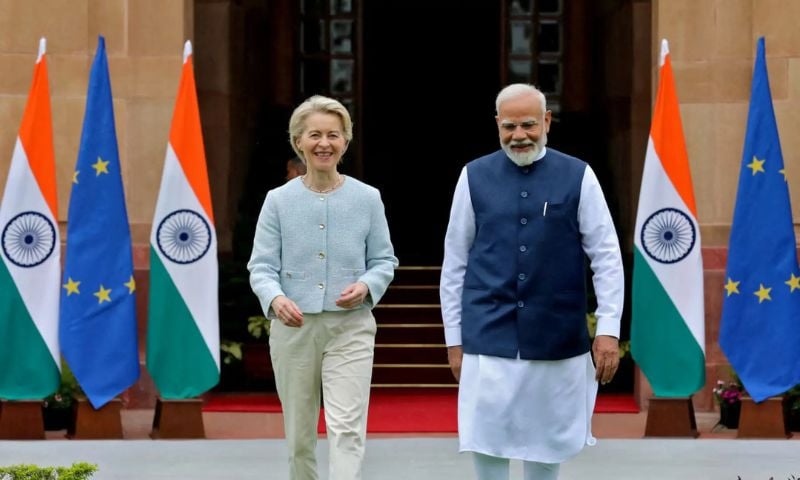
EU leaders are due to meet Indian Prime Minister Narendra Modi in New Delhi next week, following India’s Republic Day celebrations, with both sides signalling optimism about concluding what officials have described as a landmark trade and cooperation deal after nearly two decades of talks.
But Amnesty International has warned that deepening economic and security ties must not come at the expense of human rights, calling the summit a “crucial moment” for both partners to address rights concerns at home and abroad.
“With human rights ever more embattled worldwide, it’s a crucial moment for two key global players both to get their own houses in order on human rights and to jointly re-assert the importance of human rights and the rule of law across all areas of their relations, including trade, security and defence, energy transition and people to people cooperation,” said Eve Geddie, director of Amnesty International’s European Institutions Office.
India and the European Union are seeking to expand cooperation beyond trade into defence, maritime security, technology and energy transition, driven in part by shifting geopolitics and pressure from China and the United States. Bilateral trade in goods reached €120 billion in 2024, according to EU figures, with services trade adding another €60 billion.
Yet Amnesty said the growing strategic alignment risks sidelining human rights concerns, particularly in India, where it says repressive laws are increasingly used to curb freedom of expression, association and peaceful assembly.
“India must hold the EU accountable for its delivery on human rights in practice – and equally, the EU must no longer remain silent about India’s human rights record because of geostrategic and economic considerations,” said Aakar Patel, chair of Amnesty International India.
The rights group has documented what it describes as intensified discrimination against Muslims, Christians and other minorities in India, alongside the punitive demolition of Muslim homes and properties, despite a 2024 Supreme Court ruling and calls from United Nations human rights experts to halt such practices.
Amnesty also criticised the EU’s New Strategic EU–India Agenda, published in October 2025, saying human rights receive “shockingly short shrift” in a document that will shape relations for years to come.
At the same time, the organisation said Europe’s own human rights record is under strain, with EU member states rolling back protections linked to the rule of law, migration and civil liberties.
Human rights defenders and civil society groups working on climate justice, refugee and migrant rights, minorities issues, racism and Palestinian rights face increasing pressure, including smear campaigns, criminalisation and legal restrictions, Amnesty said.
Despite these concerns, EU and Indian officials remain confident that a trade agreement could be finalised soon, potentially unlocking greater market access in sectors ranging from manufacturing and pharmaceuticals to digital services and green energy. Talks are also under way on a strategic partnership covering security and defence cooperation.
Amnesty, however, warned that silence on rights would send a damaging signal.
“The EU must clearly denounce serious human rights violations and demand that India respect its commitments in this area,” Patel said. “Where India and the EU fail to speak about human rights, when they are under attack worldwide, both sides will send a disastrous political signal of normalization and impunity.”
The organisation also criticised both India and EU member states for continuing to transfer military equipment to Israel, calling for a comprehensive arms embargo. Amnesty said arms exports that enable Israel’s actions in Gaza and the occupied Palestinian territory violate international law and undermine global human rights standards.
As leaders prepare to gather in New Delhi, analysts say the summit will test whether the EU and India can reconcile their push for closer economic and strategic cooperation with growing demands for accountability on human rights — a balance that could define the future of the partnership.