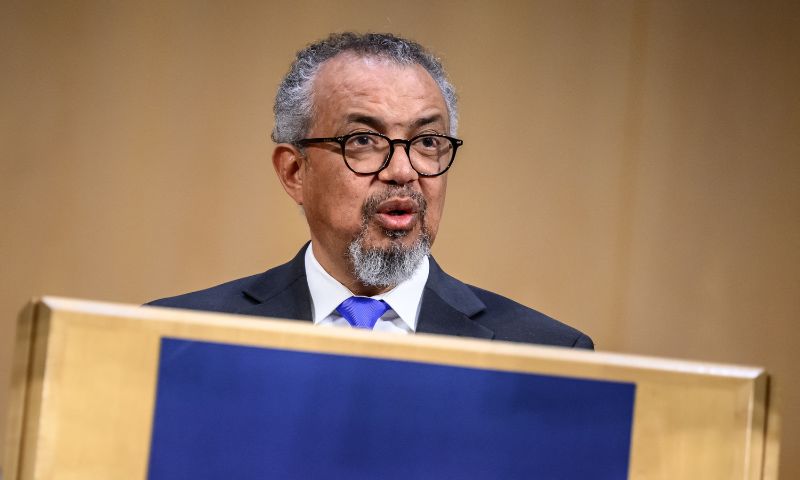
GENEVA: World Health Organization chief Tedros Adhanom Ghebreyesus warned on Monday that recent outbreaks of Ebola and Hantavirus reflected increasingly “dangerous and divisive” global conditions as health ministers gathered in Geneva for the organisation’s annual assembly.
Opening the World Health Assembly, Tedros pointed to a new Ebola outbreak in the Democratic Republic of Congo and a rare hantavirus outbreak aboard the MV Hondius cruise ship as examples of mounting global health threats.
“The two are just the latest crises in our troubled world,” Tedros told delegates.
“From conflicts to economic crises to climate change and aid cuts, we live in difficult, dangerous and divisive times,” the WHO chief added.
Tedros formally declared the Ebola outbreak in Congo an international health emergency over the weekend.
He is expected to expand on global health risks during a major address to the assembly on Tuesday.
Spanish Prime Minister Pedro Sanchez received applause from delegates after delivering a surprise address to the assembly.
Spain was praised after allowing the MV Hondius, affected by the hantavirus outbreak, to anchor off the Canary Islands last week so passengers and crew could be evacuated.
“Protecting others is the best way to protect ourselves,” Sanchez said.
“No country can save itself” alone, he added, warning against what he described as a growing “pandemic of egoism”.
“Defending common sense has become a form of rebellion,” the Spanish leader said.
WHO faces financial strain
The 2026 World Health Assembly opened against the backdrop of deep financial pressures facing the WHO following the announced withdrawal of the United States and major budget cuts.
Swiss Health Minister Elisabeth Baume-Schneider said the WHO’s budget had been reduced by around 21 percent, equivalent to nearly one billion dollars.
“Hundreds of jobs have been eliminated, programmes have been reduced,” she told delegates.
“The WHO had to, and was able to, undergo profound reform in the midst of the emergency,” she added.
Suerie Moon, co-director of the Global Health Centre at the Geneva Graduate Institute, said the hantavirus outbreak highlighted the continuing importance of the organisation.
“The world needs an effective, trusted, impartial, reliably-funded WHO,” she said.
Pandemic treaty talks remain stalled
Negotiations over the WHO’s proposed pandemic treaty also remained deadlocked.
Countries had hoped to finalise a key annex to the 2025 pandemic agreement during this year’s assembly.
The annex concerns the sharing of pathogens with pandemic potential and equitable access to vaccines, tests and treatments developed from them.
However, disagreements between wealthy and developing nations have stalled progress, and member states now appear likely to extend negotiations for another year.