


KEY POINTS
- Maduro pleads not guilty in New York court to charges after being captured in US military operation.
- Maduro told the court he was seized at his home and said he still considers himself the president of Venezuela.
- Trump said Washington is now “in charge” of Venezuela and warned interim leaders to cooperate.
- Russia, China and several countries condemned the US action at an emergency UN Security Council meeting.
- China and Russia called the US operation illegal and demanded the release of Maduro and his wife.
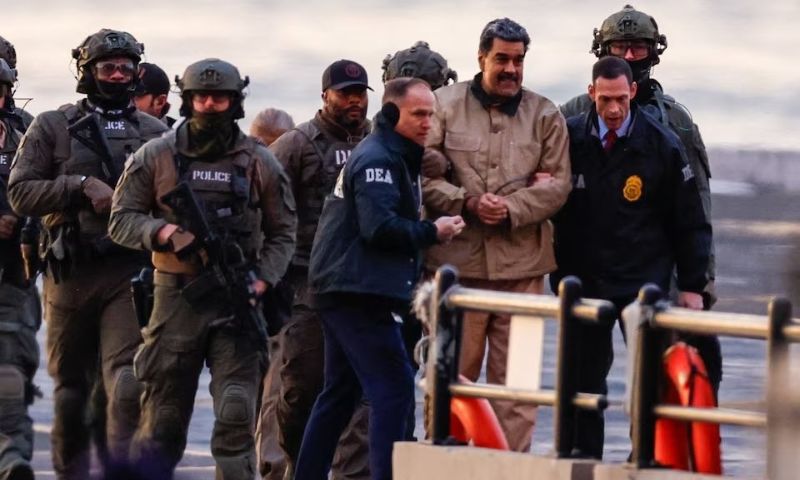
NEW YORK: Venezuela’s ousted president Nicolas Maduro pleaded not guilty on Monday to narco-terrorism, drug trafficking and weapons charges during his first appearance in a US federal court in New York, two days after he was captured in a surprise US military operation in Caracas.
“I am innocent. I am not guilty,” the 63-year-old told Judge Alvin Hellerstein in Spanish, adding that he was seized at his home in the Venezuelan capital and still considers himself the country’s president.
“I am a decent man. I am still the president of my country,” Maduro said in court, according to journalists present.
His wife, Cilia Flores, who was captured alongside him, also entered a not guilty plea. “Not guilty, completely innocent,” Flores told the court in Spanish when asked how she pleaded.
Charges against Nicolas Maduro
US prosecutors have charged Maduro and Flores with narco-terrorism conspiracy, cocaine importation conspiracy and weapons offences.
After the judge read a summary of the charges, Maduro repeated his plea of not guilty.
Judge Hellerstein informed Maduro of his right to legal counsel, including a court-appointed lawyer if he cannot afford one, and said he could be released before trial unless prosecutors show there is a reason to detain him.
“I did not know of these rights; your honour has informed me of them now,” Maduro told the judge.
Crowds gathered outside the Manhattan courthouse. Some protesters waved Venezuelan flags and chanted for freedom, while others carried banners reading “Free President Maduro”.
US now ‘in charge’ of Venezuela
US President Donald Trump said Washington, which does not recognise Maduro as Venezuela’s legitimate leader, is now “in charge” of the country.
He warned Venezuela’s interim leadership to cooperate or face a “very big price”.
Trump has said the United States intends to tap Venezuela’s vast oil reserves and has expressed confidence that American companies will help rebuild the country’s battered energy sector.
Delcy Rodríguez, who served as vice president under Maduro and is acting as interim president, called for “cooperation” with Washington but said Venezuela “has the right to peace, development, sovereignty and a future”.
Maduro is accused of overseeing a cocaine-trafficking network that partnered with violent groups including Mexico’s Sinaloa and Zetas cartels, Colombian FARC rebels and Venezuela’s Tren de Aragua gang.
Maduro has long denied the allegations, saying they were a mask for imperialist designs on Venezuela’s rich oil reserves.
While world leaders and US politicians grappled with the extraordinary seizure of a head of state, an emergency order in Venezuela, published in full on Monday, orders police to search and capture anyone who supported Saturday’s US attack.
International reaction
The dramatic US operation has triggered alarm internationally.
On Monday, the UN Security Council debated its legality and implications. Russia, China and leftist allies of Venezuela condemned the raid.
United Nations Secretary-General Antonio Guterres told an emergency meeting of the UN Security Council that there must be “respect for the principles of sovereignty, political independence and territorial integrity”.
Guterres raised concerns about instability in Venezuela and the legality of Trump’s strike.
Mexico’s President Claudia Sheinbaum said the Americas “do not belong” to anyone, while Colombian President Gustavo Petro issued a strongly worded statement warning against US intervention.
The emergency meeting was requested by Venezuela and formally relayed to the Council by Colombia, which has been a non-permanent member since January 1. China and Russia also supported the call.
The session is being held under the agenda item “Threats to International Peace and Security,” reflecting growing concern among several UN members that the crisis has moved beyond bilateral tensions and now poses wider regional and global risks.
China calls US action ‘illegal and bullying’
US Ambassador to the United Nations Mike Waltz addressed the Security Council meeting on Venezuela.
“There is no war against Venezuela or its people. We are not occupying a country. This was a law enforcement operation,” he said of the raid in which Maduro was captured.
“The overwhelming evidence of his crimes will be presented openly in US court proceedings,” Waltz said.
“I want to reiterate that President Trump gave diplomacy a chance. He offered Maduro multiple off-ramps. He tried to de-escalate. Maduro refused to take them.”
He added that the US will not waver in its actions to “protect Americans from the scourge of narco-terrorism and seek peace, liberty and justice for the great people of Venezuela.”
China called on the US to release Maduro and his wife, its deputy UN representative Sun Lei told the Security Council.
“China is deeply shocked by and strongly condemns the unilateral, illegal and bullying acts of the US,” said Sun through an interpreter.
“We demand that the United States change its course, cease its bullying and coercive practices, and develop relations and cooperation with regional countries on the basis of mutual respect, equality and non-interference in international affairs.”
Russia says no justification for US ‘crimes’ in Venezuela
Russia condemns the US for what it called the “act of armed aggression” against Venezuela, its UN envoy Vassily Nebenzia told the Security Council.
“There is no and can be no justification for the crimes cynically perpetrated by the United States in Caracas. We firmly condemn the US act of armed aggression against Venezuela, in breach of all international legal norms,” Nebenzia said through an interpreter.
Russia also called on the US to release Maduro and his wife.
Maduro became president in 2013, succeeding Hugo Chávez.
The US military operation that led to his capture involved a surprise raid on his residence, backed by air and naval assets, according to US officials and media reports.
Washington said no US service members were killed, though some were wounded. Cuba claimed that 32 Cubans died during the operation.
In Caracas, thousands of Maduro supporters rallied over the weekend, waving Venezuelan flags and chanting slogans in his support.
Lawmakers in the Venezuelan parliament shouted “Let’s go Nico!” during a session on Monday.
Despite the upheaval, the Trump administration has signalled it wants continuity within Venezuela’s governing structures, provided remaining officials comply with US demands.
Venezuela holds the world’s largest proven oil reserves, though years of sanctions have left its oil infrastructure in poor condition.
Following the developments, shares in major US oil companies rose sharply on Wall Street.