


Key Points
- Social Democrats record worst vote share in over a century
- Centrist Moderates emerge as kingmakers with 14 seats
- Liberal Party refuses alliance with Frederiksen’s party
- Far-right Danish People’s Party triples its support
- Greenland and Faroe Islands seats still to influence final outcome
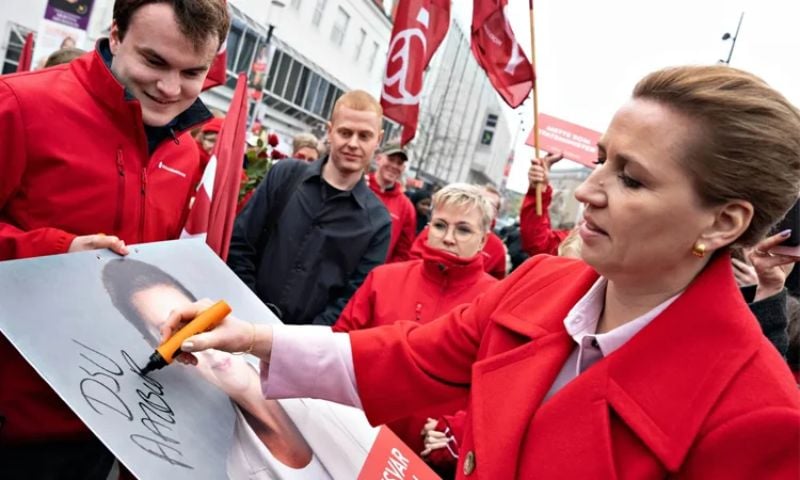
COPENHAGEN: Denmark’s Prime Minister Mette Frederiksen and her Social Democrats emerged as the largest political force in the country’s general election, but the broader left-wing bloc failed to secure a governing majority, setting the stage for complex coalition negotiations.
Preliminary results from mainland Denmark show the left bloc winning 84 seats in the 179-member parliament, falling short of the 90 needed to govern, according to AFP.
The right-wing parties secured 77 seats, leaving the centrist Moderates—led by Foreign Minister Lars Løkke Rasmussen—with a decisive 14 seats that position them as kingmakers in the formation of the next government.
Despite finishing first, Frederiksen’s Social Democrats recorded their weakest electoral performance in over a century, capturing just 21.8 percent of the vote—a significant drop from their previous result in 2022.
The decline reflects broader voter dissatisfaction, as all parties in the current cross-bloc government lost support.
Attention now turns to Rasmussen, whose Moderates could determine whether Denmark sees a continuation of cross-party governance or a shift toward a new political alignment.
Rasmussen has advocated for cooperation across traditional political divides, calling for unity rather than ideological polarization. However, divisions remain sharp, with the Liberal Party ruling out participation in any government led by the Social Democrats.
The election also highlighted a resurgence of far-right sentiment. The Danish People’s Party, known for its strong anti-immigration stance, saw its support more than triple compared to the previous election, signaling renewed public backing for stricter migration policies.
Meanwhile, parties on the left are positioning themselves for negotiations. The Green Left alliance, buoyed by a strong performance, has emphasized welfare and environmental priorities as key conditions for joining any coalition.
Beyond mainland Denmark, the final composition of parliament will also depend on results from Greenland and the Faroe Islands, which together hold four seats. Voting in Greenland has drawn unusual attention this year, amid geopolitical tensions and renewed debate over the island’s future.
Greenland’s leadership has underscored the significance of the election, particularly in light of external pressures and ongoing discussions about independence from Denmark. While political parties in the territory broadly agree on eventual independence, they remain divided over the timeline and approach.
Domestically, the election campaign centered on economic pressures, public services, environmental concerns, and immigration—issues that appear to have reshaped voter priorities.
Frederiksen, who has led Denmark since 2019, has taken a firm stance on tightening migration policies, a move seen as an attempt to counter the rise of right-wing parties.
With no clear majority and political divisions deepening, Denmark now faces a period of intense negotiations that will determine the direction of its next government.