


The final moments at the ICC Men’s T20 World Cup 2026 carried a familiar sense of heartbreak for New Zealand.
After navigating a demanding tournament with discipline and composure, beating a better South African side in the semi-final, the Black Caps once again found themselves on the brink of global glory — and once again, the trophy slipped away.
India Triumph, New Zealand Fall in Another Final
In the final, India proved stronger when it mattered most, defeating New Zealand to secure the title.
The match unfolded as a one-sided encounter, with Black Caps asking the host side to bat first after winning the toss. India seized control in the early stage and posted the highest target in the history of the T20 WC finals.
While chasing, New Zealand faltered, and the game slipped away in the power play, where New Zealand lost 3 wickets before reaching fifty.
India bundled the innings in 19 overs and defeated them by 96 runs, the most in the history of T20 WC finals.
For New Zealand, the defeat must be painfully familiar. The loss echoed another recent disappointment: their defeat against India in the ICC Champions Trophy 2025 final.
Within just twelve months, the Black Caps had reached two major ICC finals — and lost both to the same opponent.
The immediate reaction across cricket circles ranged from admiration to criticism.
While many praised New Zealand’s consistency in reaching the latter stages of global tournaments, others revived a harsh label that has long haunted international cricket: the accusation of being bigger chokers than the actually labelled South Africa.
A Strong Campaign in the 2026 T20 World Cup
The Black Caps will not be pleased with how things unfolded in this T20 World Cup. On paper, their side looked stronger than the performance they displayed on the field.
In the group stage, they secured wins against Afghanistan and associate sides like the UAE and Canada, but they lost to South Africa, who proved to be the superior team.
In the Super 8s, they managed a win against Sri Lanka, though they were missing some key players, and their only notable victory came against Australia, who had one of their worst T20 World Cup campaigns.
New Zealand’s clash with England, which seemed like a game they should have won comfortably, slipped away due to questionable decisions: the 18th over was bowled by a part-timer, and the penultimate over went to captain Santner, a spinner.
Those two overs ultimately cost them the match, allowing England to snatch victory.
Their encounter with Pakistan was washed out, but judging by New Zealand’s performance against England and Pakistan’s own showing, it appeared Pakistan might have been the stronger side and could have emerged victorious if the game had taken place.
In the semi-final against South Africa, it was the brilliance of Finn Allen that effectively decided the match by the 13th over.
However, in the final, India displayed complete dominance, exceptionally outplaying New Zealand and claiming the title with authority.
A History of Near Misses in T20 World Cups
The 2026 defeat adds to a pattern that stretches across multiple ICC tournaments for New Zealand.
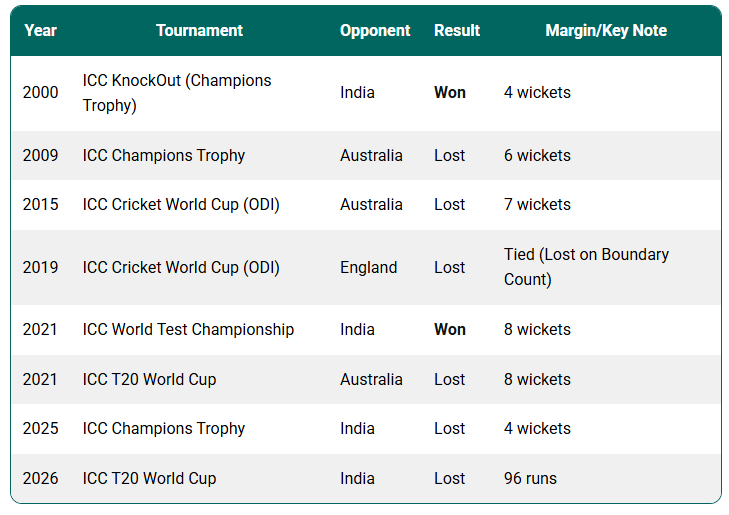
In the ICC Champions Trophy 2025, they fell to India in the final. Earlier, they had reached the final of the T20 World Cup 2021 but were defeated by Australia.
One of the most dramatic heartbreaks came in the 2019 ICC Cricket World Cup final against England, where the match and the Super Over ended in ties, leaving England to claim the title on boundary count.
Four years earlier, New Zealand had also lost the 2015 ICC Cricket World Cup final to Australia.
Before that, they were beaten by the same opposition in the final of the ICC Champions Trophy 2009.
Despite these setbacks, New Zealand have also experienced notable successes. They lifted the title in the ICC Champions Trophy 2000 and later secured the inaugural ICC World Test Championship Final 2021 — on both occasions defeating India in the final.
Yet the recent defeats in two ICC tournament finals within twelve months have also come against India.
Beyond finals, the semi-finals have also often proven challenging.
In several tournaments, New Zealand have fallen narrowly at the last hurdle before the final, despite entering those tournaments with strong momentum and consistent performances throughout the competition.
Why Do New Zealand Lose on the Biggest Stage?
There is no simple answer to this question. Cricket offers no logical explanation for how a team can be the best side throughout a tournament yet fail to lift the trophy.
The reality is that in the finals they have lost, New Zealand have rarely been the better team on the day.
Take the final in Ahmedabad, for instance. India piled up 255, and New Zealand lost three key wickets within the first five overs of the chase.
From that point onward, the contest was effectively over.
In the 2021 World Cup final in Dubai, the heavy dew in the evening made conditions ideal for chasing, allowing Australia to pursue New Zealand’s target with relative ease.
Similarly, in the 2015 World Cup final, once Brendon McCullum was clean bowled by Mitchell Starc early in the innings, New Zealand struggled to regain momentum and were eventually bowled out for a below-par total.
In most of these finals, therefore, New Zealand were not truly competitive.
The notable exception was the 2019 World Cup final, where they pushed England to the absolute limit, tying both the match and the Super Over before losing on the boundary-count rule.
Are New Zealand Bigger Chokers Than South Africa?
South Africa’s reputation developed largely from unexpected collapses or dramatic match-turning moments.
New Zealand’s defeats, by contrast, have more often come through competitive matches where the opposition ultimately proved stronger.
Few teams in modern cricket reach as many ICC knockout matches across formats.
Sustained presence at that level suggests structural strength rather than mental fragility.
If anything, New Zealand’s story is less about choking and more about the brutal mathematics of tournament cricket.
When a team repeatedly reaches the final stages, it inevitably accumulates high-profile defeats alongside occasional triumphs.
The irony is that New Zealand’s greatest strength — their relentless consistency — may also shape the perception of their failures.
Because they appear so often on the biggest stages, their defeats are remembered more vividly.