


BEIJING: Senior trade officials from China and the United States began two days of economic and trade talks in Paris on Sunday, Chinese state media reported, as both sides prepare for an expected summit between US President Donald Trump and Chinese leader Xi Jinping later this month.
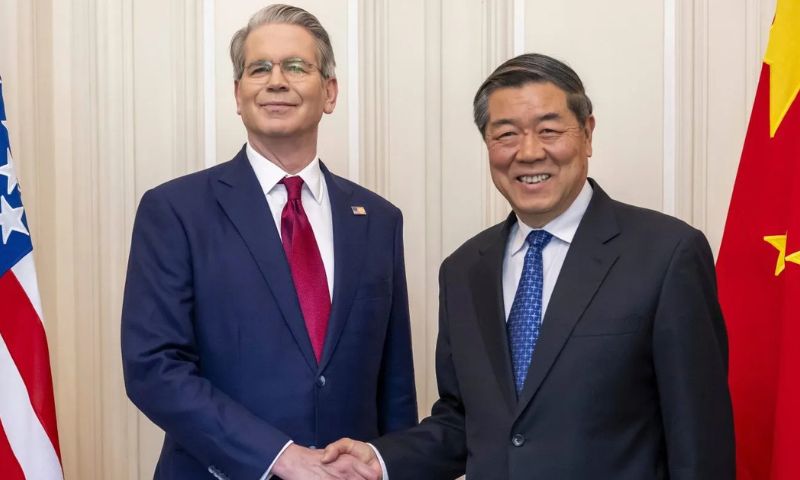
The discussions are being led by Scott Bessent and Chinese Vice Premier He Lifeng, according to China’s official news agency Xinhua.
China’s state broadcaster China Central Television said the meetings are being held at the headquarters of the Organisation for Economic Co operation and Development in Paris.
Officials said the talks would last two days and focus on economic and trade issues between the world’s two largest economies.
Trump–Xi meeting
The Paris talks are widely seen as laying the groundwork for an expected visit by Trump to China at the end of March.
The White House has said Trump plans to travel to Beijing from March 31 to April 2, although Chinese authorities have not formally confirmed the dates in line with Beijing’s usual diplomatic practice.
If confirmed, the trip would mark Trump’s first visit to China since his earlier presidential trip in 2017.
The summit would come about five months after Trump and Xi met in the South Korean city of Busan, where the two leaders agreed to a one-year truce in a trade war that had seen retaliatory tariffs soar to triple-digit levels.
Trade tensions
Despite the temporary easing of tensions, trade disputes remain a major source of friction between the two countries.
The United States and China fought a bitter trade conflict for much of 2025, with reciprocal tariffs and export restrictions threatening global supply chains, particularly for critical minerals.
Recent data show that Chinese exports to the United States fell by 11 percent in the first two months of the year compared with the same period in 2025.
However, China’s overall exports surged by nearly 22 percent during the same period.
China’s commerce ministry said earlier that officials meeting in Paris would conduct consultations on “economic and trade issues of mutual concern.”
Bessent said on Thursday that economic dialogue between Washington and Beijing “is moving forward.”
He added that his team would continue working to deliver results that benefit American farmers, workers and businesses.
US trade probes
Tensions have resurfaced after Washington announced new investigations into industrial overcapacity and forced labour involving China and other trading partners.
The US Trade Representative’s office said it has launched trade investigations into 60 economies, including China, to examine “failures to take action on forced labour.”
The probes could eventually lead to new tariffs, although the investigations are expected to take months.
The move followed a February ruling by the US Supreme Court that struck down sweeping global tariffs previously imposed by the Trump administration.
China criticised the investigations, calling them “a typical act of unilateralism that severely undermines the international economic and trade order.”
Chinese foreign ministry spokesman Guo Jiakun rejected the allegations.
“The so-called forced labour is entirely a lie fabricated by the US side,” Guo said, adding that China “opposes all forms of unilateral tariff measures.”
Global tensions add pressure
The Paris meeting comes at a turbulent moment for the global economy, with energy markets unsettled by the ongoing conflict involving the United States, Israel and Iran.
Trump said on Saturday that he hopes China and several other countries — including France, Japan, South Korea and the United Kingdom — will deploy ships to help ensure the Strait of Hormuz remains open.
The narrow waterway carries around one-fifth of the world’s oil supply, making it a critical global shipping route.
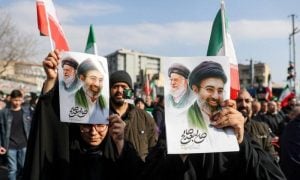
China has condemned the killing of Iran’s former supreme leader Ayatollah Ali Khamenei but has also criticised Iranian strikes against Gulf states.
China’s foreign ministry has not yet responded to Trump’s call for naval deployments.
Meanwhile, South Korea said it was “closely monitoring” the US president’s remarks, while a senior Japanese official said Tokyo maintained a high threshold for such a move.
Chinese Foreign Minister Wang Yi said last week that 2026 would be “a big year” for relations between the two countries.
While he did not confirm Trump’s upcoming visit, Wang said the agenda for high-level exchanges between Beijing and Washington was already under discussion.