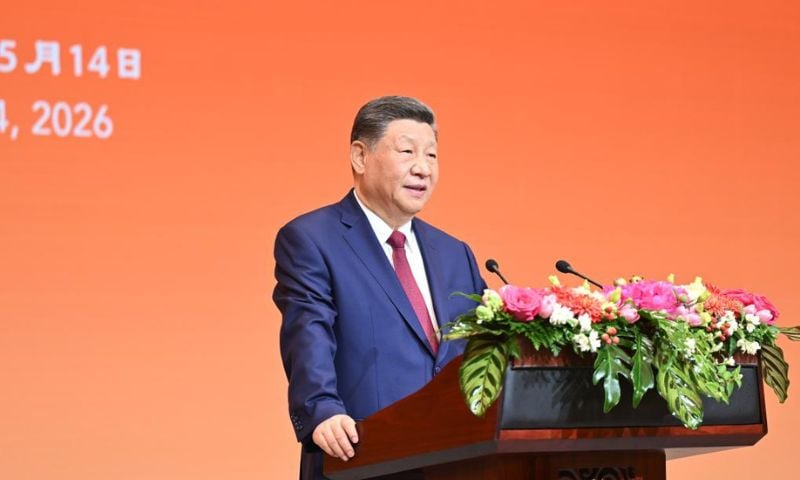
BEIJING/PYONGYANG: Chinese President Xi Jinping arrived in Pyongyang on Monday, state news agency Xinhua reported, for his first official visit to North Korea since 2019.
Xi, who will hold talks with Kim Jong Un during his two-day visit, arrived in the North Korean capital at midday local time (03:00 GMT) on Monday, Xinhua reported.
Earlier, ahead of his first visit to the country in seven years, Xi Jinping said that China’s friendship with North Korea was “invincible” and pledged closer cooperation with Pyongyang, according to North Korean state media.
In an article published on the front page of North Korea’s ruling Workers’ Party newspaper, Rodong Sinmun, Xi said the longstanding relationship between the two neighbours would endure despite changing global circumstances.
“No matter how the times change or how the international situation evolves, the traditional friendship between China and North Korea will always remain invincible,” Xi wrote.
China has long been North Korea’s largest trading partner and its most important source of economic and diplomatic support. Beijing’s backing has been crucial to the survival of the North Korean economy despite years of international sanctions.
Xi’s trip also comes as efforts to revive negotiations over North Korea’s nuclear programme remain stalled. Last month, the White House said Xi and Trump had reaffirmed their shared objective of achieving the denuclearisation of North Korea during talks in Beijing.
Chinese Foreign Ministry spokeswoman Mao Ning said the two leaders would discuss bilateral relations and regional issues and seek ways to contribute to peace and stability.
However, prospects for progress on the nuclear issue appeared limited after Kim Yo Jong, the influential sister of North Korean leader Kim Jong Un, declared that the country’s nuclear weapons programme was “the line of no retreat”.
Analysts say Beijing’s priorities have increasingly shifted from denuclearisation to maintaining stability on the Korean Peninsula.
Minseon Ku, a diplomacy professor at DePaul University, said China appeared to have accepted North Korea’s status as a nuclear-armed state.
“Beijing probably has accepted North Korea as a nuclear state,” she said, adding that Xi’s main message to Kim would likely focus on preserving regional stability.
Seong-Hyon Lee, a visiting scholar at the Harvard University Asia Center, said China was increasingly focused on ensuring the durability of the North Korean regime rather than pressuring it to abandon its nuclear arsenal.
“China’s broader regional strategy benefits from a stable, heavily armed, and aligned buffer state that absorbs US and allied military bandwidth,” he said.
North Korea has repeatedly described itself as an irreversible nuclear power since negotiations between Kim and Trump collapsed in 2019 over disagreements regarding sanctions relief and denuclearisation measures.
Although Trump has indicated he remains open to another summit with Kim, Pyongyang has shown little interest in returning to talks.
Meanwhile, North Korea’s growing military cooperation with Russia has strengthened Kim’s position internationally. Pyongyang has provided troops and support to Moscow during the war in Ukraine, deepening ties between the two countries.
Some analysts believe Xi’s visit may also be aimed at balancing Russia’s growing influence in North Korea. However, experts note that Beijing remains Pyongyang’s most important strategic partner.
Xi last met Kim in September, when both leaders joined Putin at a military parade in Beijing marking the 80th anniversary of the victory over imperial Japan in World War Two.
The appearance highlighted Kim’s elevated international profile as he stood alongside the leaders of China and Russia during one of Beijing’s most significant state events.