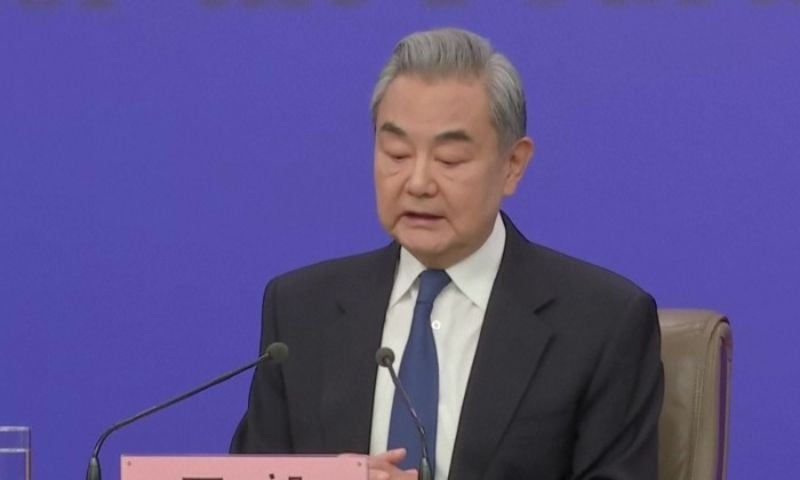



BEIJING: China’s Foreign Minister Wang Yi urged the United States on Sunday to responsibly manage its differences with Beijing as tensions between the world’s two largest economies intensify over trade policies, security concerns and global conflicts.
Speaking at a press conference in Beijing during China’s annual political meetings – known as the “Two Sessions” – Wang stressed that both countries must find ways to coexist despite their strategic rivalry.
Relations between Washington and Beijing have grown increasingly strained since US President Donald Trump returned to the White House last year, triggering a renewed trade dispute marked by tariffs on a wide range of goods from both sides.
Wang criticized what he described as attempts by the United States to disrupt global supply chains and impose tariff barriers, warning that such policies could ultimately damage the global economy.
He compared the strategy to “trying to extinguish a fire with fuel,” suggesting that escalating trade restrictions could backfire rather than resolve economic tensions, according to AFP.
‘Big Year’ for China–US relations
According to Wang, 2026 could prove pivotal for Sino-US relations. He acknowledged that while the two powers cannot fundamentally change each other’s political systems or global ambitions, they can adjust the way they interact.
“We cannot change each other, but we can change how we engage with each other,” he said, urging both sides to manage disputes and avoid unnecessary confrontation.
The remarks come ahead of a planned meeting between US President Donald Trump and Chinese President Xi Jinping in Beijing in April, which could shape the future trajectory of bilateral relations.
China criticizes Middle East escalation
During the briefing, Wang also addressed the ongoing war in the Middle East sparked by US and Israeli military strikes on Iran, which China has strongly condemned.
Beijing maintains close diplomatic and economic ties with Tehran and has criticized the reported killing of Iran’s Supreme Leader, Ayatollah Ali Khamenei, during the conflict.
Wang described the war as unnecessary and dangerous, warning against the use of force in international relations. “A strong fist does not represent strong reason,” he said. “The world must not return to the law of the jungle.”
China maintains supportive ties with Russia
Wang also reaffirmed that China’s relationship with Russia remains “steadfast and unshakeable,” despite criticism from Western nations that Beijing’s trade with Moscow is helping sustain the war in Ukraine.
While China insists it is a neutral actor seeking peace in the conflict, Western governments argue that Chinese economic support allows Russia to bypass international sanctions.
Europe moving closer to Beijing
The Chinese foreign minister suggested that relations between China and the European Union have improved over the past year. Several Western leaders – including officials from France, Canada, Finland and the United Kingdom – have visited Beijing recently amid disagreements with Washington over trade tariffs and geopolitical issues.
Wang welcomed the engagement, saying an increasing number of European policymakers now view China as a partner rather than a strategic rival. In recent months, China has also expanded visa-free travel agreements with about 50 countries and reduced tariffs on some imports from Canada and the UK in an effort to deepen economic ties.
Taiwan remains a critical flashpoint
Despite calls for cooperation, tensions remain particularly high over Taiwan, which Beijing regards as an inseparable part of China and a core issue in its relations with the United States.
Beijing has repeatedly warned that it will not tolerate any moves toward Taiwanese independence and has not ruled out using military force to bring the island under its control.
Wang reiterated that Taiwan remains a “red line” for China’s leadership. “China will never allow any individual or force to separate Taiwan from China,” he said.
The issue has also strained relations between China and Japan after Japanese Prime Minister Sanae Takaichi suggested Tokyo could intervene militarily if Taiwan were attacked.
As global tensions persist, analysts believe upcoming diplomatic engagements – including the anticipated Xi-Trump meeting – could play a critical role in determining whether competition between the two major global powers stabilizes or escalates further.