
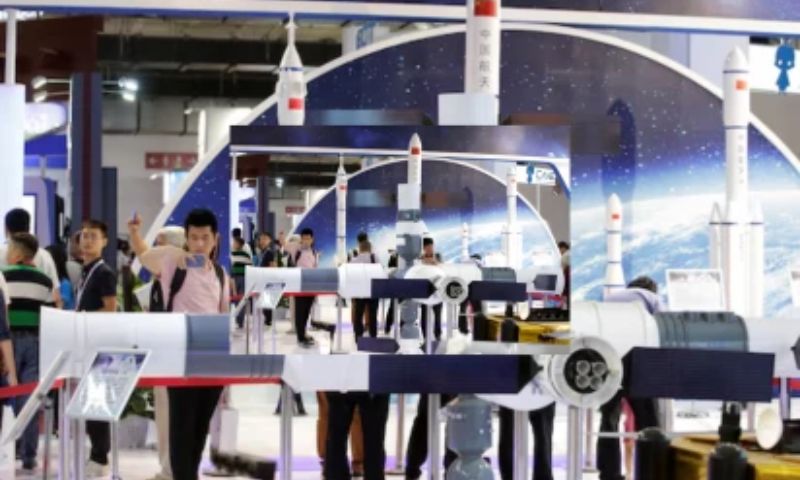



BEIJING: China’s main state-owned aerospace contractor has pledged to begin space tourism operations within the next five years, signaling Beijing’s determination to accelerate commercial spaceflight and deep space exploration as rivalry with the United States intensifies.
The China Aerospace Science and Technology Corporation (CASC) said it aims to “achieve the flight operation of suborbital space tourism and gradually develop orbital space tourism,” according to a report by state broadcaster CCTV on Thursday.
The company also announced plans to build a gigawatt-level space digital intelligence infrastructure to support future space operations.
China and the United States are increasingly competing to transform space exploration into a commercially viable industry, comparable to civil aviation, while also seeking to secure the military and strategic advantages of space dominance. CASC has previously stated its goal of transforming China into a “world-leading space power” by 2045.
According to Reuters, a major challenge for Beijing remains the development of reusable rocket technology, which is critical to reducing launch costs and enabling frequent space missions.
US-based SpaceX currently dominates this area with its Falcon 9 reusable rocket, which has underpinned the rapid expansion of its Starlink satellite network and enabled commercial orbital space tourism.
Despite this bottleneck, China recorded a historic 93 space launches last year, driven largely by the rapid growth of domestic commercial spaceflight startups.
Beijing has repeatedly characterized SpaceX’s dominance of low Earth orbit (LEO) satellites as a national security concern and is pushing ahead with its own satellite constellations.
In late December, Chinese entities submitted filings to the International Telecommunications Union (ITU) outlining plans to deploy around 200,000 satellites over the next 14 years.
Two mega-constellations account for most of the proposed satellites, a move that would effectively reserve key orbital slots and radio frequencies for China.
CASC’s announcement follows the inauguration this week of China’s first School of Interstellar Navigation, established under the Chinese Academy of Sciences.
The institution aims to cultivate talent in frontier fields such as interstellar propulsion, deep-space navigation, and planetary exploration, supporting China’s long-term ambitions beyond near-Earth orbit.
According to state news agency Xinhua, the new school will contribute to China’s planned lunar research station and efforts to detect planets outside the solar system.
“The next 10 to 20 years will be a window for leapfrog development in China’s interstellar navigation field,” Xinhua said.
CASC also plans to pursue breakthroughs in technologies including celestial resource exploration, intelligent autonomous mining, and space debris monitoring, while playing a larger role in shaping international space traffic management rules.
China has already demonstrated its growing capabilities, with the Chang’e-6 lunar probe becoming the first spacecraft to return samples from the far side of the moon in 2024. Meanwhile, competition with the United States is intensifying as both countries aim to return astronauts to the moon this decade, more than half a century after the final US Apollo mission in 1972.