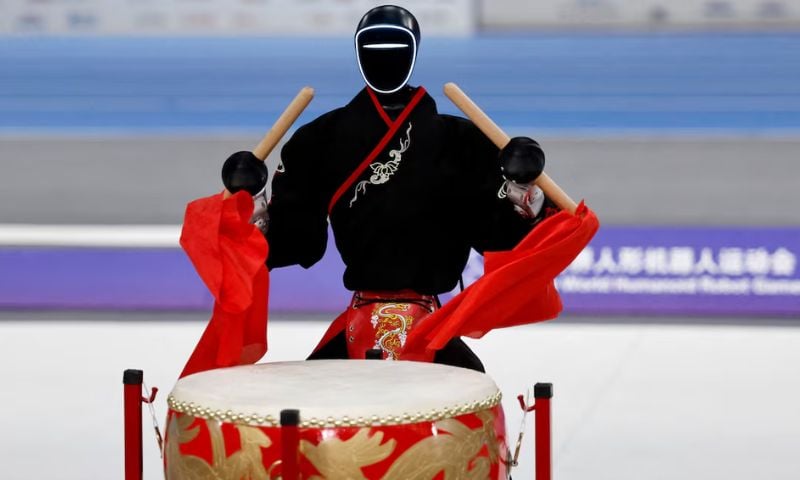



BEIJING, China: China’s most-watched television programme, the annual CCTV Spring Festival Gala, spotlighted the country’s rapidly advancing humanoid robotics sector, underscoring Beijing’s ambition to dominate the future of manufacturing and artificial intelligence.
Four emerging robotics firms — Unitree Robotics, Galbot, Noetix, and MagicLab — showcased their latest humanoid models during the Lunar New Year broadcast, often described as China’s equivalent of the Super Bowl due to its massive nationwide audience, according to Reuters.
The first three sketches prominently featured humanoid robots, including a martial arts demonstration where more than a dozen Unitree humanoids executed complex fight sequences, wielding swords, poles, and nunchucks alongside human children performers.
A particularly ambitious segment imitated the wobbly movements and backward falls of China’s “drunken boxing” style, highlighting advanced multi-robot coordination and fault recovery — allowing robots to get up after falling.
Bytedance’s AI chatbot Doubao also featured in the opening sketch, while four Noetix humanoids joined human actors in a comedy skit, and MagicLab robots performed a synchronized dance to the song “We Are Made in China.”
Robots take centre stage
The gala’s emphasis on robotics coincides with major industry developments: AgiBot and Unitree are preparing for initial public offerings this year, while domestic AI startups continue releasing advanced models during the lucrative nine-day Lunar New Year holiday.
Last year’s gala featured 16 full-size Unitree humanoids twirling handkerchiefs in unison with human performers, and Unitree’s founder subsequently met President Xi Jinping at a high-profile tech symposium – the first since 2018.
Xi has met with five robotics startup founders over the past year, comparable to meetings with four electric vehicle and four semiconductor entrepreneurs, giving the sector unusually high visibility.
The CCTV show, which drew 79% of live TV viewership in China last year, has long been used to highlight Beijing’s technological ambitions, including its space programme, drones, and robotics.
“What distinguishes the gala from comparable events elsewhere is the directness of the pipeline from industrial policy to prime-time spectacle,” said Georg Stieler, Asia managing director and head of robotics and automation at technology consultancy Stieler.
“Companies that appear on the gala stage receive tangible rewards in government orders, investor attention, and market access.”
Stieler added that the robots’ performance improvements, especially in motion control, reflect Unitree’s focus on developing robot “brains” – AI-powered software enabling fine motor tasks applicable in real-world factories.
Beijing-based tech analyst Poe Zhao said, “Humanoids bundle a lot of China’s strengths into one narrative: AI capability, hardware supply chain, and manufacturing ambition.
They are also the most ‘legible’ form factor for the public and officials. In an early market, attention becomes a resource.”
China accounted for 90% of the roughly 13,000 humanoid robots shipped globally last year, far ahead of US competitors like Tesla’s Optimus, according to research firm Omdia.
Morgan Stanley projects Chinese humanoid sales will more than double to 28,000 units this year.
Elon Musk has acknowledged China as a key competitor as Tesla pivots toward embodied AI and its humanoid Optimus, stating, “People outside China underestimate China, but China is an ass-kicker next level.”