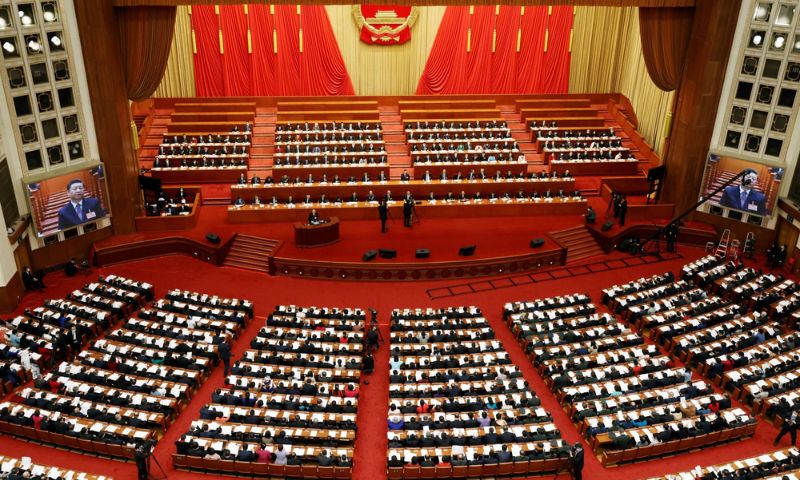



BEIJING: China’s top legislature on Thursday approved an “ethnic unity” law that has triggered strong criticism from human rights organisations, which warn the measure could further restrict the cultural and linguistic freedoms of minority groups across the country.
The law, adopted by the National People’s Congress, formalises a nationwide push to promote Mandarin as China’s “national common language” in schools, public institutions and official communications.
Authorities say the legislation aims to strengthen social cohesion during a period of rapid economic and social transformation. However, critics argue that the policy could accelerate the assimilation of China’s ethnic minorities into the dominant Han culture.
According to AFP, China officially recognises 55 ethnic minority groups that collectively speak hundreds of languages and dialects. For years, Beijing has faced accusations from international rights advocates of implementing policies that dilute minority identities, particularly in regions such as Xinjiang, Tibet and Inner Mongolia.
Under the new law, Mandarin will become the primary language of instruction in educational institutions. Students completing compulsory education will be required to demonstrate a basic proficiency in Mandarin.
Rights organisations say the move could weaken the use of minority languages, including Uyghur, Mongolian and Tibetan.
Yalkun Uluyol, a China researcher at Human Rights Watch, described the legislation as a major shift away from earlier policies that had allowed minorities to maintain and use their own languages.
According to observers, the law may significantly affect young people in minority communities. Erika Nguyen of PEN America noted that the policy appears to target environments where children commonly use their native languages, potentially distancing them from their cultural roots and heritage.
Concerns have also been raised about the broader impact on cultural expression and digital spaces.
A recent report by PEN America and the Southern Mongolian Human Rights Information Center (SMHRIC) found that more than 80 percent of Mongolian-language websites in China have been censored or blocked.
Advocates warn that language requirements could also create economic barriers. SMHRIC director Enghebatu Togochog said that prioritising Mandarin in public and professional life may limit job opportunities and advancement for people who primarily speak minority languages.
The law also includes provisions addressing national security and unity. It criminalises activities deemed to involve terrorism, ethnic separatism or religious extremism.
In addition, the legislation contains clauses that extend beyond China’s borders. While it encourages stronger engagement with overseas Chinese communities, it also states that individuals abroad who allegedly undermine “ethnic unity” or promote separatism could face legal consequences under Chinese law.
The development is expected to intensify international debate over Beijing’s policies toward ethnic minorities and the balance between national integration and cultural diversity.