


• GCC secretary general meets China’s special envoy for the Middle East
• Discussions focus on regional stability and diplomatic coordination
• Meeting reflects China’s expanding political and economic engagement in Gulf region
• Gulf states increasingly important partners in global energy and trade networks
ISLAMABAD: The secretary general of the Gulf Cooperation Council (GCC) held talks with China’s special envoy to the Middle East in a meeting reflecting Beijing’s growing diplomatic engagement in a region that remains central to global energy supplies and geopolitical stability.
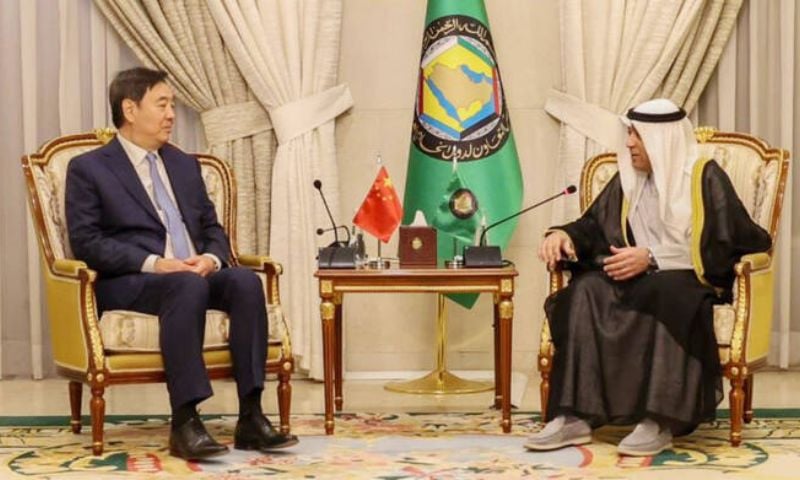
During the meeting, GCC Secretary General Jasem Mohamed Albudaiwi received China’s Special Envoy for the Middle East, Zhai Jun, and discussed developments across the Middle East, as well as prospects for strengthening cooperation between China and the Gulf bloc.
Both sides exchanged views on regional security, political developments and the importance of dialogue in addressing tensions affecting the broader Middle East.
Officials said the discussions also covered ways to expand cooperation between China and the six‑member Gulf Cooperation Council, which includes Saudi Arabia, the United Arab Emirates, Qatar, Kuwait, Bahrain and Oman.
China has steadily increased its diplomatic and economic presence in the Middle East over the past decade, positioning itself as a major trade partner for Gulf economies and an increasingly active participant in regional diplomacy.
Beijing is already the largest trading partner for several Gulf states and a major importer of crude oil from the region. Chinese companies have also expanded investments in energy infrastructure, logistics networks and digital technology projects across Gulf economies.
Analysts say China’s engagement with the GCC has intensified as part of broader efforts to deepen ties with energy‑producing nations and strengthen supply chains linked to its global manufacturing sector.
The Gulf region also plays a key role in China’s Belt and Road Initiative, which aims to expand trade and infrastructure links across Asia, the Middle East, Africa and Europe.
Diplomatic contacts between Beijing and Gulf governments have grown in frequency as regional powers seek diversified international partnerships amid shifting geopolitical alignments.
Officials familiar with the discussions said the GCC secretary general and the Chinese envoy emphasised the importance of political dialogue, economic cooperation and multilateral engagement in de-escalating the situation in the Middle East.
The meeting comes at a time of heightened international focus on the region due to ongoing conflicts, energy market volatility and broader strategic competition among global powers.
Observers note that China has increasingly sought to present itself as a diplomatic partner capable of maintaining relations with a wide range of regional actors.
The GCC leadership has also been expanding cooperation with major global economies in areas including energy security, investment, technology and trade.
Analysts say continued dialogue between China and the Gulf bloc could play an important role in achieving a ceasefire and shaping future economic and diplomatic engagement across the Middle East.